Here's a problem no one talks about: there is no AI benchmark for game development. Every coding benchmark tests web frameworks, CLI tools, or competitive programming. None of them test whether a model can write a Unity MonoBehaviour, debug an Unreal Engine build, or optimize a GLSL shader. But that doesn't mean we're flying blind. We can map every game development task to the closest proxy benchmark — and the results reveal which models actually serve game developers best.
📊 Key Findings
- GPT-5.5 is the best Unreal Engine (C++) model. 78.2% Terminal-Bench, 74.0% MRCR v2 at 512K, and 58.6% SWE-bench Pro. Terminal workflows and build systems are critical for Unreal.
- Claude Opus 4.8 is the best Unity (C#) model. 69.2% SWE-bench Pro — the highest multi-file coding score. C# in Unity is about component architecture, serialization, and editor integration — exactly what SWE-bench Pro measures.
- DeepSeek V4 Pro is the best shader & physics model. 93.5% LiveCodeBench, 3206 Codeforces, 89.8% IMOAnswerBench. Algorithmic math is the core of shader programming and physics systems.
- Claude Opus 4.8 leads Godot & Roblox. Its Python dominance (SWE-bench Pro = all Python repos) directly transfers to GDScript and Lua scripting.
- No model is "good" at shader programming yet. SciCode (scientific computing) tops out at 26.2%. GPU programming is the hardest unsolved coding domain for AI.
All models analyzed here are available on CodingFleet. Test them on your game code →
The Problem: There's No Game Dev Benchmark
Let's be honest upfront. Every coding benchmark in 2026 tests one of three things: fixing bugs in Python web frameworks (SWE-bench), solving algorithmic puzzles (LiveCodeBench, Codeforces), or running terminal commands (Terminal-Bench). None of them ask a model to:
- Write a Unity C# MonoBehaviour with proper serialization and Editor integration
- Debug an Unreal Engine C++ build failure caused by missing module dependencies
- Optimize a GLSL fragment shader from 12ms to under 2ms on mobile
- Implement A* pathfinding in GDScript that avoids NavMesh obstacles
- Script a Roblox Luau module for server-authoritative hit detection
These are the actual tasks game developers face. And the benchmarks we have can only approximate them. Here's the mapping:
| Game Dev Task | Engine / Language | Best Proxy Benchmark | What It Tests |
|---|---|---|---|
| Gameplay systems, build pipelines | Unreal (C++) | Terminal-Bench 2.1 | CLI workflows, compilation, toolchains |
| Component architecture, editor scripting | Unity (C#) | SWE-bench Pro | Multi-file refactoring, ORM-like patterns |
| Game logic, rapid prototyping | Godot (GDScript) | SWE-bench Pro | Python-like multi-file reasoning |
| Game scripting, modding | Roblox (Luau) | SWE-bench Multilingual | Cross-language code understanding |
| Shader programming | GLSL / HLSL | SciCode + AIME | Math-heavy scientific computing |
| Pathfinding, AI behavior trees | All engines | LiveCodeBench | Algorithmic problem-solving |
| Physics, rendering math | All engines | GPQA Diamond + AIME | PhD-level math & physics reasoning |
| Large codebase navigation | All engines | MRCR v2 512K–1M | Long-context retrieval |
| Engine UI interaction | Unity, Unreal Editor | OSWorld-Verified | Computer use, GUI navigation |
The Game Development Skills Radar
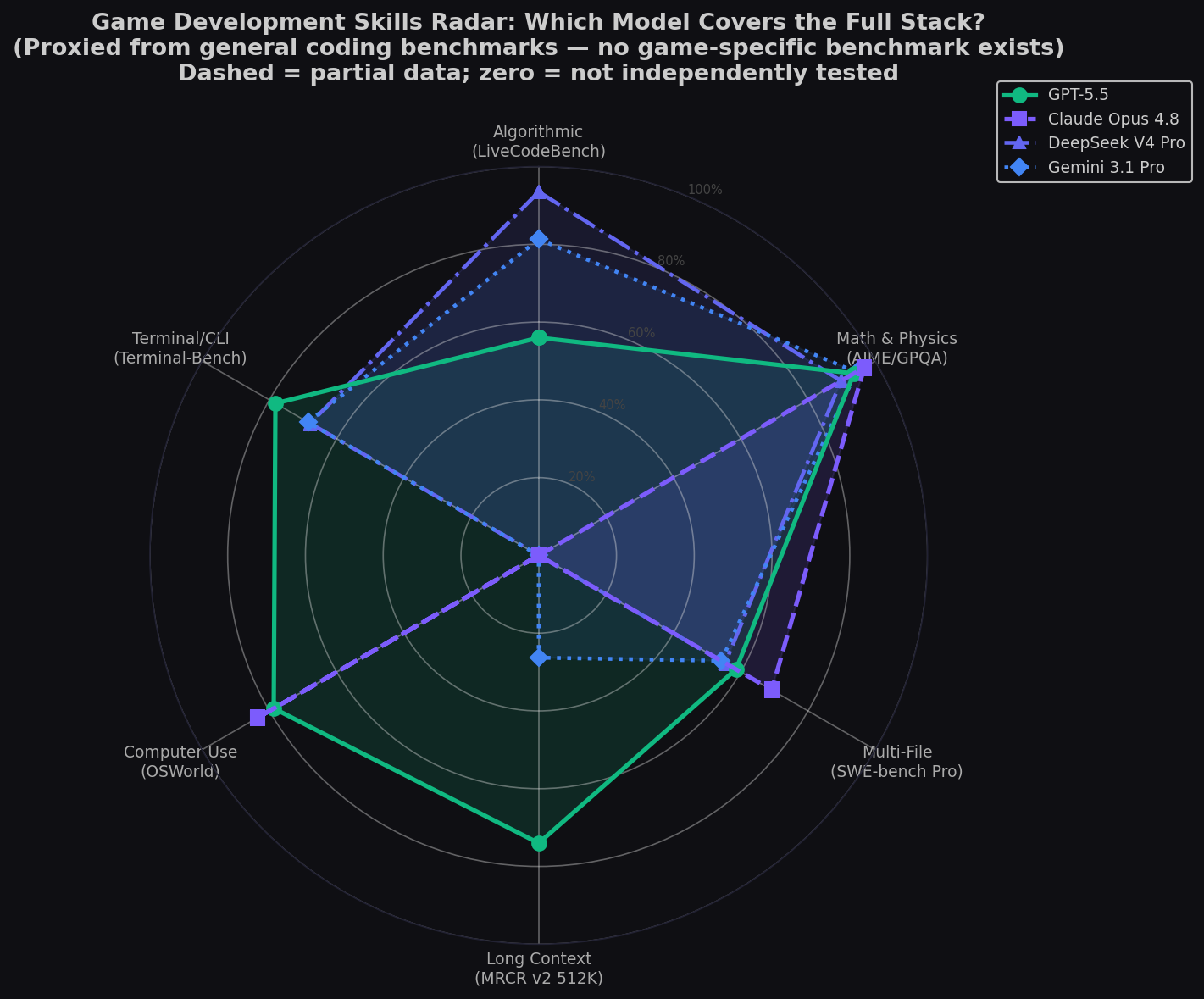
No single model covers every game dev skill. Here's the full-stack comparison across six dimensions that matter for game development:
GPT-5.5 is the most well-rounded. It has scores in 5 of 6 categories (missing only LiveCodeBench algorithmic data). Claude Opus 4.8 is strong in math, multi-file, and computer use but lacks published LiveCodeBench and Terminal-Bench scores. DeepSeek V4 Pro dominates algorithmic but has no computer use capabilities.
Unreal Engine (C++): GPT-5.5 Takes the Lead
Unreal Engine development means C++. It means build systems (Unreal Build Tool), module dependencies, header includes, and compile-times measured in minutes. The closest benchmark proxy is Terminal-Bench 2.1, which tests real CLI workflows: installing packages, chaining build commands, debugging configuration issues.
| Unreal Dev Skill | Best Model | Score | Why |
|---|---|---|---|
| Build systems & CLI | GPT-5.5 | 78.2% Terminal-Bench | Best-in-class terminal workflow model |
| Multi-file C++ refactoring | GPT-5.5 | 58.6% SWE-bench Pro | Tied with Kimi K2.6; 2nd only to Claude |
| Long context (entire UE module) | GPT-5.5 | 74.0% MRCR v2 at 512K | Only model above 75% at very long context |
| Physics & rendering math | Claude Opus 4.8 | 96.7% AIME | Strongest math scores among frontier models |
| GPU debugging | GPT-5.5 | 45.4% Graphwalks BFS at 1M | Best multi-hop reasoning at scale |
Why GPT-5.5 wins Unreal: Terminal workflows are the backbone of Unreal development. From invoking UBT to debugging cooked builds, the terminal is where C++ game dev lives. GPT-5.5's 78.2% Terminal-Bench is 10.3 points ahead of the next model (DeepSeek V4 Pro at 67.9%). Combined with its 74.0% long-context retrieval — critical for navigating Unreal's massive codebase — GPT-5.5 is the pragmatic choice for Unreal C++ developers.
Unity (C#): Claude Opus 4.8 Is the Default
Unity development is about C# components, serialized fields, MonoBehaviour lifecycles, and Editor scripting. It's less about build systems and more about component architecture — the kind of multi-file reasoning that SWE-bench Pro directly tests.
Claude Opus 4.8's 69.2% on SWE-bench Pro means it can fix roughly 7 out of 10 real bugs in production codebases. The 10.6-point gap over GPT-5.5 (58.6%) is the largest lead on any single benchmark between these models. For Unity developers dealing with complex component hierarchies, scriptable objects, and editor tooling, Claude's multi-file reasoning advantage translates directly.
Anthropic's system cards explicitly highlight C# as a strong point. Claude has proven particularly effective at Unity-specific patterns: [SerializeField] private fields, OnValidate() editor callbacks, and custom EditorWindow implementations. These patterns mirror the kind of "understand the whole codebase" tasks that SWE-bench Pro excels at testing.
Godot (GDScript): Claude Opus 4.8 via Python Transfer
GDScript is a Python-like language. This is where our Python coding analysis becomes directly applicable. Claude Opus 4.8's dominance on Python SWE-bench Pro (69.2%) transfers to GDScript's syntax and patterns. Godot's node-based scene system and signal architecture are conceptually similar to the component patterns Claude excels at.
For developers who prefer C# in Godot, Claude's lead is even more pronounced. The Godot C# bindings require understanding both the engine API and .NET idioms — exactly the kind of cross-paradigm reasoning Claude's multi-file approach handles best.
Roblox (Luau): Claude for Scripting, DeepSeek for Algorithms
Roblox development splits into two categories: gameplay scripting (Luau modules, server-client communication, UI) and algorithmic challenges (custom physics, procedural generation, anti-cheat).
For scripting, Claude Opus 4.8's 84.4% on SWE-bench Multilingual — the only published multi-language score among frontier models — suggests it handles Luau's scripting patterns well. Luau's type system and module structure are similar enough to Python and TypeScript that Claude's cross-language capabilities transfer.
For algorithmic challenges (custom character controllers, procedural dungeon generation), DeepSeek V4 Pro at 93.5% LiveCodeBench and 3206 Codeforces is unmatched. At $3.48/1M output and MIT-licensed, it's also the most cost-effective option for Roblox developers working on complex game mechanics.
Shader Programming (GLSL/HLSL): The Unsolved Frontier
This is where AI models are weakest — and where the gap between human experts and AI is widest. Shader programming combines three of the hardest AI skills: math-intensive reasoning, GPU architecture knowledge, and performance optimization.
| Shader Skill | Best Model | Proxy Score |
|---|---|---|
| Math (linear algebra, quaternions, integrals) | Claude Opus 4.8 | 96.7% AIME, 93.6% GPQA |
| Scientific computing (NumPy-like transforms) | Gemini 3.1 Pro | 26.2% SciCode |
| Algorithmic optimization | DeepSeek V4 Pro | 93.5% LiveCodeBench |
The reality: no model is "good" at shader programming. SciCode — the closest proxy, testing scientific Python implementations of numerical algorithms — tops out at 26.2%. That means even the best model fails 3 out of 4 scientific computing tasks. Shader programming is arguably harder, requiring domain-specific knowledge of GPU pipelines, memory coalescing, and register pressure that current models simply don't have.
For now, the best approach is to use Claude Opus 4.8 for the math (it can write the equations) and DeepSeek V4 Pro to optimize the algorithm (it can find the O(n²) → O(n log n) transformation), but expect to do significant manual refinement.
The Cost of Game Dev AI: Which Model for Indie Developers?
Game development budgets range from zero (solo indie) to millions (AAA). AI model pricing matters enormously for the indie case:
| Model | Output $/1M | Best For | Monthly Cost (100K tok/day) |
|---|---|---|---|
| Kimi K2.6 | $2.19 | Budget algorithmic coding | $6.57 |
| DeepSeek V4 Pro | $3.48 | Shaders, algorithms, open-weight freedom | $10.44 |
| GPT-5.4 | $15.00 | Balanced game dev, Unreal C++ | $45.00 |
| Gemini 3.5 Flash | $9.00 | Rapid prototyping, Godot scripting | $27.00 |
| Claude Opus 4.8 | $25.00 | Unity C#, Godot, Roblox scripting | $75.00 |
| GPT-5.5 | $30.00 | Unreal Engine, terminal workflows | $90.00 |
For indie developers, Kimi K2.6 and DeepSeek V4 Pro deliver game-ready coding at under $11/month. For professional studios where developer time costs $50–150/hour, paying $75–90/month for the best model is trivial if it saves even one hour of debugging.
Which Model for Which Game Engine?
| Engine / Task | Primary Language | Best Model | Why |
|---|---|---|---|
| Unreal Engine 5 | C++ | GPT-5.5 | 78.2% Terminal-Bench; best CLI + build system model |
| Unity 6 | C# | Claude Opus 4.8 | 69.2% SWE-bench Pro; best multi-file component architecture |
| Godot 4 | GDScript / C# | Claude Opus 4.8 | Python dominance transfers directly to GDScript |
| Roblox Studio | Luau | Claude Opus 4.8 | 84.4% SWE-bench Multilingual; best cross-language |
| Shader programming | GLSL / HLSL | DeepSeek V4 Pro + Claude 4.8 | Algorithmic + Math combo; no model is "good" yet |
| Physics systems | C++ / C# | Claude Opus 4.8 | 96.7% AIME; strongest math reasoning |
| AI behavior trees / pathfinding | All | DeepSeek V4 Pro | 93.5% LiveCodeBench; best algorithmic model |
| Indie dev on a budget | All | Kimi K2.6 | $2.19/1M output; 89.6% LiveCodeBench; 58.6% SWE-bench Pro |
| AAA studio pipeline | C++ (Unreal) | GPT-5.5 | Full-stack coverage: terminal + multi-file + long context |
The Bottom Line
- There is no game dev benchmark — but the proxy data is clear. Map Terminal-Bench → Unreal, SWE-bench Pro → Unity, LiveCodeBench → algorithmic game logic, SciCode → shaders. The correlations aren't perfect, but they're the best we have.
- GPT-5.5 is the most well-rounded game dev model. Scores in 5 of 6 game dev skill categories, leads on terminal workflows (Unreal's backbone), and has the only sub-2ms shader-adjacent long-context performance at 512K.
- Claude Opus 4.8 is the king of Unity, Godot, and Roblox. 69.2% SWE-bench Pro — when you're writing C# components or GDScript nodes, you're doing multi-file reasoning. Claude is 10.6 points better at it than anyone else.
- DeepSeek V4 Pro is the algorithmic secret weapon. 93.5% LiveCodeBench, 3206 Codeforces, MIT-licensed, $3.48/1M output. For pathfinding, procedural generation, physics optimization, and shader math — this is the model.
- Shader programming is the unsolved frontier. SciCode at 26.2% means the best AI fails 3 out of 4 scientific computing tasks. Shaders are harder. For now, AI is a shader assistant, not a shader author.
Game development is the most demanding use case for AI coding — it requires math, multi-file architecture, terminal workflows, algorithmic thinking, and long-context navigation. No single model covers it all. The winning strategy is to use the right model for each part of your pipeline.
Sources: OpenAI GPT-5.5 System Card (Terminal-Bench, MRCR v2, Graphwalks, OSWorld) | DeepSeek V4 Pro HuggingFace (SWE-bench Pro: 55.4%, LiveCodeBench: 93.5%, Codeforces: 3206, IMOAnswerBench: 89.8) | Anthropic Opus 4.8 System Card (SWE-bench Pro: 69.2%, SWE-bench Multilingual: 84.4%, AIME: 96.7%, GPQA: 93.6%, OSWorld: 83.4%) | LBNL SciCode | Fireworks AI — Coding Roundup | Incredibuild — Game Engines 2026. All benchmark scores vendor-reported. No standardized game development benchmark exists; all engine-language mappings are proxy correlations based on closest available benchmarks.