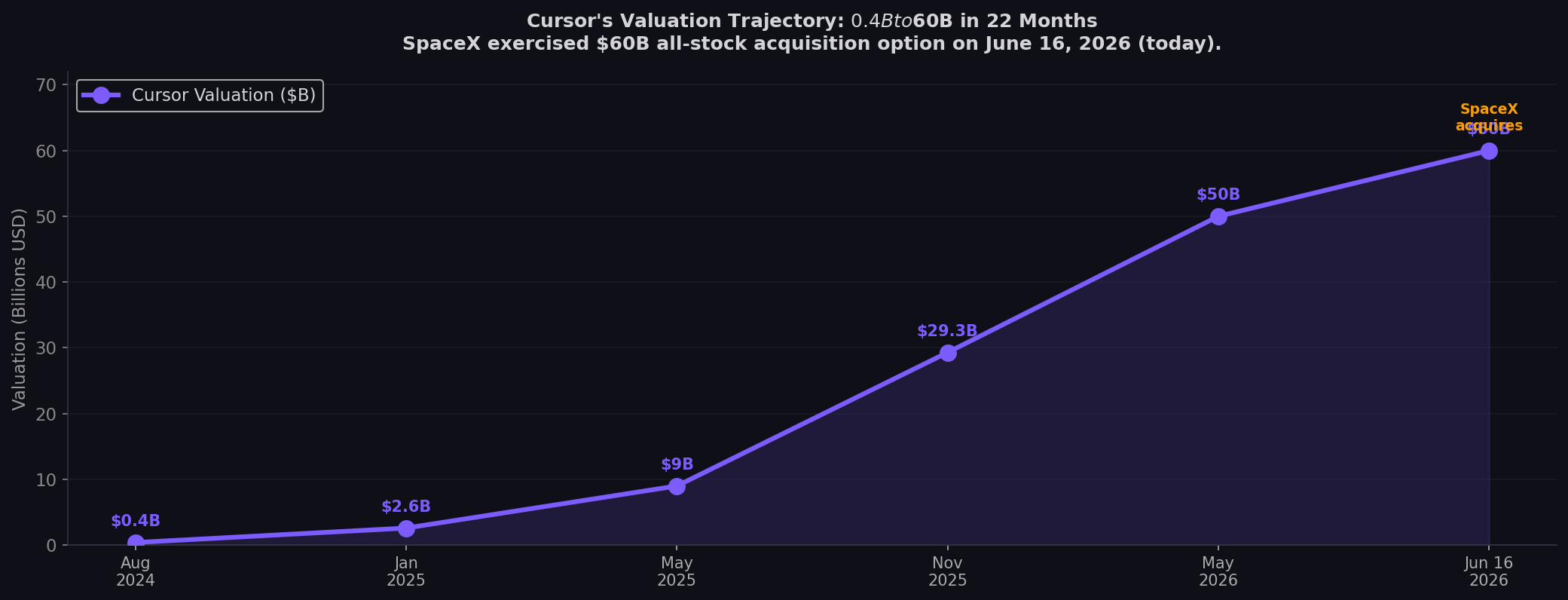
Today, June 16, 2026, SpaceX exercised its option to acquire Cursor for $60 billion in an all-stock deal — just days after Elon Musk's rocket and AI company made its record-breaking public market debut. The New York Times reports SpaceX stock rose more than 13% on the news. The AI coding tool that went from a $400M valuation to $60B in 22 months now sits inside a $2.5 trillion company. Meanwhile, GitHub Copilot — with 4.7 million paid subscribers and 42% market share — remains the most widely used AI coding assistant on the planet. One is the insurgent turned acquisition target. The other is the Microsoft-backed incumbent. Here's how they actually compare — and what the SpaceX deal changes for developers. Try both on CodingFleet's code generator and sandbox.
🚀 BREAKING: SpaceX Acquires Cursor — Today
On April 21, 2026, SpaceX announced an option to either acquire Cursor for $60 billion or pay $10 billion for an ongoing compute partnership using xAI's Colossus supercomputer. Today, June 16, SpaceX exercised the acquisition option in an all-stock deal. The agreement preempted a $2 billion Cursor funding round at a $50 billion valuation. Microsoft reportedly examined acquiring Cursor before declining. SpaceX absorbed xAI in February 2026 and its IPO last week valued the company at roughly $2.5 trillion — making Elon Musk the world's first trillionaire. Sources: NYT, Futurum Research, CNBC.
Key Metrics at a Glance
| Metric | Cursor | GitHub Copilot |
|---|---|---|
| Daily Active Users | ~1M (Bloomberg, Mar 2026) | ~5M+ estimated |
| Paid Subscribers | ~2M estimated | 4.7M (Microsoft, 75% YoY growth) |
| Business Customers | 50,000+ businesses | GitHub-wide — 90% of Fortune 100 |
| Fortune 500 Reach | 120+ companies (over half) | ~90 (90% of Fortune 100) |
| Market Share | ~23% | ~42% |
| Annual Revenue | $2B ARR (Bloomberg, Feb 2026) | Not disclosed separately |
| Valuation | $60B (SpaceX acquisition, today) | Part of Microsoft ($3.2T) |
| SWE-bench Verified | 51.7% | 56.0% |
| Entry Price | $20/mo (Pro) | $10/mo (Pro) |
Sources: Gradually AI — Cursor Statistics 2026 | GetPanto — Cursor AI Stats | Second Talent — enterprise comparison | Tech Insider — hands-on testing | Tembo — pricing breakdown | Bloomberg, TechCrunch, CNBC.

Pricing: $10 vs $20 — But It's Not That Simple
| Plan | Cursor | GitHub Copilot |
|---|---|---|
| Free | Hobby: $0 (limited) | Free: $0 (2,000 completions, 50 chat, limited agent) |
| Individual | Pro: $20/mo | Pro: $10/mo (300 premium requests) |
| Power User | Pro+: $60/mo, Ultra: $200/mo | Pro+: $39/mo (1,500 premium requests) |
| Business | Teams: $40/user/mo | Business: $19/user/mo |
| Enterprise | Custom | $39/user/mo |
Copilot switched to usage-based AI Credits on June 1, 2026 — heavy users saw bills rise. Cursor's Ultra tier at $200/mo provides 20× usage on all frontier models with no per-request limits. Sources: Tembo, official pricing pages.
Origins: Four MIT Students vs Microsoft
Cursor — Four Friends, One Dorm Room, $60B
Cursor was founded in 2022 by four MIT students — Michael Truell, Sualeh Asif, Aman Sanger, and Arvid Lunnemark — who built an AI-native code editor from their dorm room. Their thesis was simple: don't bolt AI onto an existing editor as a plugin. Rebuild the editor around AI from the ground up. In 2023, they raised $8M seed from OpenAI's Startup Fund. By August 2024, a $60M Series A at $400M. December 2024: $105M at $2.6B. May 2025: $900M at $9B. November 2025: $2.3B at $29.3B. January 2026: crossed $100M ARR in 14 months — fastest in B2B SaaS history — reportedly with zero marketing spend. Contrary Research notes: "Anysphere initially made it difficult for enterprises to contact it, even removing contact options from their website." The growth was entirely product-led. By February 2026, $2B ARR. May 2026: $3B ARR. Today: $60B SpaceX acquisition.
GitHub Copilot — Microsoft's 4.7M-User Juggernaut
Copilot launched in June 2022 as a joint GitHub-OpenAI project. The first version was glorified autocomplete — write a comment, get code. Fast forward to 2026: Copilot is a suite spanning inline completions, chat, agent mode, Copilot Workspace, CLI agent, code review, and PR generation. 4.7 million paid subscribers with 75% YoY growth. 90% of Fortune 100 as customers. Available in 6 IDEs. The distribution moat is real — but so is the backlash over the June 1, 2026 billing change.
How They Actually Work
Cursor — The Agent-First IDE
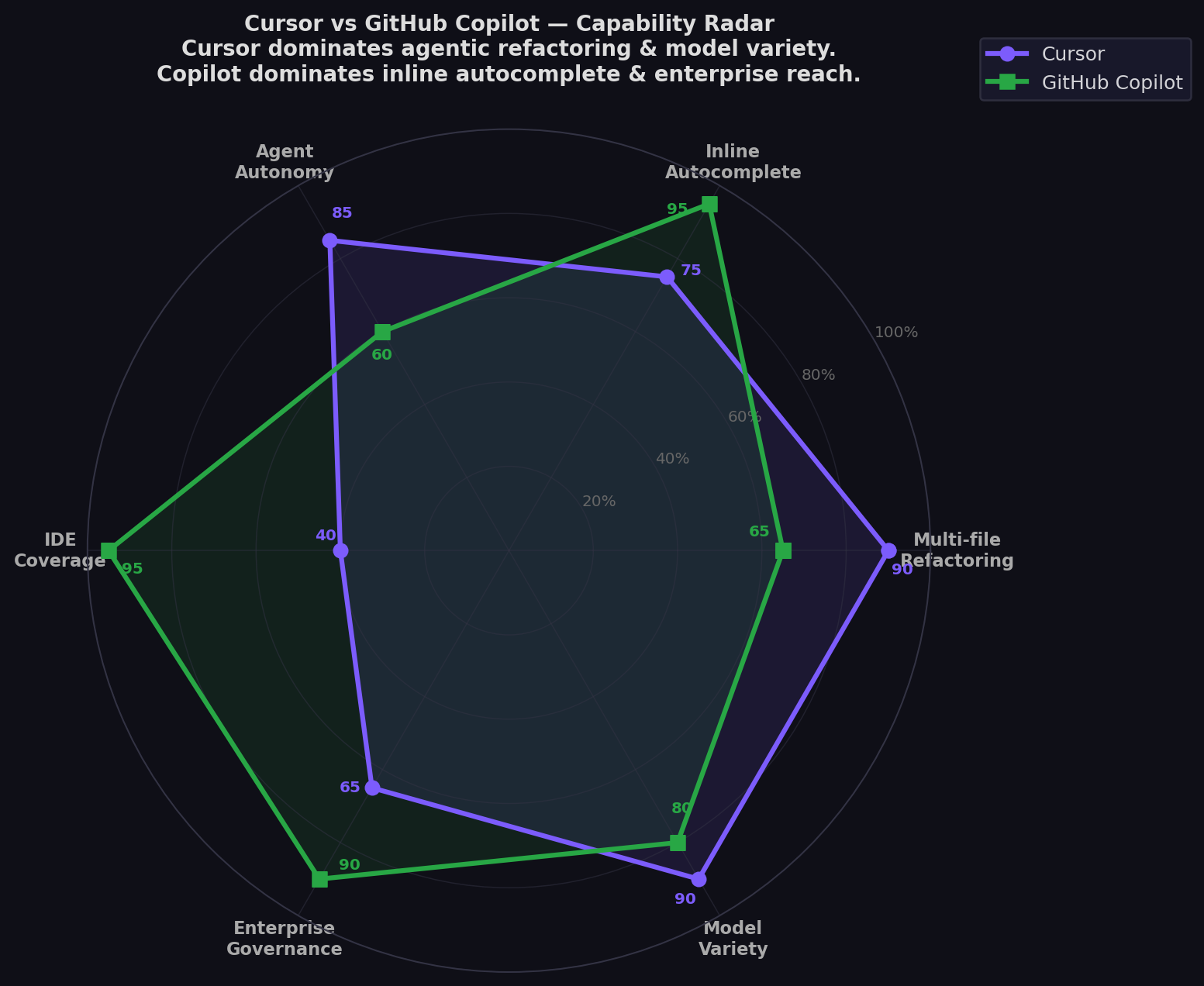
Cursor is a VS Code fork rebuilt around AI. The editor IS the AI — no extension to install. Tab completions predict your next edit (sometimes in a different file). Composer 2 handles multi-file agentic refactors with an autonomy slider. Background cloud agents run on isolated VMs while you work. Bugbot does automated code review. Model buffet: GPT-5.5, Claude Opus 4.8, Gemini 3.1 Pro, and Cursor's own Composer model — swappable per request. 8 parallel agents in agent mode. The tradeoff: single-IDE lock-in. If you live in JetBrains, Visual Studio, or Xcode, Cursor doesn't work for you.
GitHub Copilot — The Everywhere Autocomplete
Copilot ships natively into 6 IDEs: VS Code, JetBrains, Visual Studio, Neovim, Xcode, and Eclipse. The inline autocomplete is the best in the business — developers trigger it 200+ times a day without thinking. The Coding Agent generates full PRs from GitHub Issues. Copilot Workspace handles end-to-end feature development with agent mode. Enterprise governance: SAML SSO, IP indemnity, custom knowledge bases, PR summaries. The tradeoff: agent mode is less autonomous than Cursor's Composer. Copilot's strength is assistance, not delegation. Second Talent's enterprise analysis notes: "Cursor wins on multi-file refactoring and agent workflows. Copilot leads on enterprise governance, IDE coverage, and ecosystem fit."
SWE-bench: Copilot 56% vs Cursor 51.7%
On SWE-bench Verified (the human-validated 500-task coding benchmark), GitHub Copilot edges Cursor 56.0% to 51.7% — a 4.3-point lead. But Tech Insider's hands-on testing adds important context: "Cursor completes benchmark tasks roughly 30% faster than Copilot on average. For developers who prioritize throughput and iteration velocity over first-pass accuracy, that speed advantage remains compelling." On agent task wall-clock for mid-size refactors: Cursor's Composer with Opus 4.7 finishes in 3-7 minutes vs Copilot's Coding Agent at 4-9 minutes. The benchmark gap exists — but the speed gap may matter more in daily use.
What the SpaceX Acquisition Means
The Futurum Research analysis identifies three implications:
- Compute unlocked: Cursor gains access to xAI's Colossus supercomputer — "equivalent to 1 million H100 GPUs" — solving its compute ceiling and margin squeeze from model providers.
- Distribution exploded: SpaceX's $2.5T market cap and Musk's platform reach (X, Tesla, Starlink) give Cursor a distribution channel no other AI coding tool can match.
- Competitive pressure: Google (invested in Cursor's Series D), Microsoft (examined acquiring Cursor), and AWS now face a competitor backed by one of the world's most valuable companies. Futurum: "Cursor was facing a compute ceiling and margin squeeze. SpaceX needed AI revenue and credibility ahead of a record-setting IPO."
The Copilot Billing Controversy: "54% of My Monthly Quota Gone in One Request"
On June 1, 2026, GitHub Copilot switched from flat-rate subscription billing to usage-based AI Credits. The announcement in April described it as replacing premium request counts with "a monthly allotment of GitHub AI Credits, with the option for paid plans to purchase additional usage." Visual Studio Magazine documented the immediate fallout:
- "I've burned 5K in one prompt" — a Reddit user on r/GithubCopilot reported burning through credits worth 5× their subscription in a single day.
- "54% of my monthly quota gone with just one request — 822 credits in a single request" — a GitHub community discussion user showed a screenshot of their usage graph.
- "One GPT-5.4 agent query, I've now used 44% of my tokens for June already" — another Reddit user on the same thread.
- "Angry devs vow to flee GitHub Copilot as metered billing takes hold" — The Register headline, echoed across Hacker News.
Code completions and Next Edit suggestions remain free and unlimited. But agent mode, multi-file refactors, and premium model requests now consume credits rapidly. The Visual Studio Magazine author reported their own usage: "I'm going to get less and pay more." This pricing shift is the single biggest tailwind for Cursor's growth — and the reason "Copilot alternatives" search volume has spiked since June 1.
What Developers Actually Say
Across Reddit, Hacker News, and developer forums, the consensus has crystallized:
- "Cursor is far better integrated into the IDE... accumulating improvements faster than Copilot." — r/ChatGPTCoding user who uses both tools
- "Copilot for quick inline completions, Cursor for complex multi-file tasks." — recurring theme on r/programming and HN. Tech Insider notes: "Developers who have tried both tend to keep both."
- "Cursor's autocompletion is a trainwreck — it suggests the wrong thing so often." — negative review on r/ChatGPTCoding, highlighting that Copilot's inline autocomplete remains superior
- "Claude Code is eating both their lunches for agentic work." — r/AI_Agents discussion comparing all five major tools
- "Copilot's agent takes 90+ seconds just to spin up. By the time it's ready, I've lost my train of thought." — GitHub Community discussion on Copilot Coding Agent cold-start latency
The TrueFoundry analysis summarizes: "Cursor maintains an edge over GitHub Copilot for advanced agentic coding tasks, primarily due to superior codebase indexing, customizable rules system, and flexible model selection. GitHub Copilot remains the dominant choice by adoption volume, particularly in enterprise settings."
Beyond IDEs: Why CodingFleet Is the Third Option
Both Cursor and Copilot are IDEs — they live on your laptop. CodingFleet is different: it's a browser-based platform with 20+ LLMs, a code generator, and a sandbox execution environment. Here's why that matters:
- Your code runs even when your PC is off. CodingFleet's sandbox keeps executing — long-running agent tasks, test suites, data processing — in the cloud, not on your laptop. Close your lid and come back to results.
- 20+ models, not one ecosystem. Cursor and Copilot lock you into their model selection. CodingFleet gives you GPT-5.5, Claude Opus 4.8, Gemini 3.5 Flash, DeepSeek V4 Pro, Kimi K2.6, Qwen 3.7 Max, MiniMax M3, and 15+ more — all in one interface.
- No IDE lock-in. Use VS Code, JetBrains, Neovim, or nothing at all. CodingFleet works in any browser. Generate code, run it in the sandbox, download the result.
- No usage-based billing surprises. Unlimited plans include standard models (DeepSeek V4 Pro, GPT-5.4 Mini, Claude Haiku 4.5, Gemini 3 Flash, Qwen 3.6 Plus/Flash) with no per-request limits. Premium models (Claude Opus 4.8, GPT-5.5) have generous quotas — no "54% gone in one request" nonsense.
If Cursor is the agent-first IDE and Copilot is the everywhere autocomplete, CodingFleet is the cloud sandbox that runs your code while you sleep.
| Scenario | Winner | Why |
|---|---|---|
| Multi-file refactoring / agents | Cursor ✅ | Composer 2 + 8 parallel agents + autonomy slider |
| Inline autocomplete | Copilot ✅ | Best-in-class. 200+ triggers/day. Muscle memory. |
| IDE flexibility (JetBrains, Xcode, etc.) | Copilot ✅ | 6 IDEs vs Cursor's 1 (VS Code fork only) |
| Enterprise governance | Copilot ✅ | SAML SSO, IP indemnity, custom knowledge bases |
| Model flexibility | Cursor ✅ | GPT-5.5, Claude Opus 4.8, Gemini 3.1 Pro, Composer |
| Budget (individual) | Copilot ✅ | $10/mo vs $20/mo. Half the price. |
| Power users | Cursor ✅ | Ultra at $200/mo for 20× frontier access |
Conclusion: The Incumbent vs The Acquisition
GitHub Copilot is the safe choice — 4.7M paid subscribers, 42% market share, 6 IDEs, best autocomplete, and Microsoft's enterprise backing at $10/month. It wins on distribution, governance, and price.
Cursor is the ambitious choice — $60B acquisition, 1M DAU, 120+ Fortune 500 companies, the best agentic coding experience, and now the full weight of SpaceX's compute and distribution behind it. At $20/month, it's 2× the price — but the Composer 2 autonomy, 8 parallel agents, and model flexibility make it the more capable tool for developers who want AI to do things, not just suggest them.
The SpaceX acquisition changes the trajectory. Cursor went from compute-constrained startup to having access to 1M H100 GPUs overnight. If Musk integrates Cursor into the SpaceX/Tesla/Starlink/X ecosystem, the distribution advantage could reshape the AI coding market. But Copilot's head start — 4.7M paid users and the GitHub ecosystem — is a wide moat.
CodingFleet lets you generate code with 20+ LLMs and run it in a sandbox — your work keeps running even if you turn off your PC. Try the AI Chat or Code Generator.
Sources & Links
- NYT — SpaceX to Buy Cursor for $60B (June 16, 2026)
- NYT — SpaceX Strikes Deal With Cursor (April 21, 2026)
- Futurum Research — Why SpaceX-Cursor Works
- Gradually AI — Cursor Statistics 2026
- GetPanto — Cursor AI Statistics Deep Dive
- Second Talent — Enterprise comparison
- Tech Insider — Hands-on testing (April 2026)
- Tembo — Pricing breakdown 2026
- Digital Applied — Cursor $2B Revenue Analysis
- ByteMonk (385K) — Why SpaceX is Buying Cursor