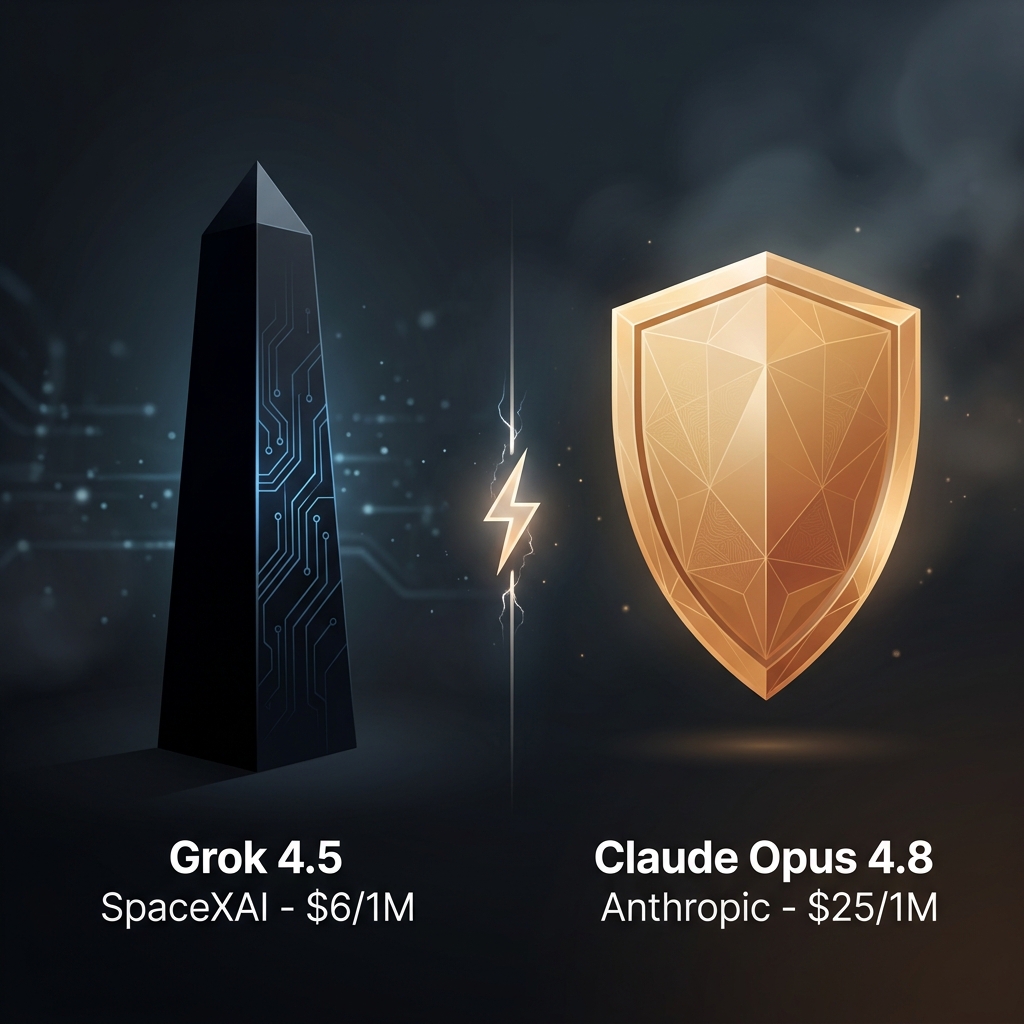
Grok 4.5 vs Claude Opus 4.8
SpaceXAI's Speed Demon vs Anthropic's Benchmark King
July 8, 2026 · 11 min read
Two Radically Different Approaches
Grok 4.5 (July 8, 2026) is SpaceXAI's most capable model, built on the V9 architecture at ~1.5 trillion parameters. Trained on tens of thousands of NVIDIA GB300 GPUs with a heavy focus on reinforcement learning for multi-step software engineering. It was trained alongside Cursor (with Cursor's developer-workflow data used in supplemental training). Priced at $2/$6 per 1M tokens, it delivers 80 TPS — faster than most "flash" models. Available in Grok Build, Cursor, and the SpaceXAI API.
Claude Opus 4.8 (May 28, 2026) is Anthropic's flagship — #1 on the Artificial Analysis Intelligence Index (61.4), #1 on SWE-bench Pro among non-Mythos models (69.2%), and the most benchmarked model in the industry. Priced at $5/$25 per 1M tokens (standard) or $10/$50 (fast mode). Features 1M context, dynamic parallel subagent workflows, and deep integration with Claude Code, Bedrock, and Vertex AI.
Coding: A Split Decision
| Benchmark | Grok 4.5 | Opus 4.8 | Delta | Winner |
|---|---|---|---|---|
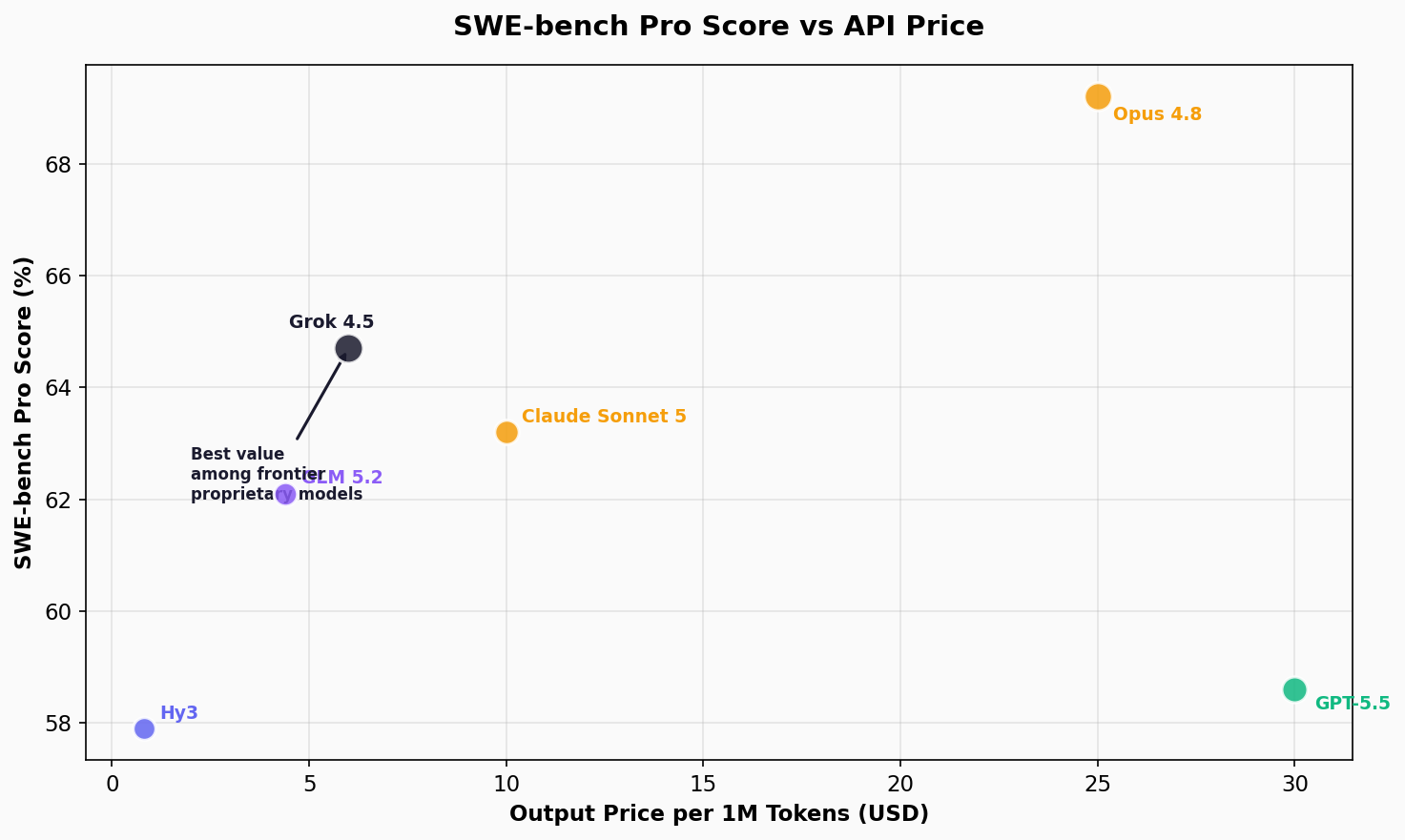
| SWE-bench Pro | 64.7 | 69.2 | +4.5 | Opus 4.8 |
| Terminal-Bench 2.1 | 83.3 | 78.9 | +4.4 | Grok 4.5 |
| DeepSWE 1.0 (AA harness) | 62.0 | 55.75 | +6.25 | Grok 4.5 |
| DeepSWE 1.1 (mini-swe-agent) | 53.0 | 59.0 | +6.0 | Opus 4.8 |
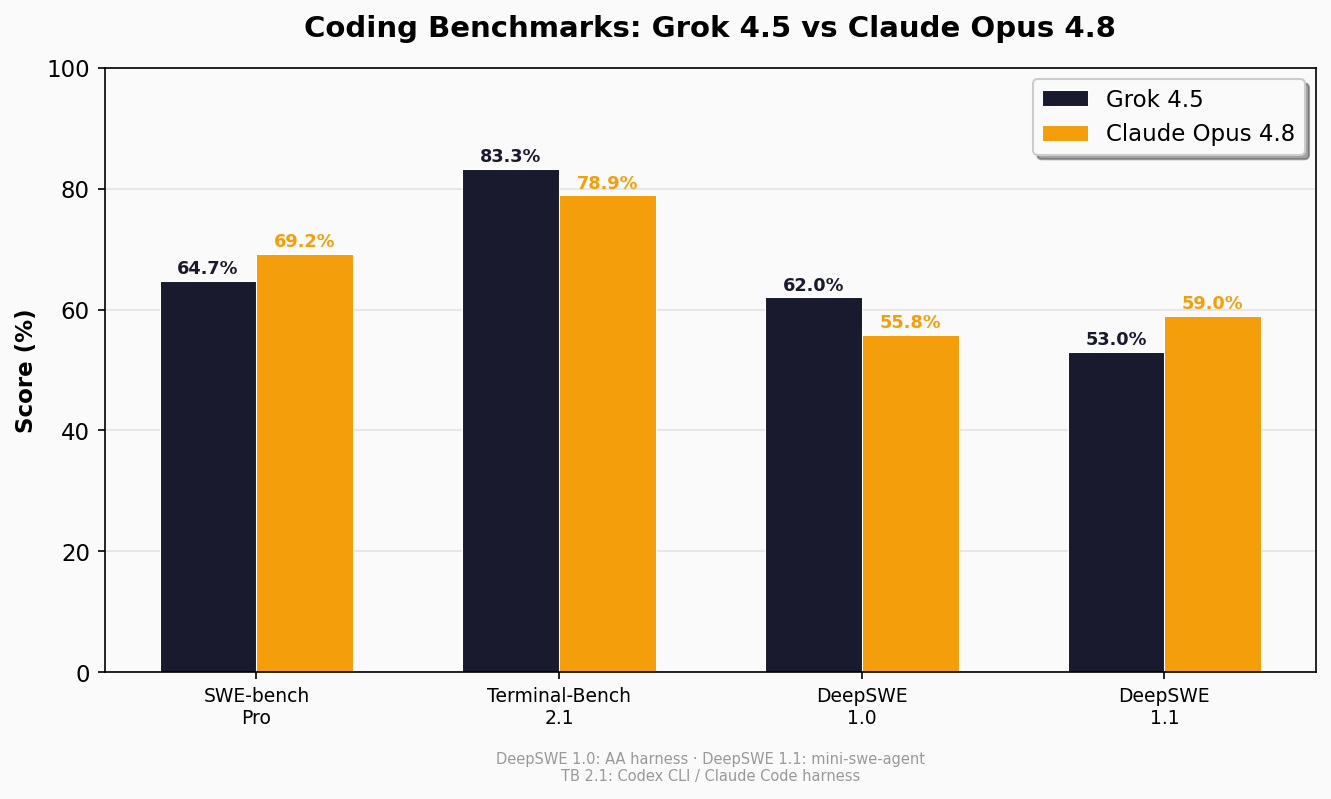
The SWE-bench Pro vs Terminal-Bench 2.1 split is the defining pattern of this comparison. Opus 4.8 wins on repository-scale bug fixing — the benchmark closest to real PR workflows across 1,865 tasks and 41 repos. Grok 4.5 wins on terminal-based agentic tasks — the benchmark closest to DevOps automation, CLI workflows, and unattended coding agents.
DeepSWE is split down the middle: Grok 4.5 wins on version 1.0 (AA harness), Opus 4.8 wins on version 1.1 (mini-swe-agent). The 1.1 gap (+6.0 for Opus) is notable — DeepSWE 1.1 tasks require 5.5x more code than SWE-bench Pro with shorter prompts, making it the closest thing to real autonomous engineering work.
Efficiency: Grok's Secret Weapon
| Metric | Grok 4.5 | Opus 4.8 | Advantage |
|---|---|---|---|
| Avg output tokens per SWE-bench Pro task | 15,954 | 67,020 | Grok (4.2x fewer) |
| Speed (tokens/sec) | 80 TPS | ~35 TPS | Grok (2.3x faster) |
| Output price /1M tok | $6 | $25 | Grok (4.2x cheaper) |
| Effective cost per SWE-bench Pro task | ~$0.10 | ~$1.68 | Grok (~17x cheaper) |
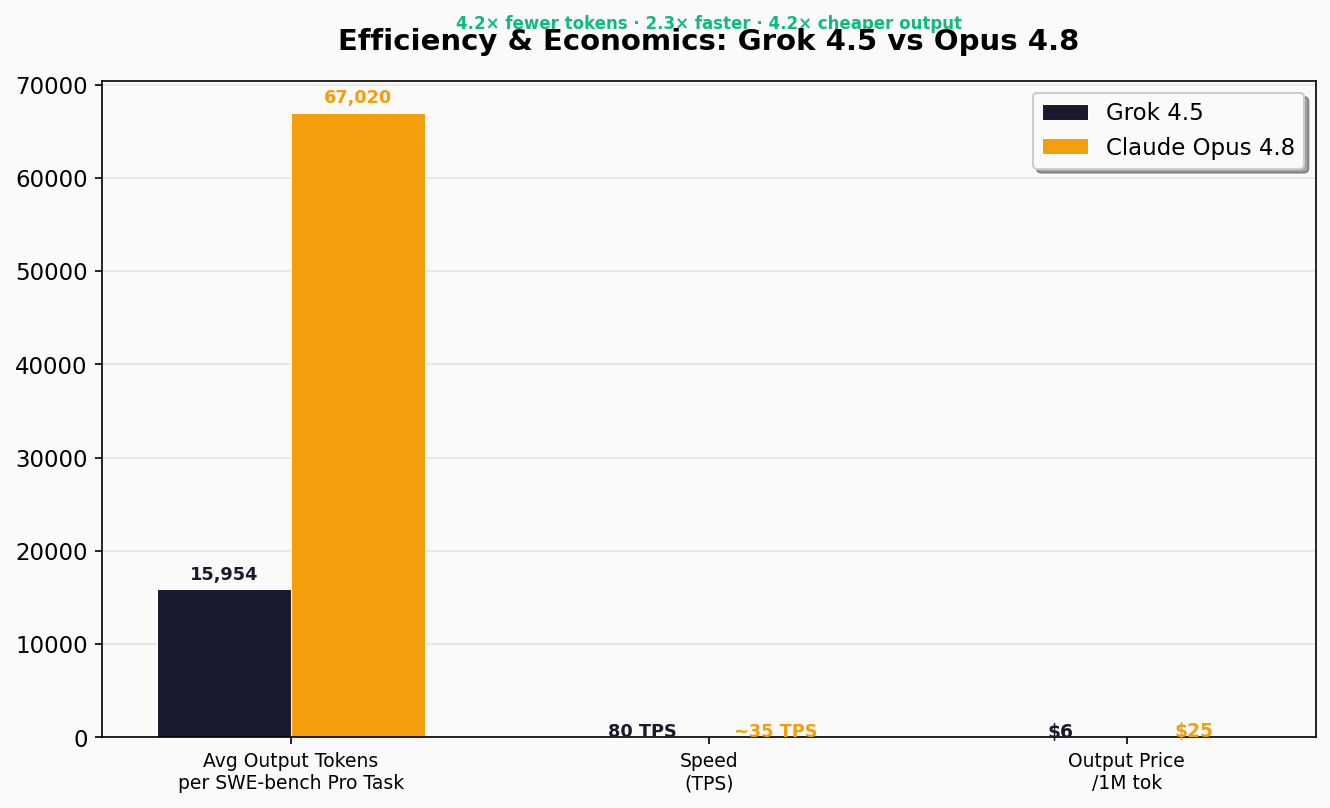
This is where the Grok 4.5 value proposition crystallizes. 4.2x fewer output tokens per task x 4.2x cheaper per-token price = roughly 17x cheaper per coding task. For teams running thousands of agentic coding tasks per day, this isn't a rounding error — it's the difference between a $100/day bill and a $1,700/day bill.
The token efficiency isn't just about cost. Fewer tokens per task means faster task completion and lower latency in agentic loops. Combined with 80 TPS throughput, Grok 4.5 delivers results at "flash model" speeds while operating at frontier capability levels.
Agentic Capabilities and Reasoning: The Published Gap
| Benchmark | Grok 4.5 | Opus 4.8 | Winner |
|---|---|---|---|
| MCP Atlas (Tool Orchestration) | — | 82.2 | Opus* |
| BrowseComp (Web Browsing) | — | 84.3 | Opus* |
| OSWorld-Verified (Computer Use) | — | 83.4 | Opus* |
| HLE (with tools) | — | 57.9 | Opus* |
| HLE (no tools) | — | 49.8 | Opus* |
| GPQA Diamond | — | 93.6 | Opus* |
| GDPval-AA (Knowledge Work) | — | 1890 Elo | Opus* |
* Grok 4.5 has not published scores for these benchmarks. Opus leads by default.
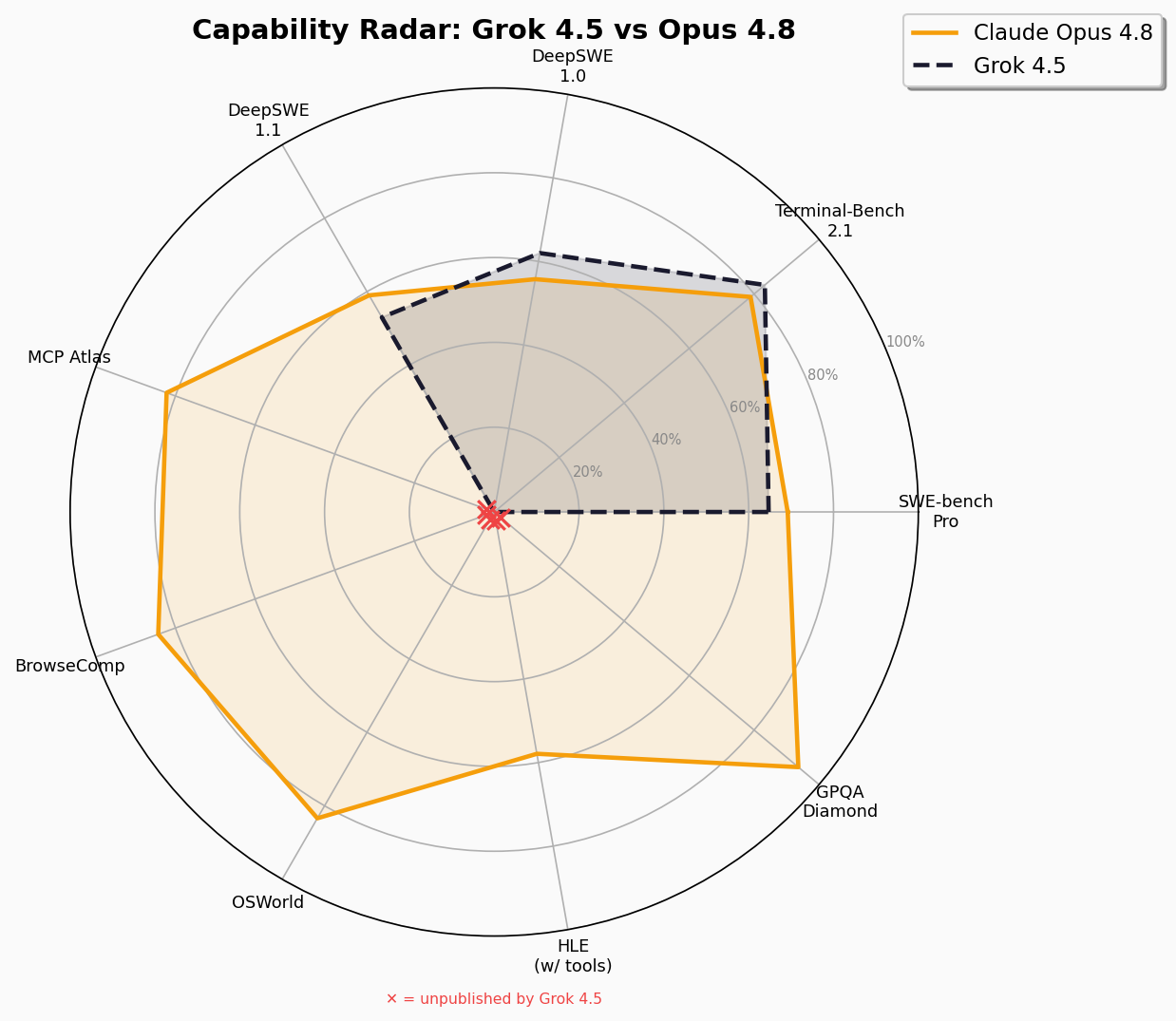
This table is the most important one in the article. Grok 4.5 has published scores for only 3 of the 9 major benchmarks that Opus 4.8 covers. For MCP Atlas, BrowseComp, OSWorld, HLE, GPQA, and GDPval, there is no Grok 4.5 data — not because Grok performs poorly, but because xAI chose not to publish them.
This matters for two reasons. First, benchmark coverage is a proxy for reliability claims. When Anthropic publishes OSWorld-Verified and MCP Atlas scores, they're implicitly saying "we stand behind our performance on these dimensions." xAI's silence on these benchmarks means you can't evaluate Grok 4.5 on tool orchestration or computer use without running your own evals.
Second, Opus 4.8's breadth of published scores — spanning coding, tool use, browsing, reasoning, and knowledge work — makes it the safer default for general-purpose agentic workloads. You know what you're getting. With Grok 4.5, you know it codes efficiently, but you don't know if it browses or orchestrates tools reliably.
The Economics
| Metric | Grok 4.5 | Opus 4.8 (Std) | Opus 4.8 (Fast) |
|---|---|---|---|
| Input /1M tok | $2.00 | $5.00 | $10.00 |
| Output /1M tok | $6.00 | $25.00 | $50.00 |
| 100M output tok/month | $600 | $2,500 | $5,000 |
| Context Window | 1M | 1M | 1M |
| License | Proprietary | Proprietary | Proprietary |
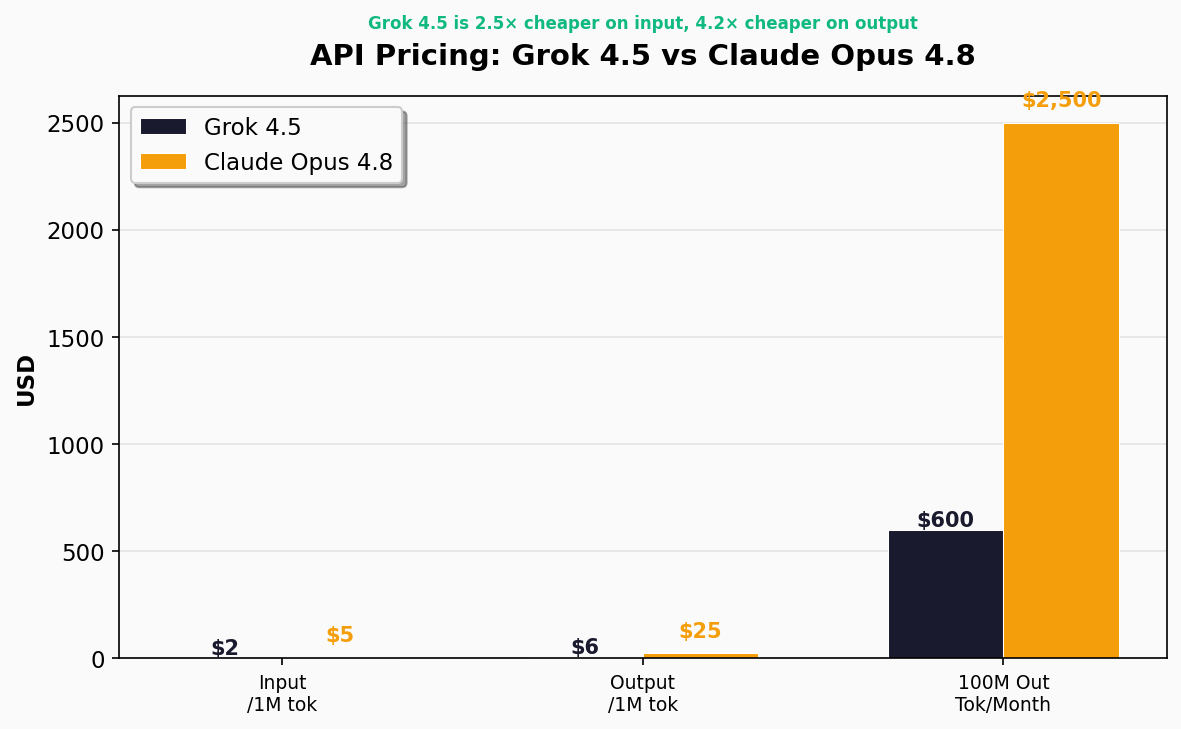
For 100M output tokens/month: Grok 4.5 costs $600. Opus 4.8 costs $2,500. Combined with Grok's token efficiency (4.2x fewer tokens per task), the effective cost per coding task is roughly 17x cheaper.
But there's a nuance: Opus 4.8 supports prompt caching (up to 90% savings on repeated contexts), which can dramatically reduce costs for workloads with stable system prompts. Grok 4.5's caching capabilities are not yet documented.
Ecosystem and Infrastructure
Grok 4.5
- Grok Build — SpaceXAI's CLI coding agent, free for limited time
- Cursor integration — natively available on all Cursor plans
- SpaceXAI API — OpenAI-compatible API
- Excel/Word/PowerPoint plugins — native Office integration
- Not yet available in the EU — expected mid-July
- No managed cloud deployment (no Bedrock/Vertex equivalent)
Claude Opus 4.8
- Claude Code — CLI agent with dynamic parallel subagent workflows
- Anthropic API, Amazon Bedrock, Google Cloud Vertex AI — three managed deployment surfaces
- Prompt caching, Batch API, computer use, tool use — mature infrastructure
- 1M context, 128K max output — industry-leading capacity
- Available globally
11-Point Verdict
Which One?
Choose Grok 4.5 if:
- Speed and cost are your top priorities. 80 TPS, 4.2x fewer tokens, ~17x cheaper per task.
- You're doing high-volume terminal-based coding. TB 2.1 at 83.3% with fast iteration loops.
- You use Cursor or Grok Build. Native integration, free for limited time.
- You only need coding. For pure coding workflows, Grok 4.5's efficiency advantage may outweigh Opus's benchmark lead.
Choose Opus 4.8 if:
- You need the best published coding scores. SWE-bench Pro 69.2% is the non-Mythos leader.
- You need multi-modal agentic capabilities. MCP Atlas, BrowseComp, OSWorld — proven and published.
- You want managed infrastructure. Bedrock, Vertex AI, Batch API, prompt caching.
- You need benchmark transparency. Opus 4.8 is the most evaluated model in the industry.
The Bottom Line
Claude Opus 4.8 is the safer, more proven choice — it leads on SWE-bench Pro, has published scores across every major benchmark category, and is backed by mature infrastructure. Grok 4.5 is the more exciting, higher-upside bet — it matches or beats Opus on terminal coding and DeepSWE 1.0, does it ~17x cheaper per task, and delivers flash-model speeds with frontier-model capability. But with only 3 of 9 major benchmarks published and zero third-party evaluations, Grok 4.5 is a bet on xAI's trajectory. Opus 4.8 is a bet on what's already proven. Choose accordingly.
Test Both on Real Code
20+ LLMs on CodingFleet. Run Grok and Claude Opus side-by-side.
Try on CodingFleetSources: xAI Grok 4.5 · Anthropic Opus 4.8 · Vellum · Artificial Analysis · LLM Stats. Grok 4.5 scores are vendor-reported. Opus 4.8 scores are Anthropic-reported with third-party verification.