Grok 4.5 vs GPT-5.5
SpaceXAI's Speed King vs OpenAI's Benchmark Giant
July 8, 2026 · 11 min read
Two Very Different Approaches to the Same Problem
Grok 4.5 (July 8, 2026) is SpaceXAI's most capable model, built on the V9 architecture at ~1.5 trillion parameters. Trained on tens of thousands of NVIDIA GB300 GPUs with heavy RL on multi-step software engineering tasks. Trained alongside Cursor with developer-workflow data. Priced at $2/$6 per 1M tokens, delivers 80 TPS — faster than most "flash" models. Available in Grok Build, Cursor, and the SpaceXAI API.
GPT-5.5 (April 23, 2026) is OpenAI's flagship general-purpose model — proprietary, $5/$30 per 1M tokens (standard), $30/$180 (Pro tier). Features 1M context, explicit chain-of-thought reasoning. #1 non-Mythos on Terminal-Bench 2.1, #3 on SWE-bench Verified, #1 on DeepSWE. Ships inside ChatGPT, Codex CLI, and the OpenAI API. BenchLM overall score: 80/100.
Coding: The SWE-bench Pro Reversal
| Benchmark | Grok 4.5 | GPT-5.5 | Delta | Winner |
|---|---|---|---|---|
| SWE-bench Pro ★ | 64.7 | 58.6 | +6.1 | Grok 4.5 |
| Terminal-Bench 2.1 | 83.3 | 83.4 | +0.1 | ~Tie |
| DeepSWE 1.0 (AA harness) | 62.0 | 64.31 | +2.31 | GPT-5.5 |
| DeepSWE 1.1 (mini-swe-agent) | 53.0 | 67.0 | +14.0 | GPT-5.5 |
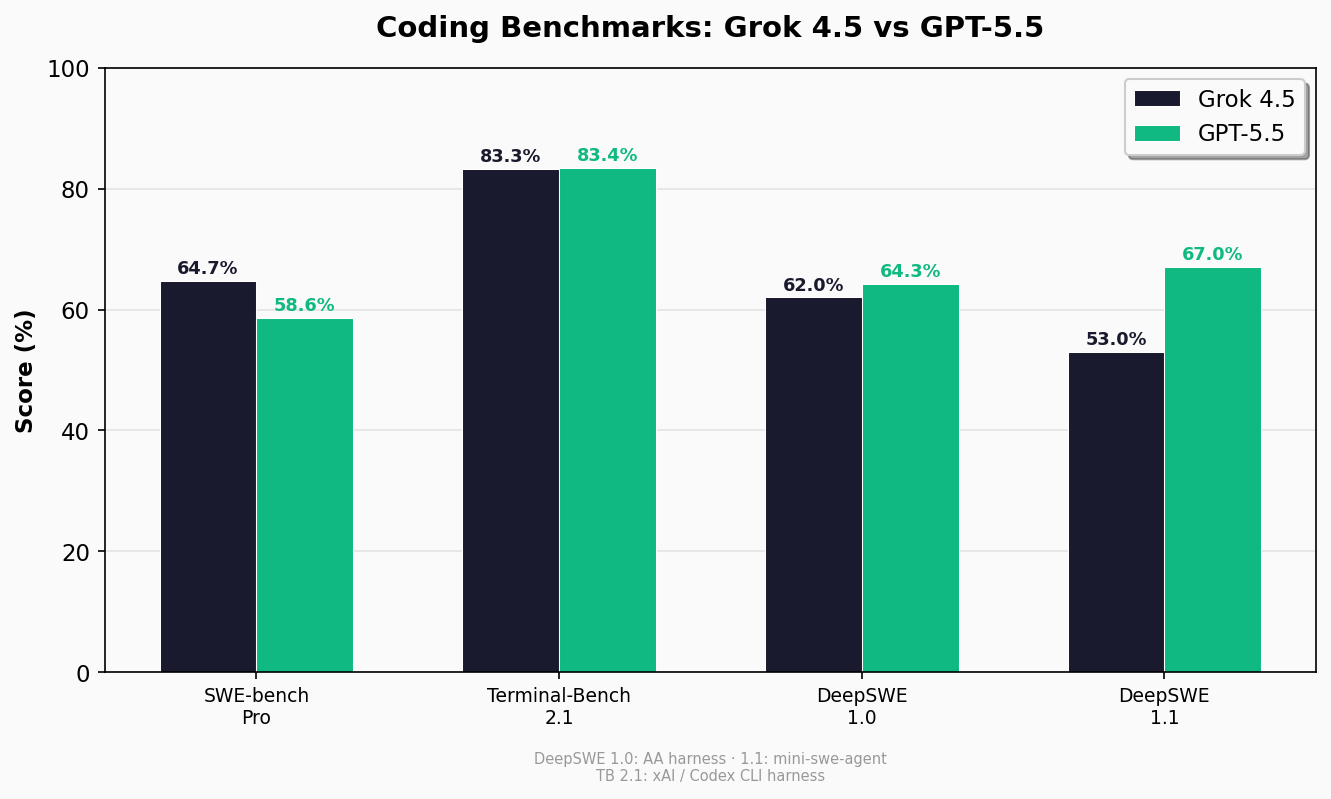
The SWE-bench Pro reversal is the headline. GPT-5.5 has been the default "best non-Mythos coder" since April. Grok 4.5 beats it by 6.1 points on the benchmark closest to real PR workflows across 1,865 tasks and 41 repos. This is the first time a non-Anthropic model has challenged GPT-5.5 on Pro with a lead this large.
But DeepSWE tells a more nuanced story. On version 1.0, GPT-5.5 edges Grok by 2.3 points. On version 1.1 (harder, longer-horizon tasks requiring 5.5× more code), GPT-5.5 leads by 14 points. DeepSWE tasks mirror real autonomous engineering work — less instruction, more output expected. GPT-5.5's chain-of-thought reasoning and larger training corpus may give it an edge on these truly long-horizon tasks.
The Terminal-Bench 2.1 near-tie (83.3 vs 83.4) is remarkable. On CLI-based agentic coding, Grok 4.5 is statistically indistinguishable from the model that held the #1 non-Mythos position. For DevOps automation, build systems, and unattended terminal agents, these two are effectively equal.
Benchmark Breadth: GPT-5.5's Published Portfolio
| Benchmark | Grok 4.5 | GPT-5.5 | Winner |
|---|---|---|---|
| BrowseComp | — | 84.4 | GPT-5.5* |
| MCP Atlas | — | 75.3 | GPT-5.5* |
| OSWorld-Verified | — | 78.7 | GPT-5.5* |
| GPQA Diamond | — | 93.6 | GPT-5.5* |
| HLE (with tools) | — | 52.2 | GPT-5.5* |
| FrontierMath T1-3 | — | 51.7 | GPT-5.5* |
| ARC-AGI-2 (High) | — | 83.3 | GPT-5.5* |
| Chatbot Arena Elo | — | 1475 | GPT-5.5* |
* Grok 4.5 has not published scores for these benchmarks.
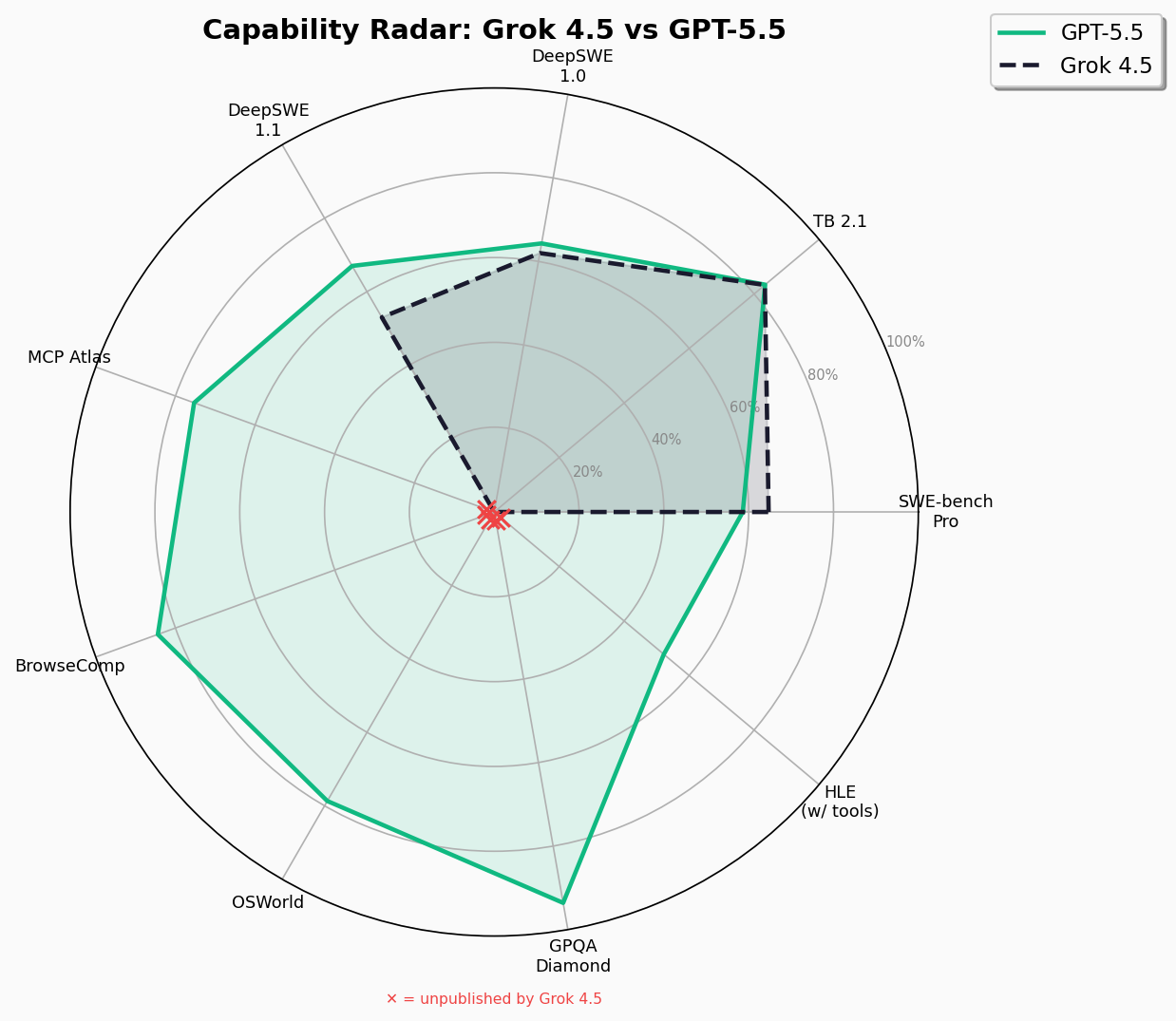
This is the critical context for the SWE-bench Pro reversal. Grok 4.5 has published scores for only 4 benchmarks. GPT-5.5 has published scores for 15+. On every dimension beyond pure coding — web browsing, tool orchestration, computer use, scientific reasoning, frontier math — GPT-5.5 has data and Grok doesn't. This doesn't mean Grok performs poorly. It means xAI chose not to publish these numbers.
For teams building general-purpose AI applications, this matters enormously. You can evaluate GPT-5.5's reliability across a dozen dimensions. With Grok 4.5, you have coding data and... that's it. The SWE-bench Pro win is impressive, but it's a single data point against a full portfolio.
Efficiency: Grok's Trifecta
| Metric | Grok 4.5 | GPT-5.5 | Advantage |
|---|---|---|---|
| Input /1M tok | $2.00 | $5.00 | Grok (2.5× cheaper) |
| Output /1M tok | $6.00 | $30.00 | Grok (5× cheaper) |
| Speed (tokens/sec) | 80 TPS | ~35 TPS | Grok (2.3× faster) |
| Avg output tokens/task | ~15,954 | ~47,000 | Grok (~3× fewer) |
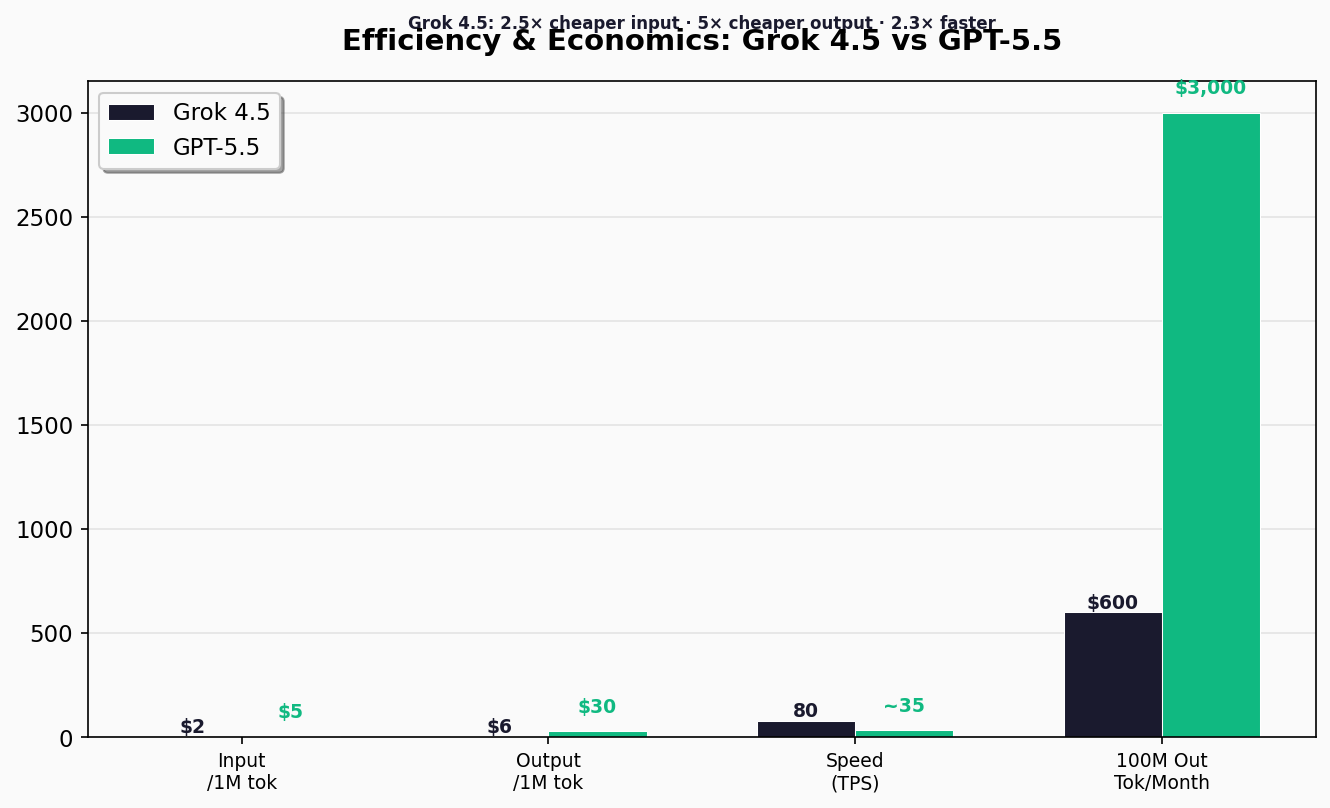
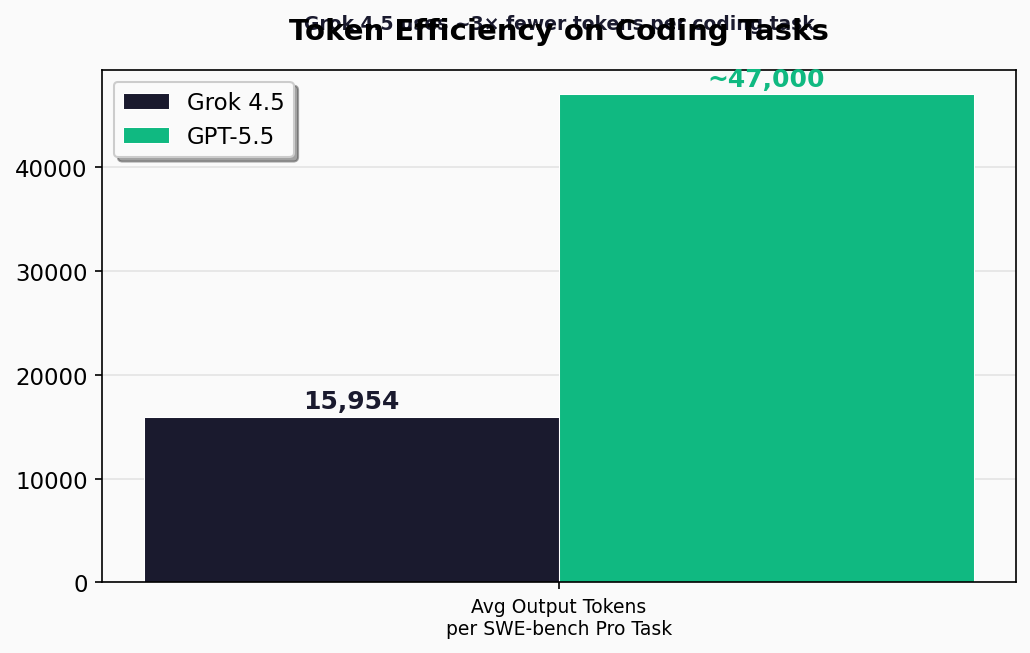
Grok 4.5 combines 5× cheaper per-token output pricing with 3× fewer tokens per task. The compound effect is roughly 15× cheaper per coding task. For teams running thousands of agentic coding tasks per day, this is the difference between a $100/day bill and a $1,500/day bill.
There's an important caveat: GPT-5.5's chain-of-thought tokens bill as output. A "simple" coding task can generate 3-10× more reasoning tokens than visible answer tokens. Grok 4.5's efficiency advantage may shrink on tasks where GPT-5.5's reasoning overhead is minimal, and may grow on tasks where it's heavy.
The Economics at Scale
| Scenario | Grok 4.5 | GPT-5.5 (Std) | GPT-5.5 Pro |
|---|---|---|---|
| 100M output tok/month | $600 | $3,000 | $18,000 |
| 1,000 coding tasks/day | ~$3 | ~$47 | ~$282 |
| Context Window | 1M | 1M | 1M |
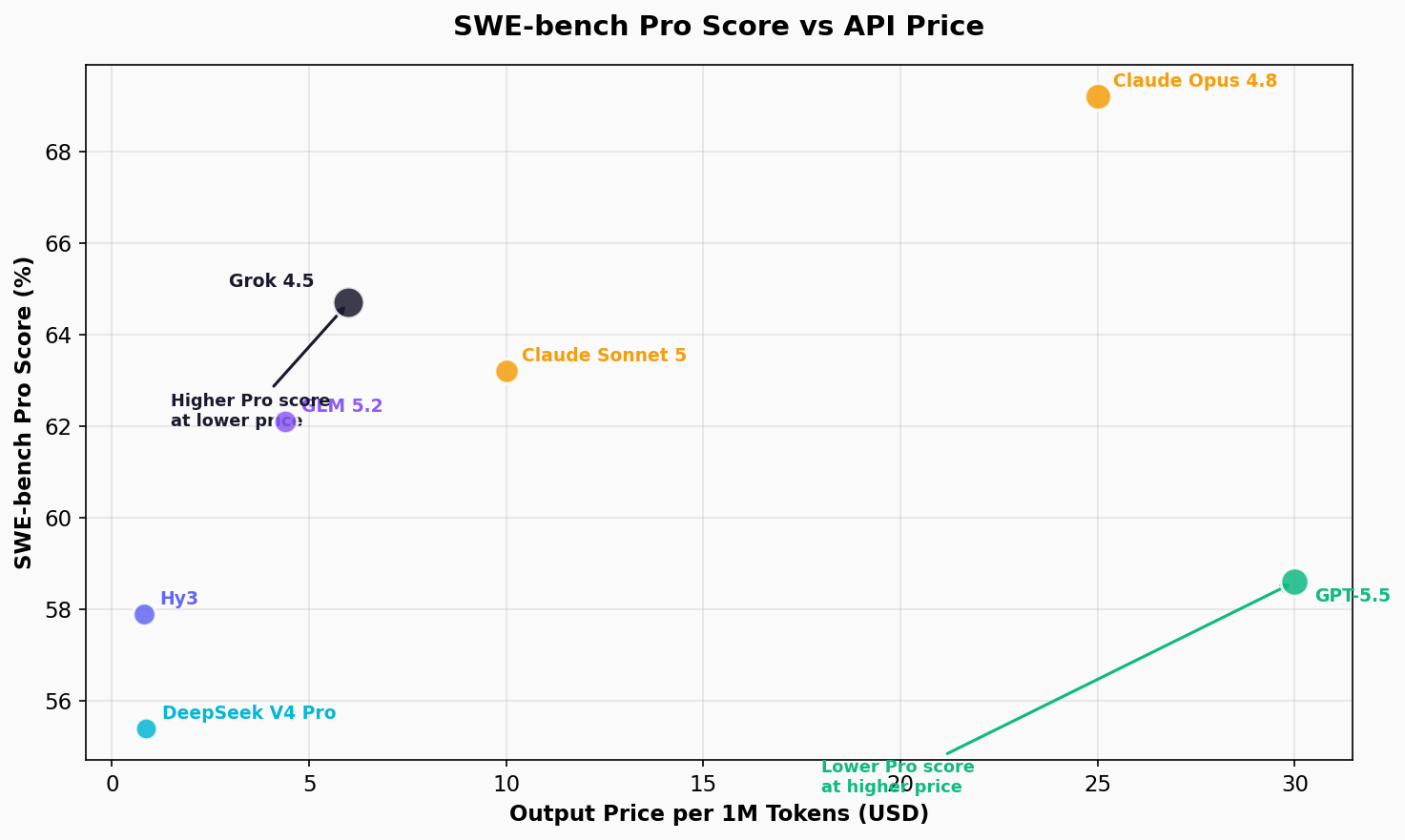
Grok 4.5 occupies a unique position on the value scatter plot: higher SWE-bench Pro score at 1/5th the output price. It's the only model in the upper-left quadrant — beating GPT-5.5 on both axes simultaneously. The question is whether this positioning holds when independent third-party evaluations arrive.
Ecosystem and Infrastructure
Grok 4.5
- Grok Build — CLI coding agent, free for limited time
- Cursor integration — natively available on all plans
- SpaceXAI API — OpenAI-compatible
- Office plugins — Excel, Word, PowerPoint
- Not yet in EU — expected mid-July
- No managed cloud (no Azure/Bedrock/Vertex equivalent)
GPT-5.5
- ChatGPT + Codex CLI — consumer and developer surfaces
- OpenAI API + Azure — enterprise deployment
- Prompt caching, Batch API, structured outputs — mature infra
- 1M context, 128K max output
- Global availability
- Pro tier — 6× compute for hardest problems
11-Point Verdict
Which One?
Choose Grok 4.5 if:
- You want the best SWE-bench Pro score for the price. 64.7% at $6/1M output is unmatched value.
- Speed and cost dominate your decision. 80 TPS, 3× fewer tokens, ~15× cheaper per task.
- You're doing high-volume terminal coding. TB 2.1 near-tie with GPT-5.5 at a fraction of the cost.
- You use Cursor or Grok Build. Native integration, free for limited time.
- Coding is all you need. If you only care about coding benchmarks, Grok 4.5 beats GPT-5.5 on the one that matters most.
Choose GPT-5.5 if:
- You need a fully-evaluated model. 15+ published benchmarks across coding, reasoning, browsing, tool use, math.
- Deep long-horizon engineering matters. +14 on DeepSWE 1.1 is a real capability gap.
- You need the OpenAI ecosystem. ChatGPT, Codex CLI, Azure, prompt caching, Batch API.
- You need frontier math and reasoning. FrontierMath, GPQA, HLE, ARC-AGI-2 — all published and verified.
- You want a proven track record. 3 months of third-party verification vs 1 day of vendor claims.
The Bottom Line
The SWE-bench Pro reversal is real and significant — Grok 4.5 at 64.7% vs GPT-5.5 at 58.6% is the first time a non-Anthropic model has opened a 6+ point lead over GPT-5.5 on the benchmark closest to real PR workflows. Combined with the Terminal-Bench near-tie and the massive cost advantage (5× cheaper output, 3× fewer tokens, 2.3× faster), Grok 4.5 makes a compelling case as the best value coding model in the frontier tier.
But GPT-5.5 remains the safer, more complete choice. Its DeepSWE lead (+2 to +14 points), its 15+ published benchmarks spanning every capability dimension, its mature ecosystem, and its 3-month track record of third-party verification make it the lower-risk option for teams that need more than just coding.
Grok 4.5 is the exciting bet — higher coding scores, dramatically lower costs, flash-model speeds. GPT-5.5 is the proven bet — deeper in the dimensions that matter for general-purpose AI, with the receipts to prove it. The SWE-bench Pro crown has a new contender. The war is far from over.
Test Both on Real Code
20+ LLMs on CodingFleet. Run Grok 4.5 and GPT-5.5 side-by-side on your own repos.
Try on CodingFleetSources: xAI Grok 4.5 · OpenAI GPT-5.5 · Vellum · DeepSWE · Terminal-Bench 2.1 · The Decoder · BenchLM. Grok 4.5 scores are vendor-reported. GPT-5.5 scores are vendor + third-party verified.