Hy3 vs GLM 5.2
Half the Size, Half the Coding — But the Agent Crown. Tencent's 295B Apache 2.0 MoE takes on Z.AI's 753B MIT coding king.
July 7, 2026 · 9 min read
The Shape of Two Open-Weight Titans
Two Chinese AI labs. Two open-weight models. Two very different philosophies.
Tencent Hy3 (July 6, 2026) is a 295B-parameter MoE with just 21B active parameters per token. It's architecturally efficient — 192 experts, top-8 routing, one shared expert per layer — and ships under the commercially bulletproof Apache 2.0 license. It was rebuilt from scratch in under 90 days after Tencent rebuilt its RL infrastructure in January 2026, then refined through feedback from 50+ internal products including WorkBuddy, Yuanbao, and WeChat. The result: a model that prioritizes reliability over leaderboard chasing — hallucination rates dropped from 12.5% to 5.4%, commonsense errors halved from 25.4% to 12.7%. It's available on OpenRouter at $0.20/$0.80 per 1M tokens with a free tier for two weeks.
Z.AI GLM 5.2 (June 13, 2026) is a 753B-parameter MoE with ~40B active parameters — nearly double Hy3's total and active count. It's the third generation of Z.AI's GLM-5 line, carrying a 1M-token context window (4× Hy3's 256K) and the coveted MIT license. It leads all open-weight models on the Artificial Analysis Intelligence Index (51), sits at #3 on GDPval-AA (1524 Elo, ahead of GPT-5.5), and became the first open-weight model to beat every Claude Opus variant on Code Arena: Frontend. Simon Willison called it "probably the most powerful text-only open weights LLM." It's priced at $1.40/$4.40 per 1M tokens — 7× Hy3's input cost, 5.5× its output cost.
Coding: GLM 5.2 Sweeps
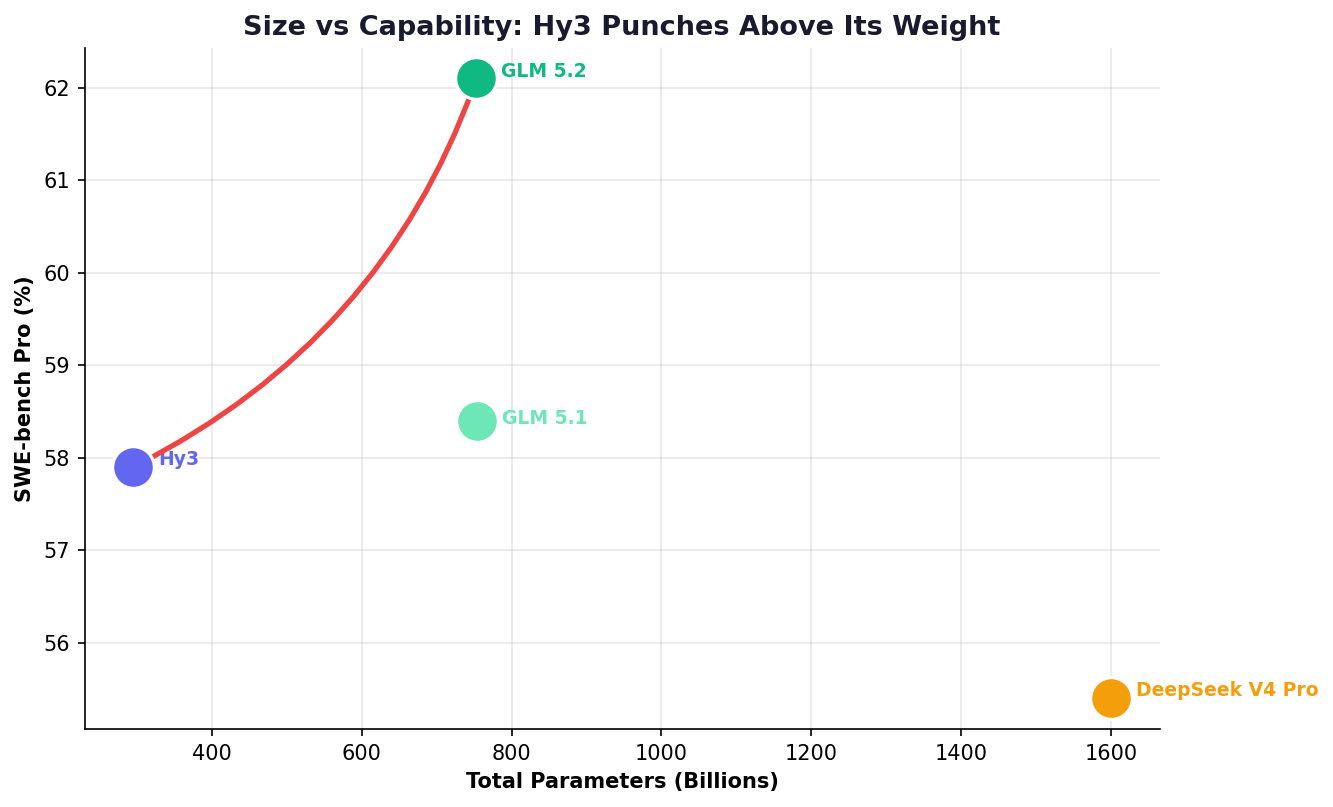
On every published coding benchmark, GLM 5.2 leads — often by wide margins. This is GLM's home turf, and the size advantage (2.6× total params, 1.9× active params) shows.
| Benchmark | Hy3 | GLM 5.2 | Δ | Winner |
|---|---|---|---|---|
| SWE-bench Verified | 78.0 | 84.2 | +6.2 | GLM |
| SWE-bench Multilingual | 75.8 | 83.0 | +7.2 | GLM |
| SWE-bench Pro ★ | 57.9 | 62.1 | +4.2 | GLM |
| Terminal-Bench 2.1 | 71.7 | 81.0 | +9.3 | GLM |
| DeepSWE | 28.0 | 46.2 | +18.2 | GLM |
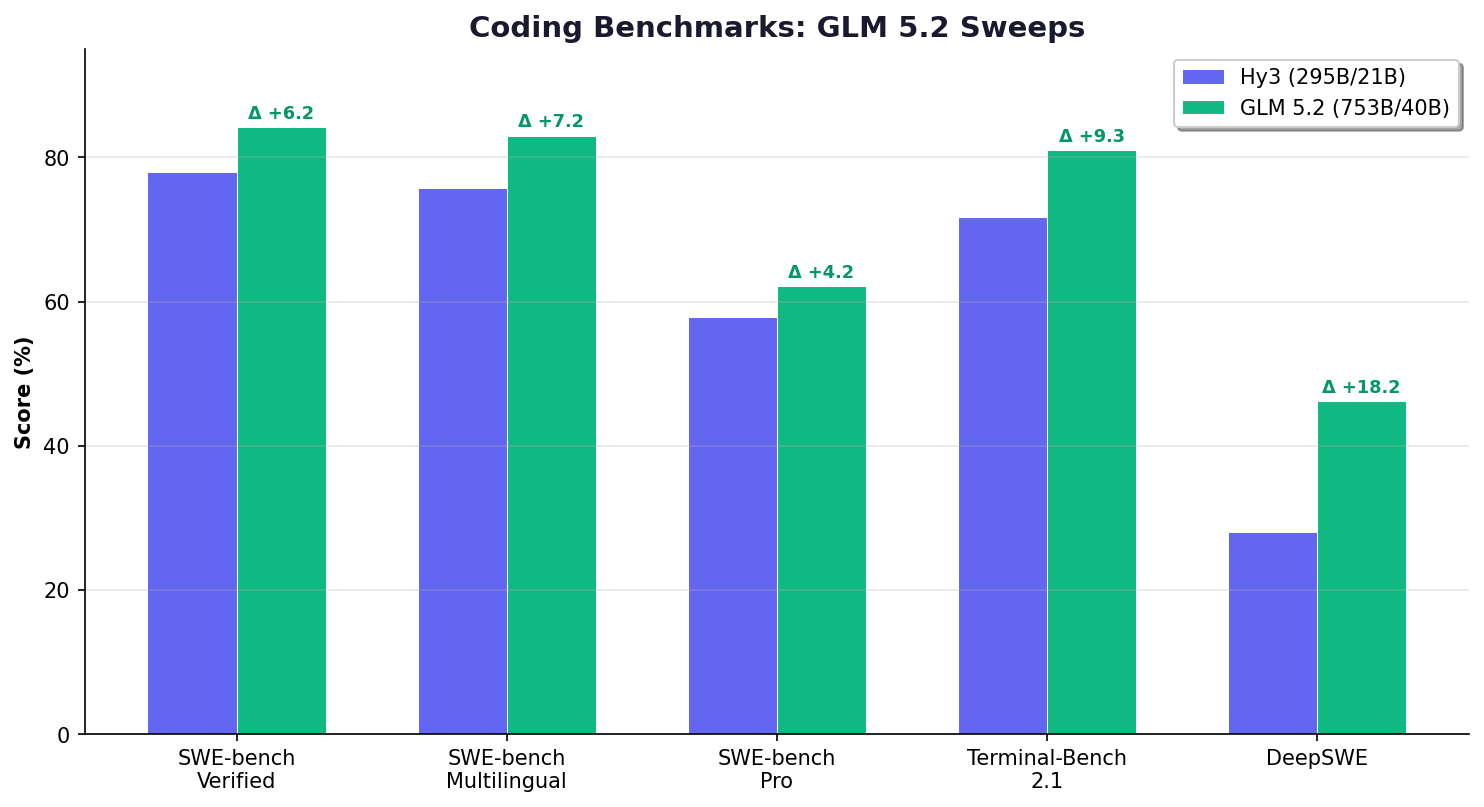
The DeepSWE gap (+18.2) is the most telling: GLM 5.2 is fundamentally stronger at the kind of deep, multi-file, repository-scale reasoning that defines modern software engineering. The +9.3 Terminal-Bench lead suggests it's also significantly better at CLI operations — package management, builds, server config. For teams where coding is the primary workload, GLM 5.2 is the clear choice.
But note: GLM 5.2 is 2.6× larger. A +4.2 Pro lead on 2.6× the parameters is not a linear scaling story. Hy3 extracts remarkable coding capability from a much smaller footprint.
Agents & Search: Hy3 Takes the Crown
Where GLM dominates coding, Hy3 dominates autonomous agent workloads. On MCP Atlas — the benchmark for multi-server tool orchestration — Hy3 scores 79.1%, the highest open-weight score ever published, placing #3 overall behind only Gemini 3.5 Flash (83.6%) and Claude Fable 5 (83.3%). GLM 5.2 scores 77.0%.
| Benchmark | Hy3 | GLM 5.2 | Δ | Winner |
|---|---|---|---|---|
| MCP Atlas (Public) ★ | 79.1 | 77.0 | -2.1 | Hy3 |
| BrowseComp | 84.2 | — | — | Hy3* |
| DeepSearchQA | 91.0 | — | — | Hy3* |
| ClawEval (pass³) | 68.5 | — | — | Hy3* |
| AA-LCR | 73.4 | ~71.0 | +2.4 | Hy3 |
* GLM 5.2 scores not published on these benchmarks. Hy3 wins by default of published data.
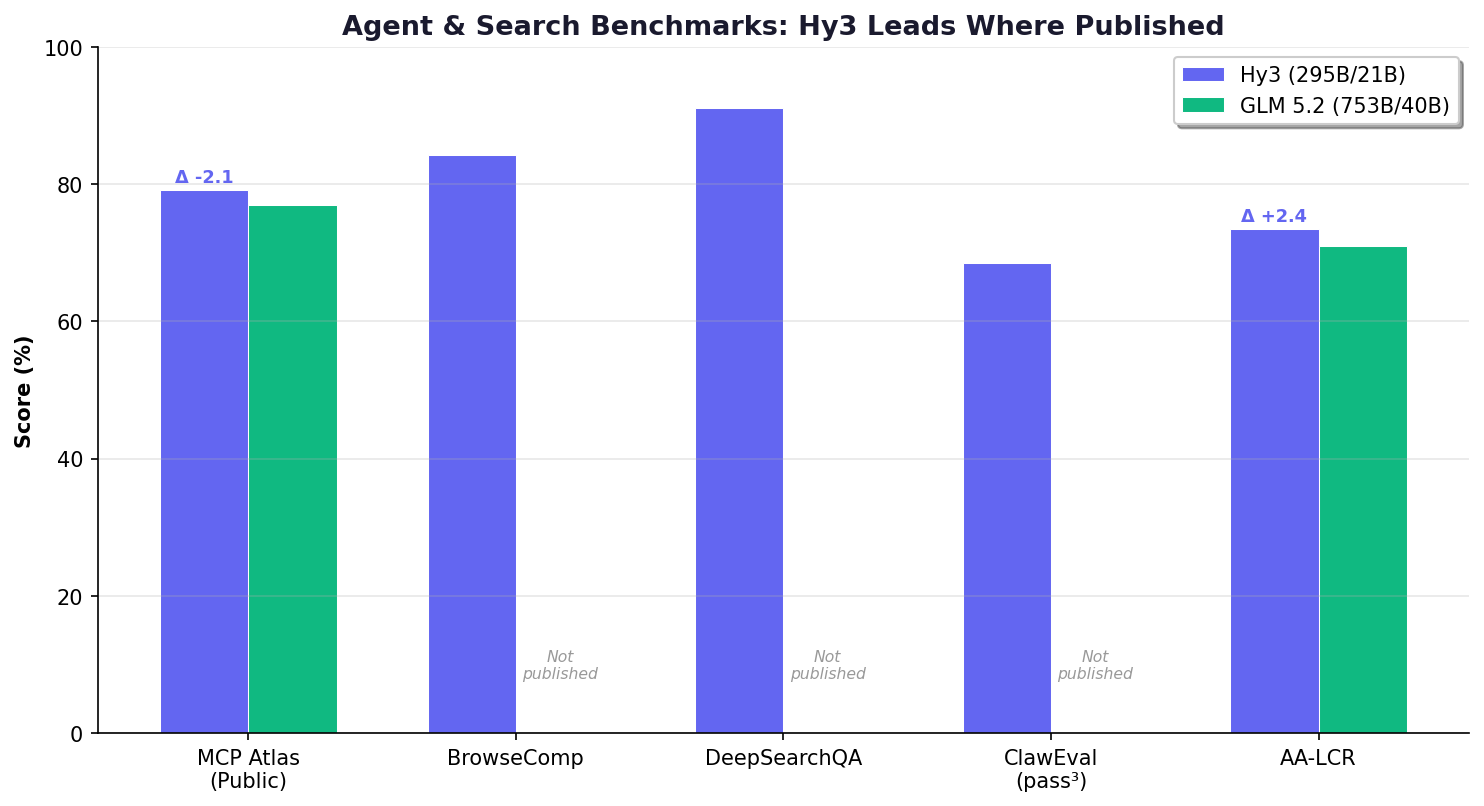
Hy3's BrowseComp 84.2% and DeepSearchQA 91.0% scores are competitive with closed frontier models — in the same tier as Claude Opus 4.8 and GPT-5.5. For agent-heavy workloads — search-and-retrieve, multi-tool orchestration, long-context reasoning — Hy3 is arguably the best open-weight model available.
Reasoning & STEM: Near-Parity
On reasoning benchmarks, the two models are close enough that the difference rarely matters in practice:
| Benchmark | Hy3 | GLM 5.2 | Δ | Winner |
|---|---|---|---|---|
| GPQA Diamond | 90.4 | 91.2 | +0.8 | ~Tie |
| HLE (with tools) | 53.2 | 54.7 | +1.5 | ~Tie |
| HLE (no tools) | 37.0 | 40.5 | +3.5 | GLM |
| IMOAnswerBench | 90.0 | 91.0 | +1.0 | ~Tie |
| USAMO 2026 | 72.0 | — | — | Hy3* |
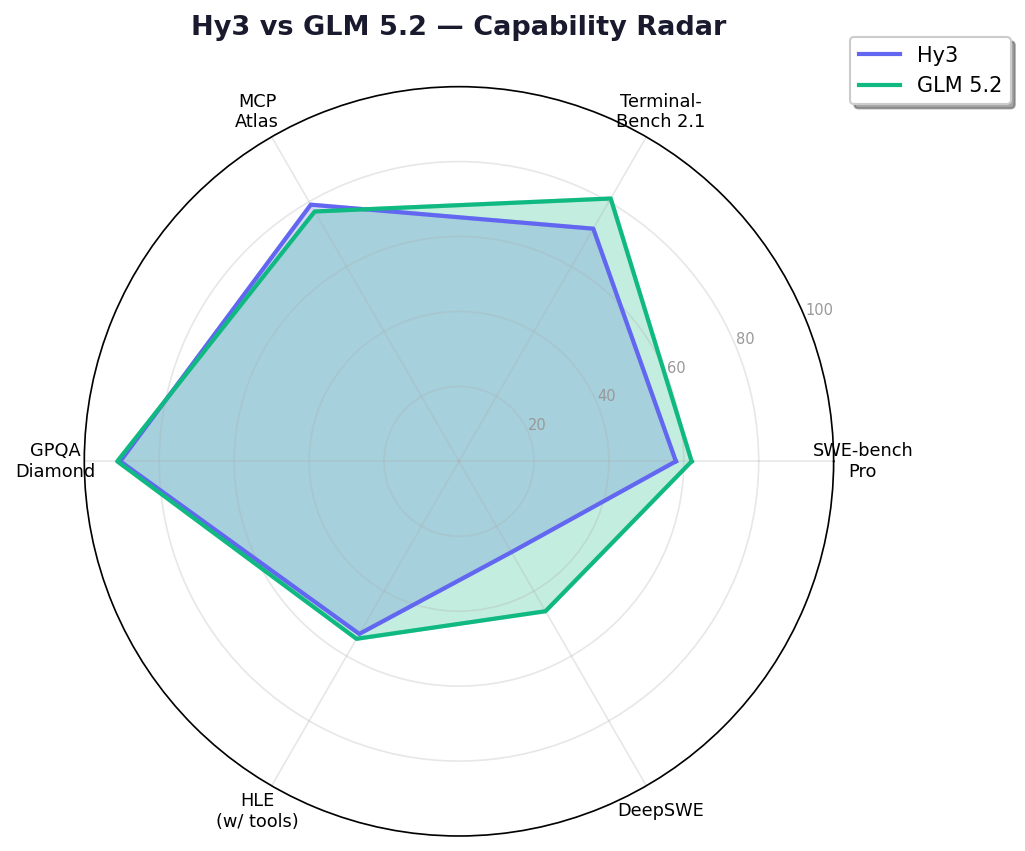
On GPQA Diamond, both models sit at ~91% — firmly in frontier territory. On HLE with tools, the 1.5-point gap is within evaluation noise. For general reasoning and STEM tasks, you won't feel a meaningful difference between these two models.
The Economics: 5.5× Price Gap
Raw benchmark scores only tell half the story. When you factor in cost, the comparison shifts dramatically:
| Metric | Hy3 | GLM 5.2 | Ratio |
|---|---|---|---|
| Input Price /1M tok | $0.20 | $1.40 | 7× |
| Output Price /1M tok | $0.80 | $4.40 | 5.5× |
| Context Window | 256K | 1M | 4× (GLM) |
| License | Apache 2.0 | MIT | Both permissive |
| Avg Tokens/Task (agent) | — | 43K | GLM verbose |
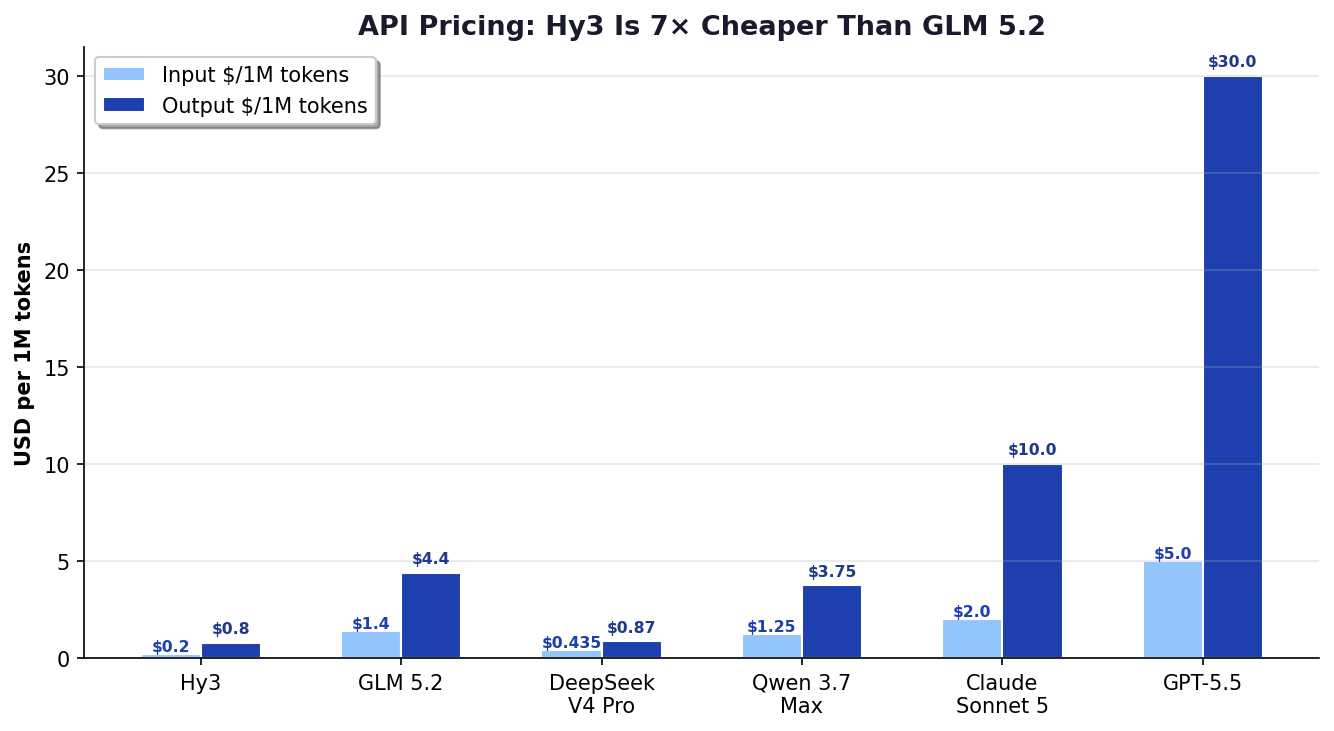
GLM 5.2 is also notably token-heavy: Artificial Analysis reports 43K output tokens per Intelligence Index task — higher than MiniMax M3 (24K), DeepSeek V4 Pro (37K), and Kimi K2.6 (35K). Hy3, by contrast, completed document processing tasks with 47.4% fewer tokens than GLM 5.2 in Tencent's internal WorkBuddy tests. The combination of lower per-token pricing and lower token consumption makes Hy3 dramatically cheaper to run at scale.
For a workload consuming 100M output tokens/month: Hy3 costs $80, GLM 5.2 costs $440 — a $360/month difference, or $4,320/year. For teams running agents at volume, that gap compounds fast.
The Reliability Factor
Tencent invested heavily in production hardening for Hy3. The numbers are striking:
| Issue | Before | After | Improvement |
|---|---|---|---|
| Hallucination Rate | 12.5% | 5.4% | -57% |
| Commonsense Errors | 25.4% | 12.7% | -50% |
| Multi-turn Intent Drift | 17.4% | 7.9% | -55% |
| Tool Call Stability | Baseline | Generalizes across scaffolds | Cross-platform |
Hy3 also demonstrates consistent performance across different agent scaffolds: on SWE-bench Verified, accuracy variance across CodeBuddy, Cline, and KiloCode stays within 4%. This scaffold-agnostic reliability is rare and valuable for production deployments where you can't afford to babysit the model.
GLM 5.2, by contrast, is a known token-heavy thinker. Its strength comes from generating more reasoning tokens — which works brilliantly for coding but can be wasteful for simpler agent tasks. The AA-Omniscience benchmark showed GLM 5.2 with a 28.1% hallucination rate (non-hallucination rate: 71.9%), while Hy3's anti-hallucination training explicitly targets the "answer when grounded, flag when evidence is missing" behavior.
10-Point Verdict Matrix
Which One Should You Use?
Choose GLM 5.2 if:
- Coding is your primary workload. The +4.2 Pro, +9.3 TB 2.1, and +18.2 DeepSWE leads are decisive.
- You need the 1M context window. For long-horizon coding sessions that span many files and turns, GLM's context edge matters.
- You're replacing Claude Code. GLM 5.2's native Anthropic API compatibility makes it a drop-in replacement.
- Budget is not your top constraint. At $440/month for 100M output tokens, GLM 5.2 is still far cheaper than Opus 4.8 ($2,500) or GPT-5.5 ($3,000).
Choose Hy3 if:
- You're building autonomous agents. MCP Atlas 79.1%, BrowseComp 84.2%, DeepSearchQA 91.0% — Hy3 is the best open-weight agent orchestrator.
- Cost matters at scale. 5.5× cheaper per token, plus 47% fewer tokens per task — the savings compound dramatically.
- You self-host on limited hardware. 295B total / 21B active fits a 2× DGX Spark setup. GLM 5.2's 753B needs serious infrastructure.
- Reliability is critical. 57% less hallucination, consistent behavior across agent scaffolds, explicit "I don't know" training.
- You're deploying in a regulated environment. Apache 2.0 with no regional restrictions is the safest open-source license for enterprise adoption.
The Bottom Line
GLM 5.2 is the better coder. Hy3 is the better agent. The choice depends entirely on your workload mix.
For pure coding performance, GLM 5.2's benchmark sweep is unambiguous. But for the increasingly common pattern of AI agents that search, browse, orchestrate tools, and reason across long contexts — Hy3 delivers comparable or superior capability at a fraction of the size and cost.
The real story isn't who wins — it's that two open-weight Chinese models, released within three weeks of each other, now compete directly with closed frontier models from Anthropic and OpenAI at 5-50× lower cost. The open-weight era isn't coming. It's here.
Test Both Models on Your Own Code
20+ LLMs on CodingFleet. Run Hy3 and GLM 5.2 side-by-side on your actual workloads. Benchmarks are directional — your codebase is the real test.
🚀 Try on CodingFleet →Sources: Tencent Hy3 Official · Z.AI GLM-5.2 Blog · VentureBeat · Artificial Analysis · Emergent.sh · MarkTechPost. Scores are vendor-reported unless otherwise noted.