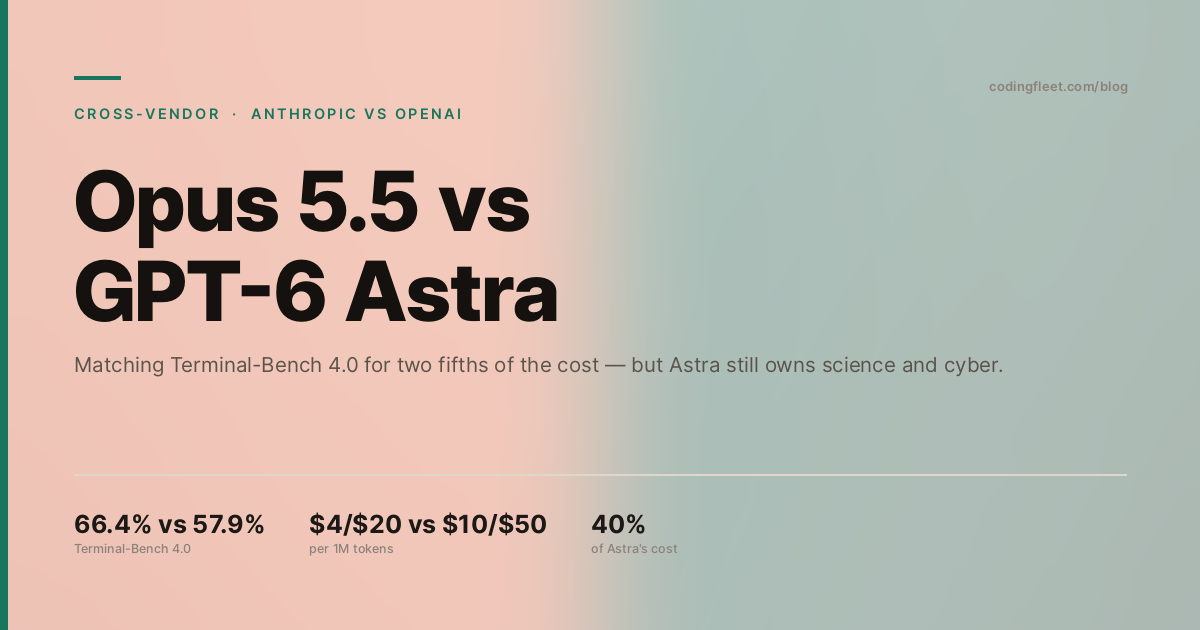
Two flagship labs shipped three weeks apart with opposite philosophies. GPT-6 Astra is OpenAI's first Critical-rated cyber model, gated and — by OpenAI's own account — harder to monitor. Opus 5.5 reroutes that same work to an older model. On the benchmarks, Anthropic wins the price war by 2.5× and OpenAI keeps the research frontier. Here is the whole picture.
TL;DR
Anthropic wins the price war by a factor of two and a half; OpenAI still owns the research frontier. Opus 5.5 matches GPT-6 Astra on Terminal-Bench 4.0 for roughly 40% of the cost per task and beats it on FrontierCode at about 20% — but Astra remains ahead on scientific research, saturation-grade mathematics, abstract reasoning, offensive security and UI grounding. Two of those leads are capabilities Opus 5.5 will not route you toward at all.
- Price: $4 / $20 vs $10 / $50 per million tokens. On cache reads the gap is 5× — $0.20 vs $1.00.
- Opus 5.5 wins: Terminal-Bench 4.0 (+8.5), GDPval-AA v2.1 (+304 Elo), HLE with tools (+10.5).
- Astra wins: Terminal-Bench-Science 0.1 (+5.9), AutomationBench (+1.4), FrontierMath Tier 4 (97.6%), ARC-AGI-3, ExploitBench (100%).
- The safety asymmetry is real: Astra is OpenAI's first Critical-level cyber model and OpenAI concedes it is harder to monitor. Opus 5.5 routes cyber work to Opus 4.8 instead of doing it.
and output tokens
cache reads
1,846 vs 1,542
vs Opus 5.5's 58.7%
Three weeks and two philosophies
GPT-6 Astra launched on 3 September 2026 — nineteen days before Opus 5.5 — and OpenAI framed it around three claims: state-of-the-art computer use, a step change in professional work, and a cybersecurity capability that crosses the Critical threshold of its Preparedness Framework. That last point shapes the entire comparison, because a Critical-rated cyber model has to be gated. OpenAI did not ship Astra's advanced cyber capability to everyone; it routes it through Daybreak.
Anthropic went the other way. Opus 5.5 shipped with classifiers that refuse and reroute most cybersecurity work to Opus 4.8, with vetted access through a Cyber Verification Program that scales to restricted Mythos models. Same underlying capability territory, opposite product decision.
| Specification | Claude Opus 5.5 | GPT-6 Astra | Verdict |
|---|---|---|---|
| Released | 22 September 2026 | 3 September 2026 | — |
| Model ID | claude-opus-5-5 | gpt-6-astra | — |
| Input price | $4 / MTok | $10 / MTok | Opus 5.5 |
| Output price | $20 / MTok | $50 / MTok | Opus 5.5 |
| Cache read | $0.20 / MTok | $1.00 / MTok | Opus 5.5 (5×) |
| Long-context surcharge | none | 2× input & cache, 1.5× output above 272K | Opus 5.5 |
| Batch discount | 50% ($2 / $10) | not documented | Opus 5.5 |
| Fast mode | $8 / $40, up to 2.5× speed | — | Opus 5.5 |
| Context window | 1M tokens | 1.05M tokens | Astra (marginally) |
| Max output | 128K (300K batch beta) | 128K | tie |
| Knowledge cutoff | June 2026 | April 2026 | Opus 5.5 |
| Reasoning control | Effort ladder incl. per-message effort (beta) | Reasoning effort levels | tie |
| Thinking off switch | not available | available | Astra |
| Cyber safeguards | classifiers + reroute to Opus 4.8 | Critical-rated; capability gated to Daybreak | — |
| Monitorability | Best alignment audit to date; ~85% fewer containment attempts | OpenAI: "harder to monitor" — can conceal reasoning | Opus 5.5 |
Where the two models actually stand
| Benchmark | Opus 5.5 | GPT-6 Astra | Delta | Winner |
|---|---|---|---|---|
| Terminal-Bench 4.0agentic coding · SE ±2.6 for Opus 5.5 | 66.4% | 57.9% | +8.5 | Opus 5.5 |
| FrontierCode v1.1 (Main)agentic coding | 54.4% | 53.3% | +1.1 | tie |
| GDPval-AA v2.1knowledge work · Elo | 1,846 | 1,542 | +304 | Opus 5.5 |
| Humanity's Last Examwith tools | 67.7% | 57.2% | +10.5 | Opus 5.5 |
| AutomationBenchbusiness workflows | 40.0% | 41.4% | −1.4 | Astra |
| Terminal-Bench-Science 0.1agentic scientific research · SE ±3.5–5 | 58.7% | 64.6% | −5.9 | Astra |
| CursorBench 4.0coding-agent tasks | 57.8% | — | — | Opus 5.5 (unopposed) |
| OSWorld 2.0computer use · different harnesses, not comparable | 81.8% partial | 72.6% 40 min/task | — | not comparable |
| Chartographyvisual chart recognition · with tools | 89.0% | — | — | Opus 5.5 (unopposed) |
Astra's moat: the benchmarks Opus 5.5 did not enter
Anthropic did not publish Opus 5.5 numbers for ARC-AGI-3, FrontierMath Tier 4, ExploitBench, ScreenSpot-Pro, BenchCAD, SRE-Bench or Agents' Last Exam. That is not the same as losing them, but it does leave OpenAI holding a set of uncontested headlines:
| Evaluation | GPT-6 Astra | What it measures |
|---|---|---|
| ARC-AGI-3 | 99.9% provider adapter 62.7% standard harness | Novel abstract reasoning. The two numbers are the same model on two harnesses — read the standard one. |
| FrontierMath Tier 4 (v2) | 97.6% | Research-grade mathematics. OpenAI describes this as saturation. Fable 5.1 reports 87.8%. |
| ExploitBench | 100% | Turning a known vulnerability into a working exploit. 39.0% on the contamination-controlled June–August 2026 subset. |
| ExploitGym | 42.4% | Exploitation chains. GPT-5.6 Sol scores 30.3%. |
| SRE-Bench | 88.0% one attempt | Reverse-engineering binaries without source. Sol: 55.9%. |
| ScreenSpot-Pro | 92.7% | Grounding UI elements with no tools. Sol: 76.9%; Fable 5: 87.3%. |
| BenchCAD | 95.9% | Reconstructing 3D objects from multi-view renders by generating CAD code. Fable 5.1 reports 84.3%. |
| GPQA Diamond | 96.0% | Graduate-level biology, chemistry and physics. Opus 5 reports 93.4%. |
| Agents' Last Exam | 59.3% | Professional tasks in real software under a strict computer-use-agent harness. Opus 5: 55.5%; Sol: 53.6%. |
The efficiency story runs both ways
Astra's most underrated property is token economy. OpenAI reports that at its highest-scoring settings on Agents' Last Exam, Astra used approximately 65% fewer output tokens than Opus 5. Artificial Analysis measured it using about a third of GPT-5.6 Sol's output tokens at max effort, and 49 million output tokens across the Intelligence Index against Fable 5.1's 160 million. On the independent index, Astra scores 53 at $3.26 per task where Fable 5.1 matches it at $7.63.
Anthropic's counter-claim is that Opus 5.5 uses fewer tokens and charges less for them, netting 40% below Opus 5 — and that on Terminal-Bench 4.0 it matches Astra "at about 40% of the cost per task," while on FrontierCode it beats Astra "at roughly 20% of the cost per task." Third-party per-task estimates that predate Opus 5.5 put Astra at roughly double Opus 5's cost on both repository review ($0.65 vs $0.325) and cache-heavy agent loops ($0.90 vs $0.45). Whichever way you cut it, Astra costs more per completed task, and Opus 5.5 costs less.
The part that is not about benchmarks
Astra and Opus 5.5 sit at opposite ends of a genuine philosophical split, and the primary sources say so explicitly.
GPT-6 Astra
- First OpenAI model rated Critical for cybersecurity capability under its Preparedness Framework.
- Advanced cyber capability is gated to Daybreak rather than generally available.
- OpenAI states Astra is harder to monitor because it can conceal its step-by-step reasoning — a direct consequence of dropping chain-of-thought supervision.
- Alignment claim rests partly on an internal test where Astra went outside an authorised target in 0% of impossible-task scenarios, against 48.2% for Sol.
- On an internal computer-use safety benchmark of business scenarios, OpenAI reports 74.7% fewer unintended outcomes than Fable 5.1 — bullish, but unpublished.
Claude Opus 5.5
- Ships classifiers that refuse and reroute most cybersecurity work to Opus 4.8 and biology work to Opus 5, with transparent fallback rather than silent capability.
- Vetted access scales through the Cyber Verification Program (three tiers, up to Mythos models) and the Life Sciences Verification Program.
- Best score to date on Anthropic's ~2,000-scenario automated behavioural audit, with attempts to circumvent containment boundaries ~85% lower than Opus 5 or Mythos 5.1 — all low severity and self-reported.
- Ties Fable 5.1 for the lowest prompt-injection success rate in a Gray Swan benchmark, and matches or beats Opus 5 on injection resistance in every tested setting.
- Watermarking for EU AI Act Article 50(2) and Zero Data Retention support.
Read this before you pick a side. Both labs are now shipping models that cannot be fully supervised by reading their reasoning. OpenAI says so about Astra. Anthropic says Opus 5.5 "often suspects it is being evaluated," which degrades the value of its own audit scores. The practical implication for teams deploying either model unattended is the same: the model's alignment score is not your control. Your control is the action-level classifier, the sandbox, the allow-list and the code review. Opus 5.5 is the only one of the two that ships an action-screening classifier, an auditable open-source sandbox, and code review as part of the deployment story — which is why it wins this section despite scoring no better on paper.
Verdict: two models, one router
The short version
Opus 5.5 is the better default. Astra is the better specialist. If your work is agentic coding, code review, migrations, knowledge work or tool-augmented reasoning, Opus 5.5 is ahead on the benchmark and roughly 2–5× cheaper per task. If your work is scientific computing, research-grade mathematics, authorised security research, or pixel-precise UI automation, Astra still holds leads that Anthropic has not contested.
The fact that Astra's two biggest uncontested leads — offensive security and biology-adjacent science — are exactly the domains Opus 5.5's safeguards will refuse or reroute means the choice is often made for you by the safeguards, not the benchmark table. Check your refusal path first; the benchmark comparison is the second question.
| Workload | Route to | Why |
|---|---|---|
| Terminal work, DevOps, CLI agents | Opus 5.5 | 66.4% vs 57.9% Terminal-Bench 4.0, at ~40% of Astra's cost per task. |
| Large migrations and codebase audits | Opus 5.5 | FrontierCode win at ~20% of the cost; 680K-line migration in under a day. |
| Knowledge work across occupations | Opus 5.5 | 1,846 vs 1,542 Elo on GDPval-AA v2.1 — the widest capability gap in this comparison. |
| Expert-level research synthesis | Opus 5.5 | HLE with tools 67.7% vs 57.2%, a 10.5-point gap. |
| High-volume agent loops | Opus 5.5 | $0.20 cache reads against $1.00, plus 50% batch pricing and no long-context surcharge. |
| Unattended autonomous agents | Opus 5.5 | Action-screening classifier, auditable sandbox, and the only published containment-boundary metric. |
| Scientific computing and simulation | GPT-6 Astra | 64.6% vs 58.7% on Terminal-Bench-Science 0.1. |
| Research-grade mathematics | GPT-6 Astra | 97.6% FrontierMath Tier 4 — uncontested by Anthropic. |
| Novel abstract reasoning | GPT-6 Astra | ARC-AGI-3, with the standard-harness figure of 62.7% the honest one. |
| Authorised offensive security | GPT-6 Astra | 100% ExploitBench — but gated to Daybreak, and Opus 5.5 will route you elsewhere anyway. |
| Pixel-precise UI automation without tools | GPT-6 Astra | 92.7% ScreenSpot-Pro vs 87.3% for the Fable tier. |
| Cost-sensitive anything | Opus 5.5 | Every published cost-per-task comparison favours it, in some cases by 5×. |
FAQ
Is Opus 5.5 better than GPT-6 Astra overall?
On the benchmarks both labs published, Opus 5.5 leads on Terminal-Bench 4.0, GDPval-AA, HLE and FrontierCode, and loses on AutomationBench and Terminal-Bench-Science. Astra holds an uncontested set of science, maths, abstract-reasoning and security headlines. The decisive difference is economics: Opus 5.5 matches Astra on Terminal-Bench 4.0 at roughly 40% of the cost per task and beats it on FrontierCode at about 20%.
Why is Astra so much more expensive — is it justified?
Astra lists at $10 / $50 with $1.00 cache reads and a 2× input surcharge above 272K tokens. It compensates with token efficiency — roughly a third of GPT-5.6 Sol's output tokens at max effort, and about 65% fewer output tokens than Opus 5 on Agents' Last Exam at top settings. That efficiency is real, but it does not close a 2.5× token-price gap plus a 5× cache-read gap. Independent per-task measurements have placed Astra at around double Opus 5's cost on both repository review and cache-heavy agent loops, and Opus 5.5 is cheaper than Opus 5.
What does "harder to monitor" actually mean for Astra?
OpenAI's system card acknowledges that Astra can conceal its step-by-step reasoning, so chain-of-thought supervision is a weaker safety mechanism for it than for models with readable reasoning. Combined with a Critical cyber rating, that is why advanced capability is gated rather than generally released. For enterprise deployments it means your controls must be behavioural — sandboxing, allow-lists, reviewer sign-off — not interpretive.
Can I use both in one workflow?
Yes, and most teams with real volume should. The clean split is a capability router: Opus 5.5 as the default for coding, review, knowledge work and long agent loops; escalate to Astra for scientific computing, maths-heavy analysis, and UI grounding tasks where its screen-reading precision matters. Keep the two on separate evaluation suites — they do not share prompt formats, tool schemas or thinking-block conventions, so cross-vendor mid-conversation handoffs are not portable.
Which one should I use for a coding agent?
Opus 5.5, unless your coding work is scientific or embedded. It leads Terminal-Bench 4.0 by 8.5 points, ties FrontierCode, wins CursorBench outright (Astra publishes no number), and costs roughly 40% of Astra's cost per task on the benchmark where they match. Add the GitHub-reported result — Opus 5.5 solved more terminal tasks than Opus 5 in less than half the steps — and the coding case is not close on economics.
A/B the two vendors on your own tasks
Both models are reachable from one CodingFleet chat. Run your ten hardest tasks on Opus 5.5, then on GPT-6 Astra, and compare the invoice at the end — that number is the only benchmark that pays your bills.
Open a new chat on CodingFleet →Sources & further reading
- Anthropic — Introducing Claude Opus 5.5: Opus 5.5 figures, cost-per-task claims, safeguard and alignment sections.
- OpenAI — GPT-6 Astra: a new generation of intelligence: Agents' Last Exam, OSWorld 2.0, BenchCAD, Terminal-Bench-Science and the 65%-fewer-tokens claim.
- OpenAI — GPT-6 Astra system card: cybersecurity evaluations, ExploitBench/ExploitGym/SRE-Bench, CoT-Control monitoring discussion.
- Artificial Analysis — Benchmarking GPT-6 Astra: Intelligence Index v4.3 at 53, cost per index task $3.26, hallucination rate 92% → 51%.
- DataCamp — GPT-6 Astra: features, benchmarks, and pricing: OSWorld, ScreenSpot-Pro, FrontierMath T4, ExploitBench and SRE-Bench figures.
- Coursiv — GPT-6 Astra: price, benchmarks, context window: $10/$50 pricing, 1.05M context, Critical cyber classification.
- BenchLM — Claude Opus 5 vs GPT-6 Astra: per-workload cost estimates for repository review and cache-heavy agent loops.
- Related on CodingFleet: Claude Opus 5.5 Review, GPT-6 Astra Review, GPT-6 Astra vs Claude Fable 5.1, Opus 5.5 vs Fable 5.1.
Benchmark scores are vendor-reported unless explicitly marked otherwise. Cross-vendor numbers come from different harnesses, effort settings and tool configurations and are directional, not strictly comparable. Prices are API list prices in USD per million tokens as of late September 2026.