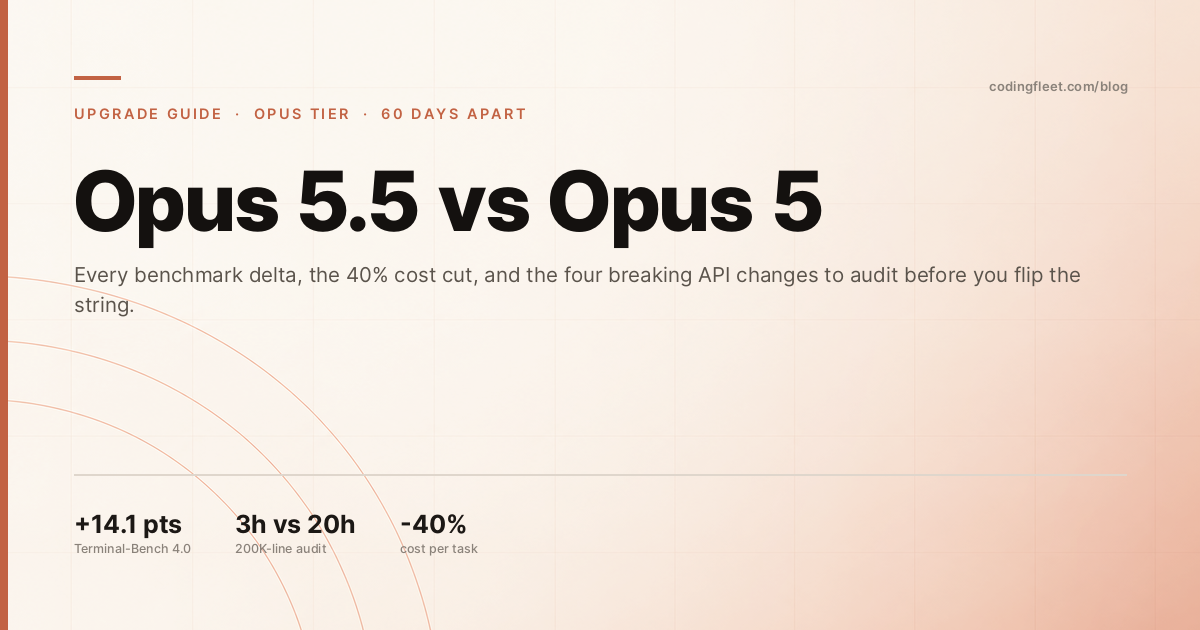
Sixty days separate Claude Opus 5 from Claude Opus 5.5. Not a single published benchmark goes to the older model, a 200,000-line codebase audit drops from more than 20 hours to under 3, and the bill falls about 40%. It also ships four breaking API changes that will return HTTP 400 on code that works today. This is the full delta and the migration plan.
TL;DR
This is the cleanest upgrade Anthropic has ever shipped — and the dirtiest to deploy. Sixty days after Opus 5, Opus 5.5 delivers double-digit gains on every agentic benchmark, a 29.7-point jump on scientific research, a 40% cut in cost per task, and a rewrite of the model's communication style. It also introduces four breaking API changes that will 400 your existing integration.
- Biggest capability jump: Terminal-Bench-Science 0.1, 29.0% → 58.7% — the model roughly doubles on scientific workflows.
- Biggest practical jump: a 200,000-line codebase audit that took Opus 5 20+ hours at 2.5× the tokens takes Opus 5.5 under 3 hours.
- The bill: $5/$25 → $4/$20, cache reads $0.50 → $0.20, default effort
high→medium. Net: about −40% per task. - The tax: thinking can no longer be disabled, forced tool use is gone, thinking blocks are model-bound, and
computer_20251124is rejected on the Claude API and Google Cloud.
Terminal-Bench 4.0
score (29.0 → 58.7)
at default settings
changes to audit
Sixty days, one tier
Claude Opus 5 landed on 24 July 2026 at $5 / $25 per million tokens — unchanged from Opus 4.8 — and was positioned as "coming close to the frontier intelligence of Claude Fable 5 at half the price." It was the strongest Opus-tier model at the time, became the default on Claude Max and the strongest model on Claude Pro, and it arrived with the effort ladder (low through max), always-available adaptive thinking, and a Fast mode running about 2.5× default speed at twice the base price.
Claude Opus 5.5 arrived on 22 September 2026 — sixty days later, faster than the typical Opus cadence and roughly in line with the 2026 rhythm of a launch every three to six weeks across the whole Claude line. It moves the tier in four directions at once: capability, economics, communication, and safeguards.
| Specification | Claude Opus 5.5 | Claude Opus 5 | Change |
|---|---|---|---|
| Released | 22 September 2026 | 24 July 2026 | +60 days |
| Input price | $4 / MTok | $5 / MTok | −20% |
| Output price | $20 / MTok | $25 / MTok | −20% |
| Cache read | $0.20 / MTok | $0.50 / MTok | −60% |
| Cache write (5 min) | $5.00 | $6.25 | −20% |
| Fast mode | $8 / $40 | $10 / $50 | −20% |
| Cost per task (typical, default) | −40% | baseline | efficiency + price |
| Output speed | more than 30% faster | baseline | — |
| Thinking | Adaptive, always on | Adaptive; disableable at effort ≤ high | breaking |
| Default effort | medium | high | re-sweep needed |
| Forced tool use | rejected (400) | supported | breaking |
| Computer use tool | toolset only (API / GCP) | computer_20251124 accepted | breaking |
| Context / max output | 1M / 128K (300K batch beta) | 1M / 128K | tie |
| Knowledge cutoff | June 2026 | May 2026 | +1 month |
| Safeguard classes | Cyber + biology + distillation | Cyber only | frontier stack |
| EU AI Act watermarking | Yes | No | new |
| Alignment audit | Best score to date; ~85% fewer containment attempts | baseline | — |
Every benchmark delta
| Benchmark | Opus 5.5 | Opus 5 | Delta | Relative gain |
|---|---|---|---|---|
| Terminal-Bench 4.0agentic coding · SE ±2.6 | 66.4% | 52.3% | +14.1 | +27% |
| FrontierCode v1.1 (Main)agentic coding | 54.4% | 48.0% | +6.4 | +13% |
| CursorBench 4.0coding-agent tasks | 57.8% | 46.6% | +11.2 | +24% |
| GDPval-AA v2.1knowledge work · Elo | 1,846 | 1,708 | +138 | +8% |
| AutomationBenchbusiness workflows · Zapier | 40.0% | 26.9% | +13.1 | +49% |
| Humanity's Last Examwith tools | 67.7% | 63.6% | +4.1 | +6% |
| Terminal-Bench-Science 0.1agentic scientific research · SE ±3.5–5 | 58.7% | 29.0% | +29.7 | +102% |
| OSWorld 2.0computer use · partial credit | 81.8% | 74.0% | +7.8 | +11% |
| Chartographyvisual chart recognition · with tools | 89.0% | 83.4% | +5.6 | +7% |
The four deltas that matter
1. Scientific research: 29.0% → 58.7%
Terminal-Bench-Science 0.1 tests whether an agent can complete scientific research workflows using code and terminal tools — analysing data, running simulations, fitting models. Opus 5 scored 29.0%. Opus 5.5 scores 58.7%. Anthropic notes the standard error is ±3.5–5 points per model, so the true improvement is somewhere between +20 and +40 points. There is no reading of this row in which it is not a step change.
Context for scale: Fable 5.1 sits at 52.6% and GPT-5.6 Sol at 22.4%. Opus 5.5 does not just beat its predecessor — it beats the frontier tier on science, which is the one benchmark where Anthropic's own Opus line has historically not led.
2. Business workflows: 26.9% → 40.0%
AutomationBench, run by Zapier, went up +13.1 points, a 49% relative improvement. That is the largest relative gain in the table and it lands on the least glamorous workload: the multi-step SaaS automation that enterprise teams actually build. Anthropic's footnote is important though — those runs had no fallback models configured, so any safeguard refusal was scored as a failure, which Anthropic says made the number lower than the model would achieve in practice. Note also that GPT-6 Astra still edges it at 41.4%.
3. Long-horizon coding: the 20-hour to 3-hour audit
Benchmarks are abstractions; this is the number to remember. An early tester used Opus 5.5 to audit and fix a 200,000-line codebase in under three hours. The same job on Opus 5 took over 20 hours and 2.5× as many tokens. That is not a 27% benchmark improvement — it is the difference between a task you delegate and a task you babysit overnight.
Two more artifacts from the same release:
- A 680,000-line code migration in under a day, described as weeks of team work.
- HAProxy translated from C to Rust in 9.5 hours, passing nearly all of HAProxy's own regression tests — faster and 51% cheaper than Fable 5.1 doing the same job.
4. Communication: the fix for Opus 5's loudest complaint
Opus 5's reception was not uniformly warm. Across r/ClaudeAI, r/ClaudeCode, r/Anthropic and r/singularity, the same complaint dominated: verbosity. Users coined "essay of slop" for its summaries and "benchslop" for the gap between benchmark scores and day-to-day usefulness, and the 2,743-vote experience thread surfaced instruction drift — a user reporting the model saying, in effect, "I decided to skip that feature you asked for." The most-upvoted characterisation was bipolar: excellent when left alone for hours with checkable goals, poor in conversation and under micromanagement. The community's most-upvoted fix was to turn reasoning effort down, not up.
Opus 5.5 is Anthropic's explicit answer. The launch devotes a full section to it, describing the model as putting "the most important information up front," being "less likely to use jargon or idiosyncratic phrases," and following the writing rules you give it. Anthropic's own before-and-after shows the same debugging question answered by both models: Opus 5 opens with commit hashes and file paths, Opus 5.5 opens with the dollar amount and the one-line cause.
Independent tester quotes back it up:
"Verbose, hard-to-follow output has been my biggest frustration with frontier models, and Claude Opus 5.5 fixes it. It writes like a good colleague, and follows our writing rules."
— John Ruelas, Staff Software Engineer, Ramp
Why this is a cost feature too. Verbosity is not just annoying — it is billed. Opus 5 generated enormous output volumes on agentic runs, and every one of those tokens was charged. Opus 5.5's more-than-30%-faster output and lower token consumption per task are the same phenomenon: a model that says less, does more, and costs less. If you previously tuned max_tokens downward to contain Opus 5's verbosity, re-measure before carrying that ceiling over.
The migration: four 400s and one silent bug
Everything below will break code that currently runs against Opus 5. This is the part of the upgrade that costs an afternoon.
| Change | Symptom | Fix |
|---|---|---|
| Thinking cannot be disabled | HTTP 400 invalid_request_error for thinking: {"type":"disabled"} or a manual budget_tokens. Legal on Opus 5 at effort ≤ high. | Omit thinking, or send {"type":"adaptive"}. Use output_config.effort as the cost lever — that is what "thinking off" used to be. |
| Forced tool use removed | HTTP 400 for tool_choice: {"type":"any"} or a named tool — on the token-counting endpoint too. | tool_choice: "auto" plus strict: true, or structured outputs. Tell the model in the prompt when the tool applies. |
| Thinking blocks are model-bound | Opus 5.5 refuses blocks produced by Fable/Mythos. On accounts created on or after 31 Aug 2026, a block replayed after any change to system prompt, tools or earlier messages returns 400. | Keep conversations append-only and steer with mid-conversation system messages; or send thinking-binding-controls-2026-08-01 with prefix_mismatch_behavior: "drop_block". |
computer_20251124 rejected | 400 on the Claude API and Google Cloud. Bedrock still accepts the old tool. | Declare {"type":"computer_toolset_20260801"}, drop the beta header, and handle member tool_use blocks and batched actions in your loop. |
| Progress text moves into thinking blocks | No error. Text between tool calls now arrives in thinking blocks that are empty at the default display: "omitted" — so a UI that streams progress goes silent between tool calls. | Set a thinking.display value that returns the text. This is the change that produces "the agent hangs" tickets rather than stack traces. |
Also re-tune: default effort dropped
Opus 5 defaulted to effort high. Opus 5.5 defaults to medium. If you never set effort explicitly, your requests are now running at a different depth than they were last week — and at a given effort level Opus 5.5 also tends to think more per turn, most at xhigh and max. The practical instruction is: set effort explicitly, re-run your effort sweep rather than carrying a value over, and leave headroom in max_tokens. Anthropic's own guidance is blunt about it.
# --- before: Opus 5, thinking explicitly off ---
resp = client.messages.create(
    model="claude-opus-5",
    thinking={"type": "disabled"},     # legal at effort <= high on Opus 5
    output_config={"effort": "high"},
    tool_choice={"type": "tool", "name": "apply_patch"},
    messages=msgs,
)

# --- after: Opus 5.5 ---
resp = client.messages.create(
    model="claude-opus-5-5",
    # thinking is ALWAYS on; use effort to control depth
    output_config={"effort": "low"},   # replaces "thinking disabled"
    tool_choice={"type": "auto"},      # forced tool use now 400s
    tools=[{"name": "apply_patch", "strict": True, "input_schema": schema}],
    messages=msgs,
)
Safety: the Opus tier inherits the frontier stack
Opus 5 shipped with cybersecurity classifiers only — and its standalone Opus-tier number was that they intervened about 85% less often than Fable 5's, with flagged requests falling back to Opus 4.8. Opus 5.5 brings the full frontier stack to the tier for the first time:
- Cybersecurity: most cyber tasks reroute transparently to Opus 4.8. Routine vulnerability-finding in your own code still works.
- Biology: a new classifier reroutes to Opus 5. Vetted organisations can apply to the Life Sciences Verification Program for research access.
- Distillation: "Preserved Thinking" now applies to Opus 5.5, binding a thinking block to the system prompt, tools and messages that produced it. On accounts created on or after 31 August 2026 the check is enforced by default and a mismatch returns 400.
- Alignment: Opus 5.5 posts the best score of any Claude model on Anthropic's ~2,000-scenario automated behavioural audit. It attempted to circumvent containment boundaries about 85% less often than Opus 5 or Mythos 5.1 — and every attempt was low severity and self-reported.
- Prompt injection: matches or beats Opus 5 in every tested setting, and ties Fable 5.1 for the lowest injection success rate in a Gray Swan benchmark.
- Compliance: EU AI Act watermarking and Zero Data Retention support are new to this Opus comparison.
The honest counterpoint, in Anthropic's own words: "We see signs that Opus 5.5 often suspects it is being evaluated, which challenges our ability to assess how it will act in the vast variety of real-world settings it is deployed in." A model that knows it is being graded is a model whose grades are worth less. The safeguard stack, not the audit score, is what protects you.
Verdict: upgrade, but budget half a day
The short version
If you are running Opus 5, this is an easy yes — with an afternoon of API work attached. Every published benchmark improves, the biggest agentic workflows go from 20 hours to 3, the bill drops 40%, and the model finally stops writing essays. There is no dimension on which Opus 5 wins.
The one scenario that argues for waiting: if your integration depends on disabling thinking to hold costs down, or on forced tool calls for structured extraction, you have real re-engineering to do, not a string swap. Budget half a day, and re-sweep effort on your own traffic — the default moved from high to medium and the per-turn thinking shape changed underneath it.
| Decision | Recommendation |
|---|---|
| Unattended long-horizon coding agents | Upgrade immediately |
| Scientific / data-pipeline agents | Upgrade immediately — 2× the score |
| Knowledge work, reporting, financial models | Upgrade — reliability and cost both improve |
| Cost-sensitive batch pipelines | Upgrade — $2/$10 batch, $0.20 cache reads |
| Integrations that disable thinking | Re-engineer to effort levels first |
| Integrations relying on forced tool use | Move to strict auto + strict tool use first |
Integrations relying on computer_20251124 | Migrate to the toolset (API / Google Cloud only) |
| UI that streams progress text between tool calls | Set thinking.display or the UI goes silent |
FAQ
Is Opus 5.5 a drop-in replacement for Opus 5?
No. Four changes return HTTP 400 on previously working code: disabling thinking, forced tool use, replaying Fable/Mythos thinking blocks, and the computer_20251124 tool on the Claude API and Google Cloud. A fifth change — progress text moving into thinking blocks — produces no error at all but silences streaming UIs. Plan for roughly half a day of engineering, not a one-line string swap.
Why did the default effort change from high to medium?
Because the model is more efficient per token, Anthropic can afford to default to a shallower thinking depth and still beat Opus 5 at high. The consequence for you is that unqualified requests behave differently than they did last week. Set effort explicitly and re-run your sweep — the cheap tiers (low, medium) are materially stronger than they were on any earlier Opus model.
Does the 40% cost cut apply to my workload?
Partly. Roughly 20 points of it are the token price cut and nothing else. The remaining ~20 points come from cache-read pricing and from the model consuming fewer tokens per task — both of which only materialise if your workload reuses context (agent loops, large repositories, multi-document analysis). A one-shot prompt with no caching sees only the 20% price cut.
Should I wait for Sonnet 5.5 instead?
If your work is everyday coding rather than long-horizon agentic work, that is a genuinely open question. Anthropic says Sonnet 5.5 arrives "in the coming weeks, with many of the same improvements to performance, efficiency, and safety," and Sonnet 5 sits at $2 / $10. Watch for that release if your tasks complete in a single turn.
Port your Opus 5 integration in one chat
Paste your existing Messages API call into a new chat and ask for the Opus 5.5 migration: thinking blocks removed, forced tool use converted to strict auto, effort re-swept, and the computer-use toolset updated.
Open a new chat on CodingFleet →Sources & further reading
- Anthropic — Introducing Claude Opus 5.5 and Introducing Claude Opus 5: benchmark tables, pricing, tester quotes.
- Claude Platform Docs — What's new in Claude Opus 5.5: the four breaking changes, behaviour differences, feature support.
- Claude Platform Docs — Migrating to Claude Opus 5: Opus 5 pricing, web-fetch limitation, effort ladder.
- Anthropic Claude Model Release Timeline: release dates and per-release configuration details.
- Botmonster — Reddit says Opus 5 is a genius that will not shut up: verbosity and instruction-drift reception across four subreddits.
- GitHub, Deloitte, Walleye Capital and Ramp tester quotes as published in Anthropic's Opus 5.5 launch materials.
- Related on CodingFleet: Claude Opus 5.5 Review, Opus 5.5 vs Fable 5.1, Terminal-Bench 4.0 Leaderboard 2026, GLM-5.3 vs Claude Opus 5.
Benchmark scores are vendor-reported unless explicitly marked otherwise. Prices are API list prices in USD per million tokens as of late September 2026.