
On July 16, 2026, Moonshot AI released Kimi K3 — a 2.8-trillion-parameter mixture-of-experts model that would ship as open weights nine days later, priced at a third of what frontier labs charge. Eight days after that, Anthropic answered with Claude Opus 5, a $25-per-million-output-token workhorse that immediately became the new #1 on Frontier-Bench v0.1. These two models never shared a launch-day comparison table — Moonshot's own benchmarks predate Opus 5 by a week. So we built the missing comparison from independent sources: BenchLM's head-to-head, Artificial Analysis's model comparison, and both companies' own system cards.
The short version: Opus 5 leads the independent aggregate score 85.88 to 79.98 and wins the benchmarks that matter most for professional coding work. Kimi K3 answers with open weights, a nearly 40% cheaper token bill, and a genuinely competitive showing on agentic browsing and graduate-level science questions — an unusual result for a model released at a third of the price. This is the full breakdown, including where the evidence is thin and the comparisons should be read directionally rather than as gospel.
| Spec | Claude Opus 5 | Kimi K3 |
|---|---|---|
| Developer | Anthropic | Moonshot AI |
| Released | July 24, 2026 | July 16, 2026 (weights: July 27, 2026) |
| API Model ID | claude-opus-5 | kimi-k3 |
| Architecture | Proprietary (params undisclosed) | MoE — 2.8T total, 16 of 896 experts active (about 32B active) |
| License | Closed / API only | Open weights — Modified MIT |
| Input Price | $5.00 / 1M tokens | $3.00 / 1M tokens |
| Output Price | $25.00 / 1M tokens | $15.00 / 1M tokens |
| Cached Input | $0.50 / 1M tokens | $0.30 / 1M tokens |
| Context Window | 1,000,000 tokens | 1,048,576 tokens |
| Max Output | 128,000 tokens | Not independently confirmed |
| Reasoning | Adaptive (always on), effort: low to max | Fixed high-effort reasoning; no effort ladder |
| Modalities | Text + Image input, Text output | Text + Image input (native vision), Text output |
| Attention | Not disclosed | Kimi Delta Attention (hybrid linear) + Attention Residuals |
| Output Speed | 57-59.8 tok/s (Artificial Analysis) | 32.0 tok/s |
| Time to First Token | 21.7s (high effort, AA) | 164.6s |
| Blended cost (7:2:1 ratio) | $3.85 / 1M | $2.31 / 1M |
| BenchAlign Score | 85.88 (#1 estimated) | 79.98 (#5 supported) |
Benchmark Scoreboard: The Apples-to-Apples Numbers
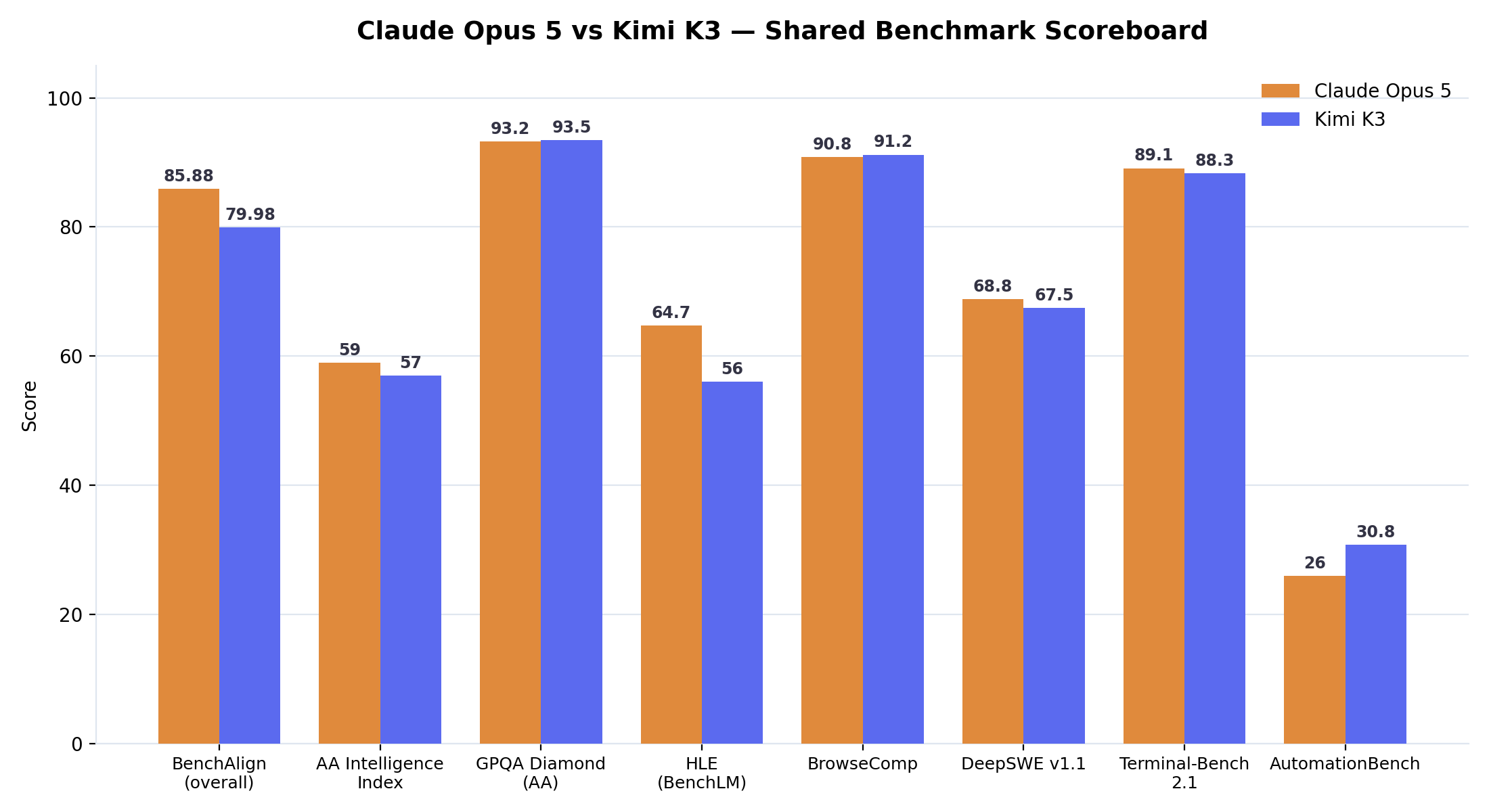
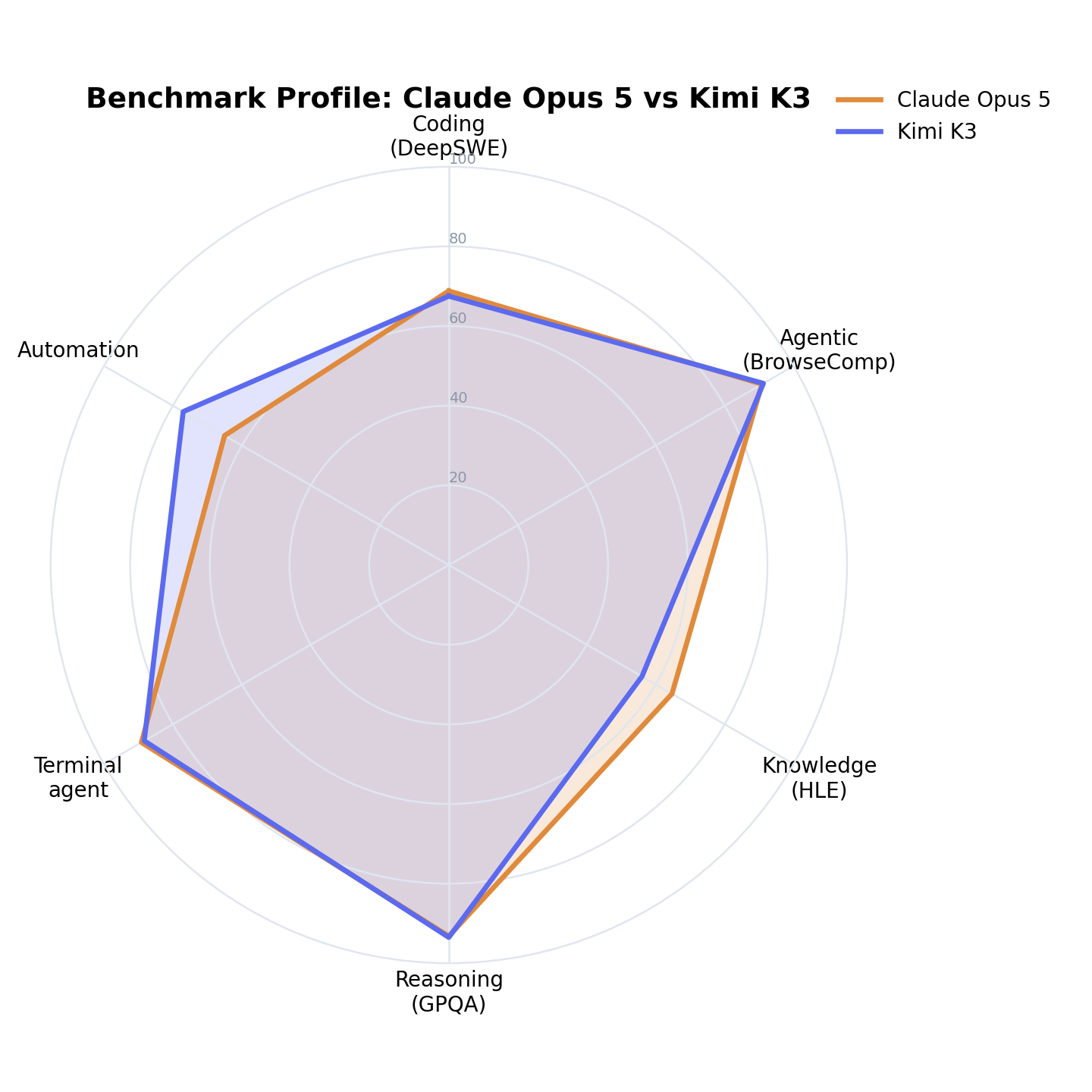
These are the benchmarks where independent trackers, BenchLM and Artificial Analysis, evaluated both models under comparable methodology. BenchLM's page reports 27 shared benchmark results across 5 categories, with Opus 5 ahead in 2 of the 3 comparable categories and Kimi K3 taking multimodal and grounded tasks.
| Benchmark | What It Measures | Claude Opus 5 | Kimi K3 | Delta | Winner |
|---|---|---|---|---|---|
| BenchAlign (overall) | Weighted aggregate, 8 categories | 85.88 | 79.98 | +5.9 | Opus 5 |
| HLE | Humanity's Last Exam (BenchLM-comparable) | 64.7% | 56.0% | +8.7 | Opus 5 |
| AA Intelligence Index | Composite reasoning + knowledge | 59 | 57 | +2 | Opus 5 |
| DeepSWE v1.1 | Long-horizon engineering | 68.8% | 67.5% | +1.3 | Opus 5 |
| Terminal-Bench 2.1 | CLI agent tasks | 89.1% | 88.3% | +0.8 | Opus 5 |
| GPQA Diamond | Graduate-level science Q&A | 93.2% | 93.5% | -0.3 | Kimi K3 |
| BrowseComp | Agentic web browsing | 90.8% | 91.2% | -0.4 | Kimi K3 |
| AutomationBench | End-to-end business automation | 26.0% | 30.8% | -4.8 | Kimi K3 |
| Output speed | Tokens/second (standard) | 58 tok/s | 32 tok/s | 1.8x | Opus 5 |
| Time to first token | Latency to start responding | 21.7s | 164.6s | 7.6x | Opus 5 |
| Blended cost per 1M tokens | 7:2:1 cache/input/output ratio | $3.85 | $2.31 | -40% | Kimi K3 |
Provider-Reported Scores: Same Benchmark Names, Different Harnesses
Beyond the independently-verified overlap, both companies separately publish scores on benchmarks with matching names, but under their own harnesses, effort settings, and (in some cases) different benchmark versions. Treat these as directional, not strictly apples-to-apples.
| Benchmark | Claude Opus 5 | Source | Kimi K3 | Source |
|---|---|---|---|---|
| SWE-bench Verified | 96.0% | Anthropic system card | Not published | - |
| SWE-bench Pro | 79.2% | Anthropic system card | Not published | - |
| ProgramBench | 83.0% (ep. 1) / 93.0% (ep. 5) | Anthropic system card | 77.8 | Moonshot launch table |
| FrontierBench v0.1 | 43.3% (self) / 43.5% (independent) | Anthropic + official leaderboard | Not tested - absent from leaderboard | - |
| FrontierSWE / FrontierCode | 53.4% (FrontierCode Main) | Anthropic system card | 81.2 (FrontierSWE - different benchmark) | Moonshot launch table |
| SWE Marathon | Not published | - | 42.0 | Moonshot launch table |
| GDPval (Elo) | 1,861 (v2, Artificial Analysis) | Anthropic system card | 1,668 (older scale) | Moonshot launch table |
| MCP Atlas | 85.8% | Anthropic system card | Not published | - |
| OSWorld 2.0 | 70.6% | Anthropic system card | Not published | - |
| Frontend Code Arena | Not published | - | #1, Elo 1,679 | Arena.ai |
The Frontier-Bench Gap Nobody Talks About
Here's a fact that's easy to miss: Kimi K3 has never been evaluated on Frontier-Bench v0.1 at all. We checked the live leaderboard directly, it currently lists exactly 9 models, all from Anthropic, OpenAI, xAI, and Z.AI. There is no Kimi entry, no Gemini entry, no DeepSeek entry. This isn't a low score being omitted; Moonshot simply hasn't submitted a run.
Claude Opus 5 sits at the top of that board with 43.3% (Anthropic's self-reported number, using mini-SWE-agent on a GKE backend) or 43.5% (plus or minus 1.7%) on the independently-run leaderboard, both comfortably ahead of every other tested model. Until Moonshot publishes a Frontier-Bench run for K3, this remains a benchmark where Opus 5 simply has no competition to report.
Where Kimi K3 Fights Back
1. Open Weights: The Structural Advantage
This is the single biggest difference that no benchmark table captures. Kimi K3 ships as open weights under a Modified MIT license. Enterprises can self-host it, fine-tune it, run it air-gapped, or audit its behavior directly. Claude Opus 5 is API-only, Anthropic controls every aspect of deployment, pricing, and access. For teams with data-sovereignty requirements, regulatory constraints, or a strategic aversion to vendor lock-in, K3's license alone can outweigh a benchmark deficit.
2. Price: Nearly 40% Cheaper, Consistently
Kimi K3 costs $3/$15 per million input/output tokens against Opus 5's $5/$25, a straight 40% discount on both ends. Artificial Analysis's blended cost metric (a realistic 7:2:1 cache/input/output mix) puts K3 at $2.31 per million tokens versus Opus 5's $3.85. At high volume, that gap compounds fast, and it's before accounting for K3's self-hosting option, which can push the marginal cost even lower for teams with existing GPU capacity.
3. GPQA Diamond and BrowseComp: Narrow but Real Wins
K3 edges Opus 5 on GPQA Diamond (93.5% vs 93.2%), graduate-level physics, chemistry, and biology questions designed to resist simple lookup, and on BrowseComp (91.2% vs 90.8%), a test of multi-step agentic web research. Both margins are inside typical run-to-run variance, but they establish that K3 isn't just cheap, it's genuinely competitive on some of the hardest knowledge and agentic evaluations that exist.
Where Claude Opus 5 Wins Decisively
1. The Independent Aggregate: 85.88 vs 79.98
BenchLM's cross-model aggregate, built from 27 shared benchmark results, puts Opus 5 nearly 6 points ahead. Opus 5's sharpest edge is in the knowledge category (64.7 average vs 61 for K3), and the single largest benchmark swing on the page is HLE: 64.7% for Opus 5 versus 56% for K3, an 8.7-point gap on one of the hardest expert-reasoning tests available.
2. Real-World Coding: SWE-bench Pro and DeepSWE
Opus 5 scores 79.2% on SWE-bench Pro, 1,865 real GitHub issues from actively maintained repositories. Kimi K3 has not published a comparable SWE-bench Pro score at all; Moonshot's own comparison table favors benchmarks like Program Bench and FrontierSWE instead. On the benchmark both companies do report, DeepSWE v1.1, Opus 5 edges ahead 68.8% to 67.5%.
3. Speed: Nearly 2x the Throughput, 7.6x Faster to First Token
Opus 5 generates roughly 58 tokens per second against K3's 32, a meaningful gap for interactive coding sessions. The latency difference is more dramatic still: Opus 5's time-to-first-token clocks in around 21.7 seconds at high effort, while K3 takes roughly 164.6 seconds to start responding under the same Artificial Analysis methodology. For latency-sensitive workflows, live pair-programming, interactive debugging, chat-based tools, that's the difference between a responsive assistant and a frustrating wait.
Pricing Breakdown
| Pricing Tier | Claude Opus 5 | Kimi K3 |
|---|---|---|
| Input (per 1M tokens) | $5.00 | $3.00 |
| Output (per 1M tokens) | $25.00 | $15.00 |
| Cached input (per 1M tokens) | $0.50 | $0.30 |
| Blended cost (7:2:1 ratio) | $3.85 | $2.31 |
| Fast/priority mode | $10/$50 (2.5x speed) | Not offered |
| Self-hosting option | Not available | Yes (open weights) |
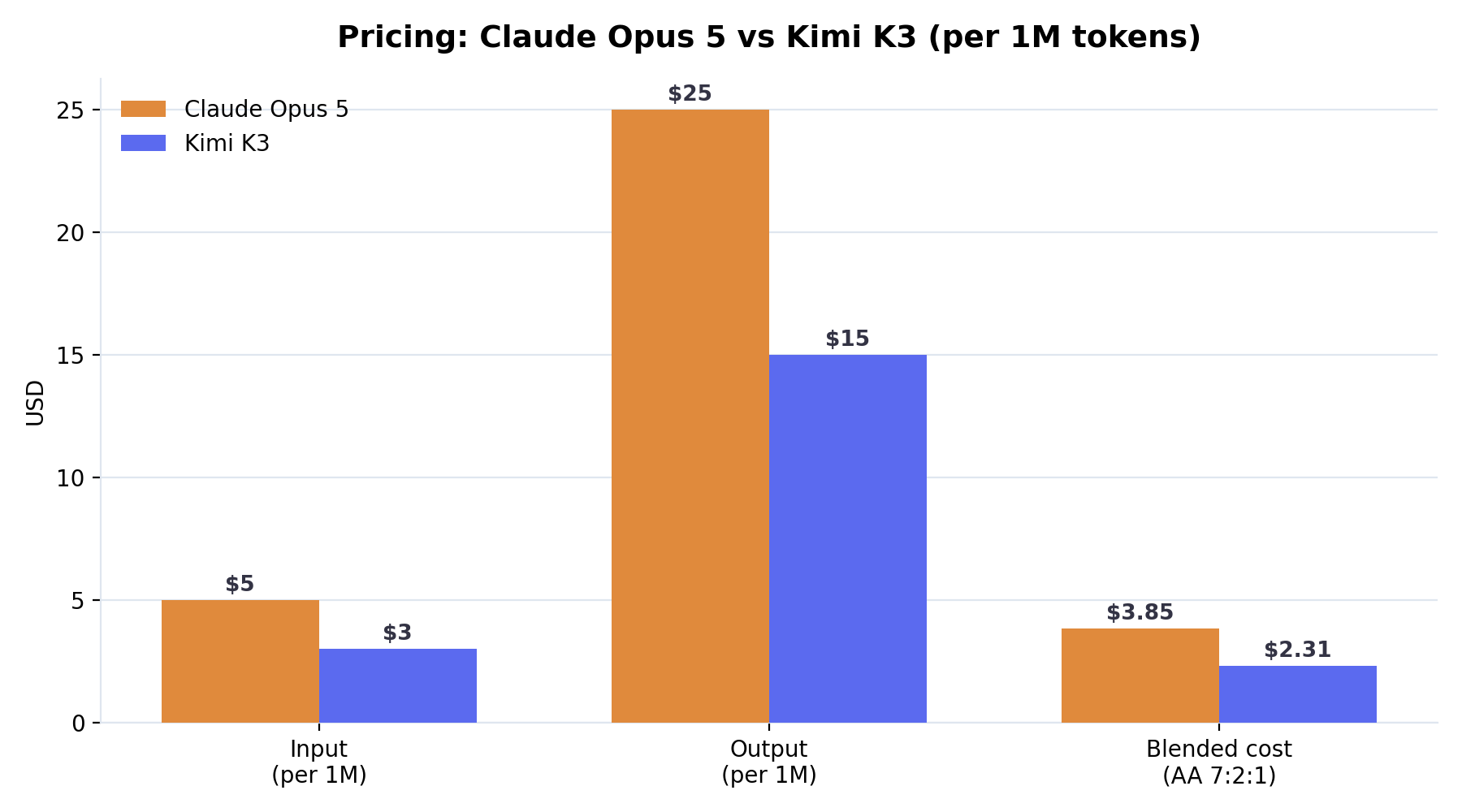
At 100M output tokens a month, Opus 5 costs $2,500,000 in raw output tokens versus K3's $1,500,000, a $1,000,000/month gap at that hypothetical volume. Most teams operate at far smaller scale, but the ratio holds: K3 is consistently 40% cheaper on list price and roughly 40% cheaper on Artificial Analysis's blended real-world metric too. See our interactive pricing calculator to run your own volume scenarios across 38+ models.
Architecture and Ecosystem
Claude Opus 5
- Claude Code - Anthropic's native agentic coding CLI, deeply integrated with Opus 5's adaptive reasoning ladder.
- Effort ladder - Full control: low to medium to high to xhigh to max, trading latency for capability per request.
- Fast Mode - 2.5x standard speed at 2x price, available today with no special deployment.
- Mid-conversation tool changes (beta) - Add/remove tools between turns without invalidating the prompt cache.
- No mandatory data retention - a meaningful factor for regulated industries.
Kimi K3
- Open weights - full model weights downloadable under a Modified MIT license (from July 27, 2026), enabling self-hosting and fine-tuning.
- KimiCode harness - Moonshot's own agentic coding tooling, used to produce most of its launch-table scores.
- Kimi Delta Attention - a hybrid linear-attention mechanism Moonshot claims delivers 6.3x faster decoding versus a standard transformer at equivalent scale.
- Native vision - image and (per some reports) video understanding built into the base model, not bolted on.
- MoE efficiency - 2.8T total parameters with only about 32B active per token (16 of 896 experts), which is what makes the aggressive pricing possible in the first place.
Honesty About Evidence Quality
This comparison leans harder on third-party aggregators than most CodingFleet comparisons, for a simple reason: Opus 5 and K3 launched eight days apart, and neither company's own launch materials benchmark the other. The BenchLM comparison explicitly flags itself as a partial-evidence comparison with only 3 of 8 categories currently scoreable for both models, recommending the verdict be treated as directional rather than definitive. We've followed that guidance here, where scores come from each vendor's own system card rather than a shared harness, we've labeled them as such rather than presenting them as head-to-head results.
The Verdict
| Choose Claude Opus 5 if... | Choose Kimi K3 if... |
|---|---|
| You need the best independently-verified overall score (85.88 vs 79.98) | You want open weights for self-hosting, fine-tuning, or air-gapped deployment |
| You're fixing real bugs in production repositories (SWE-bench Pro) | You want about 40% lower token costs at any volume |
| You need fast, responsive interactive sessions (58 tok/s, 22s TTFT) | You're comfortable with high latency in exchange for a lower bill |
| You want the current #1 Frontier-Bench score, with no direct rival tested | Your workload leans on GPQA-style science reasoning or agentic browsing |
| You need zero mandatory data retention for compliance | Vendor lock-in avoidance is a strategic priority |
| You want a mature, effort-tunable reasoning ladder | You're building on a budget and can tolerate a less mature tool ecosystem |
Bottom Line
Claude Opus 5 is the stronger model on the numbers that matter most for professional coding and knowledge work. It leads the independent BenchLM aggregate by nearly 6 points, wins SWE-bench Pro and DeepSWE outright, runs almost twice as fast, and sits alone atop Frontier-Bench v0.1, a benchmark Kimi K3 has yet to even attempt.
Kimi K3 is the more disruptive product, not the better one. At roughly 40% lower prices, with open weights Anthropic will never offer, and genuinely competitive scores on GPQA Diamond and BrowseComp, it's a serious option for teams that value cost control, self-hosting, and independence over squeezing out the last few benchmark points. For raw capability per dollar spent on infrastructure you control, K3 is arguably the more interesting model of the two, it just isn't the more capable one on the evidence available today.
For most production coding workflows, Opus 5 remains the safer default. But if your team can self-host, or if a 40% cost reduction changes your unit economics, Kimi K3 deserves a serious evaluation. Try both models on CodingFleet to see which one wins on your actual code.
Sources: Anthropic Opus 5 announcement, Opus 5 system card, BenchLM: Claude Opus 5 vs Kimi K3, Artificial Analysis model comparison, Frontier-Bench v0.1 leaderboard, Moonshot AI Kimi K3 launch materials. Prices verified against official API documentation as of July 28, 2026.