July 2026 has been the most intense month in AI history. Google DeepMind launched Gemini 3.6 Flash on July 21 — a token-efficient workhorse with a 1M context window and 17% fewer output tokens than its predecessor. Just twelve days earlier, on July 9, OpenAI released the GPT-5.6 family: Sol (flagship), Terra (balanced), and Luna (budget). GPT-5.6 Terra is the middle child — positioned as "GPT-5.5-class performance at half the cost" and aimed squarely at everyday coding, reasoning, and agentic workloads.
Both models sit in the mid-tier sweet spot. Both have 1M-token context windows. Both are priced for production scale. But which one actually delivers more? We dug into every official benchmark from OpenAI's GPT-5.6 launch page and Google DeepMind's Gemini 3.6 Flash product page — plus independent evaluations from Artificial Analysis, BenchLM, and more. Every number is sourced. No estimates.
📋 Table of Contents
🔬 Head-to-Head: Shared Benchmarks
Both Google and OpenAI publish benchmark tables that allow direct comparison. Google's Gemini 3.6 Flash page compares against GPT-5.6 Luna; OpenAI's GPT-5.6 page publishes full Terra scores. We've cross-referenced both to produce the fairest head-to-head possible.
Coding & Agentic Benchmarks
| Benchmark | 🔵 Gemini 3.6 Flash | 🟢 GPT-5.6 Terra | Winner |
|---|---|---|---|
| SWE-Bench Pro | 58.7% | 63.4% | 🟢 Terra +4.7 |
| DeepSWE v1.1 | 49.0% | 69.6% | 🟢 Terra +20.6 🔥 |
| Terminal-Bench 2.1 | 78.0% | 87.4% | 🟢 Terra +9.4 |
| MLE-Bench | 63.9% | — | 🔵 (Terra N/A) |
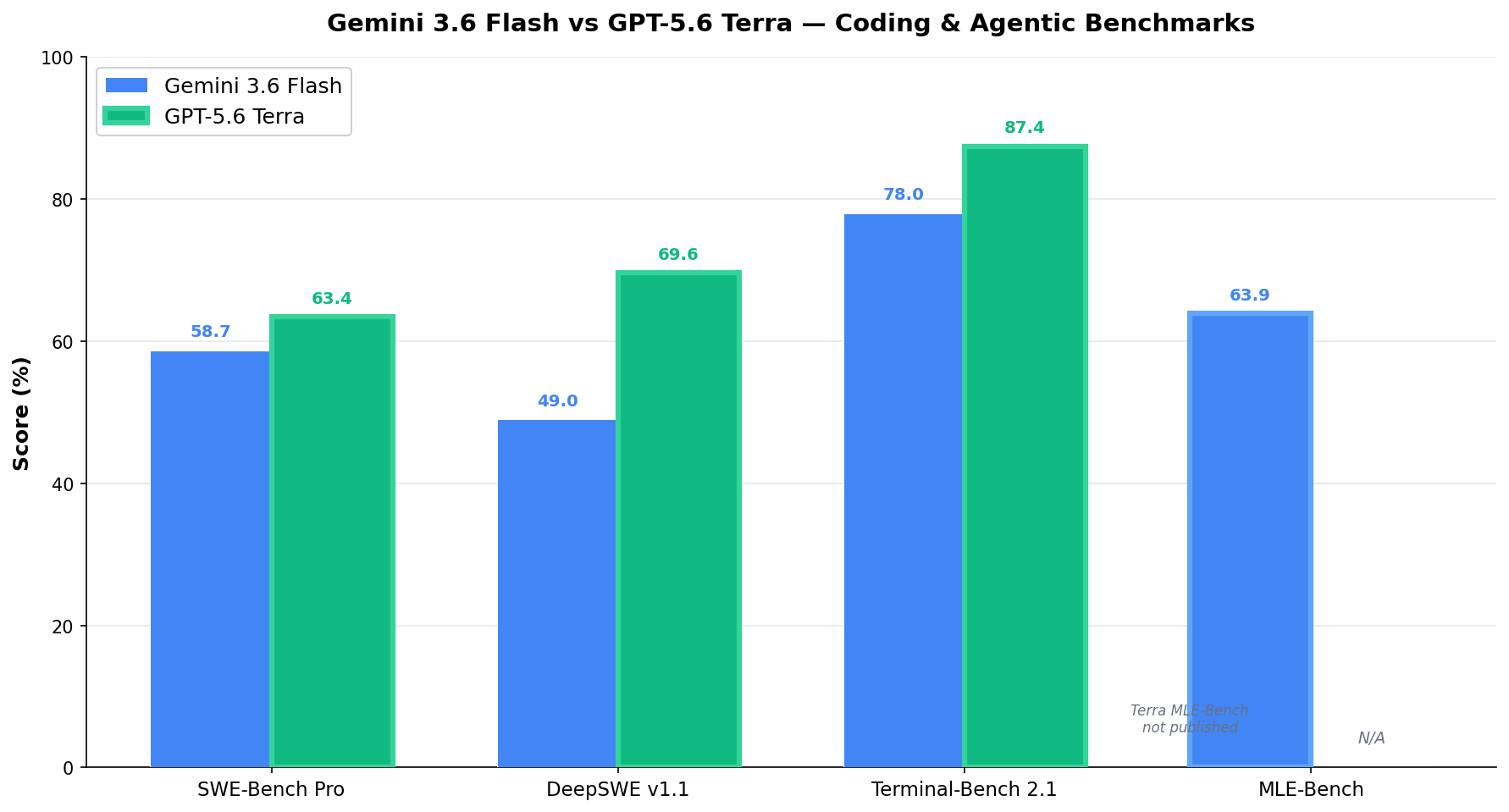
Figure 1: Coding and agentic benchmarks head-to-head. GPT-5.6 Terra leads decisively on all three shared coding benchmarks. MLE-Bench not published for Terra.
GPT-5.6 Terra dominates coding. The DeepSWE gap is particularly brutal — 69.6% vs 49.0%, a 20.6-point chasm. On Terminal-Bench 2.1, Terra's 87.4% is just 1.4 points behind Sol (88.8%) and well ahead of Gemini's 78.0%. This is a model that punches well above its price tier on agentic coding.
Knowledge & Reasoning Benchmarks
| Benchmark | 🔵 Gemini 3.6 Flash | 🟢 GPT-5.6 Terra | Winner |
|---|---|---|---|
| GDPval-AA v2 (Elo) | 1,421 | 1,593 | 🟢 Terra +172 |
| AA Intelligence Index | 50.0 | 55.0 | 🟢 Terra +5.0 |
| GPQA Diamond | — | 92.9% | 🟢 (Gemini N/A) |
| Agents' Last Exam | — | 50.4% | 🟢 (Gemini N/A) |
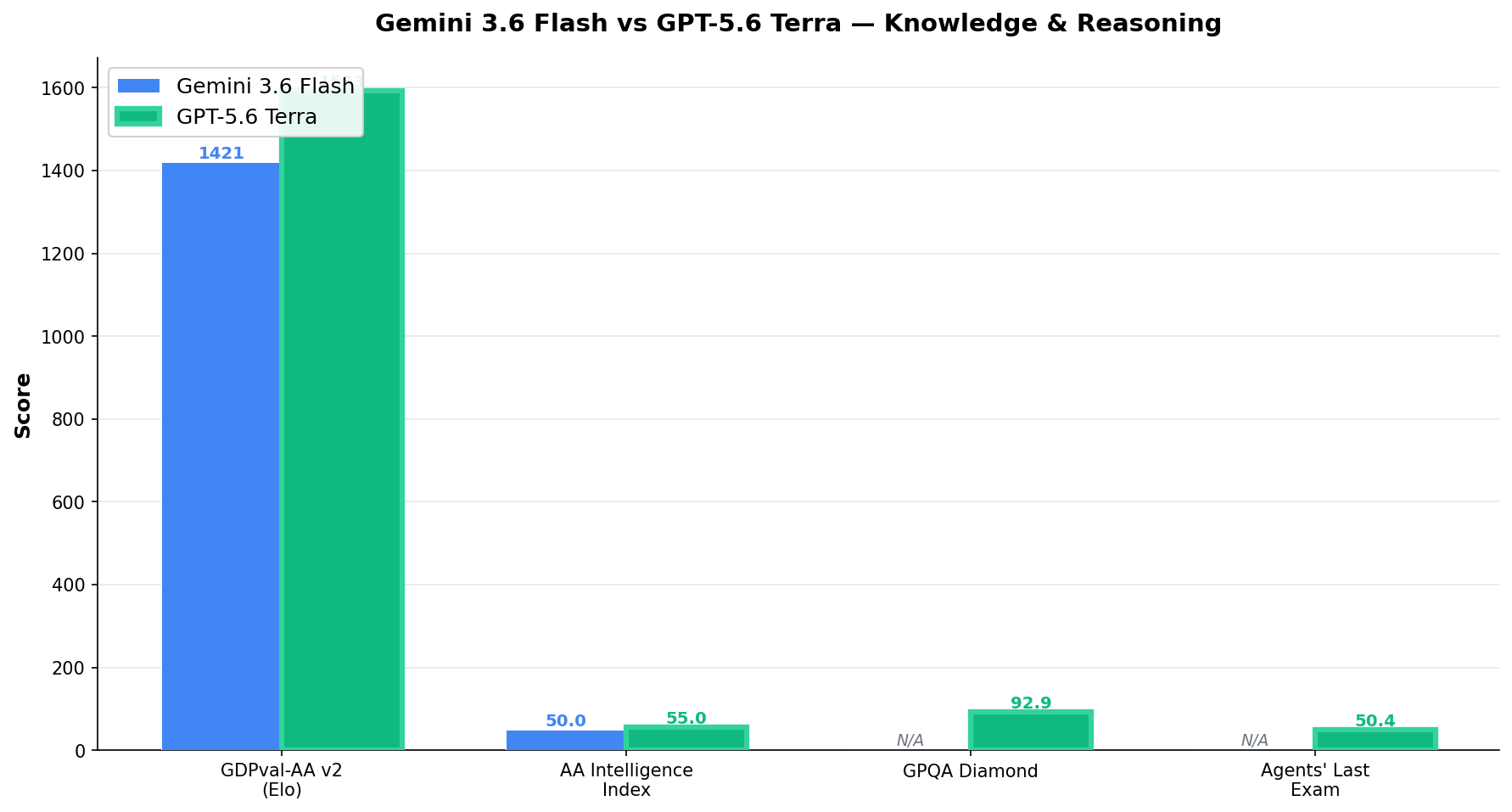
Figure 2: Knowledge and reasoning benchmarks. GPT-5.6 Terra leads on all shared metrics. Gemini 3.6 Flash does not publish GPQA Diamond or Agents' Last Exam scores.
On knowledge work, Terra's 1,593 GDPval-AA Elo is 172 points ahead of Gemini's 1,421. Its 92.9% GPQA Diamond is near the frontier — within 1.7 points of Sol's 94.6%. And on Agents' Last Exam (the successor to HLE, spanning 55 professional fields), Terra scores 50.4%, beating Claude Fable 5's 40.5%.
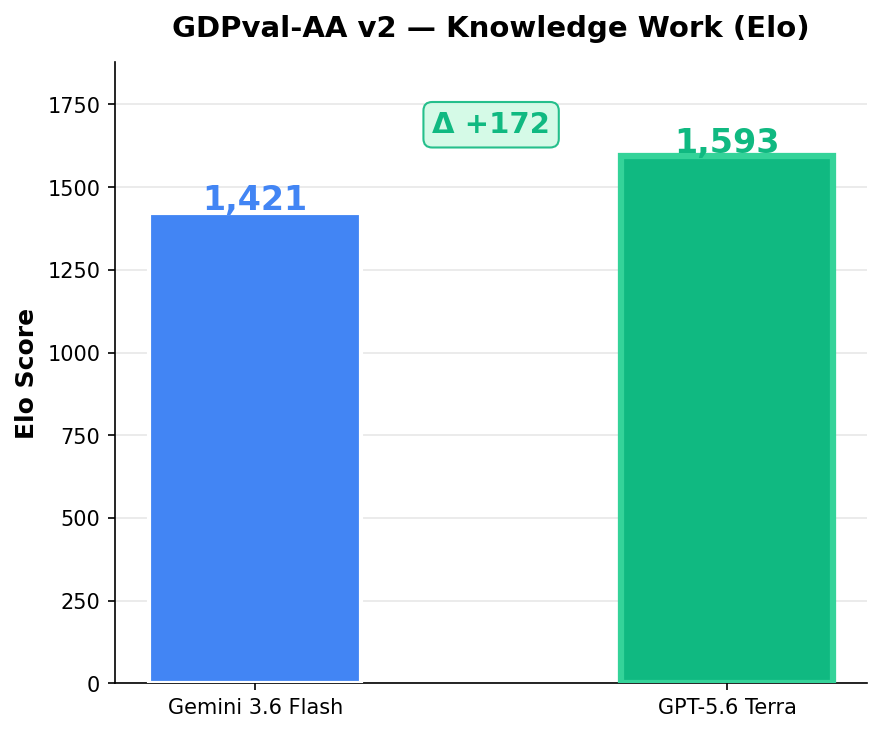
Figure 3: GDPval-AA v2 — Knowledge Work Elo. GPT-5.6 Terra leads by 172 points, a significant margin in Elo terms.
🎯 Capability Radar: Where Each Model Shines
The radar chart below normalizes five shared benchmarks to a 0–100% scale, revealing the capability profile of each model. GPT-5.6 Terra is the larger, more capable shape across the board — particularly on DeepSWE and Terminal-Bench.
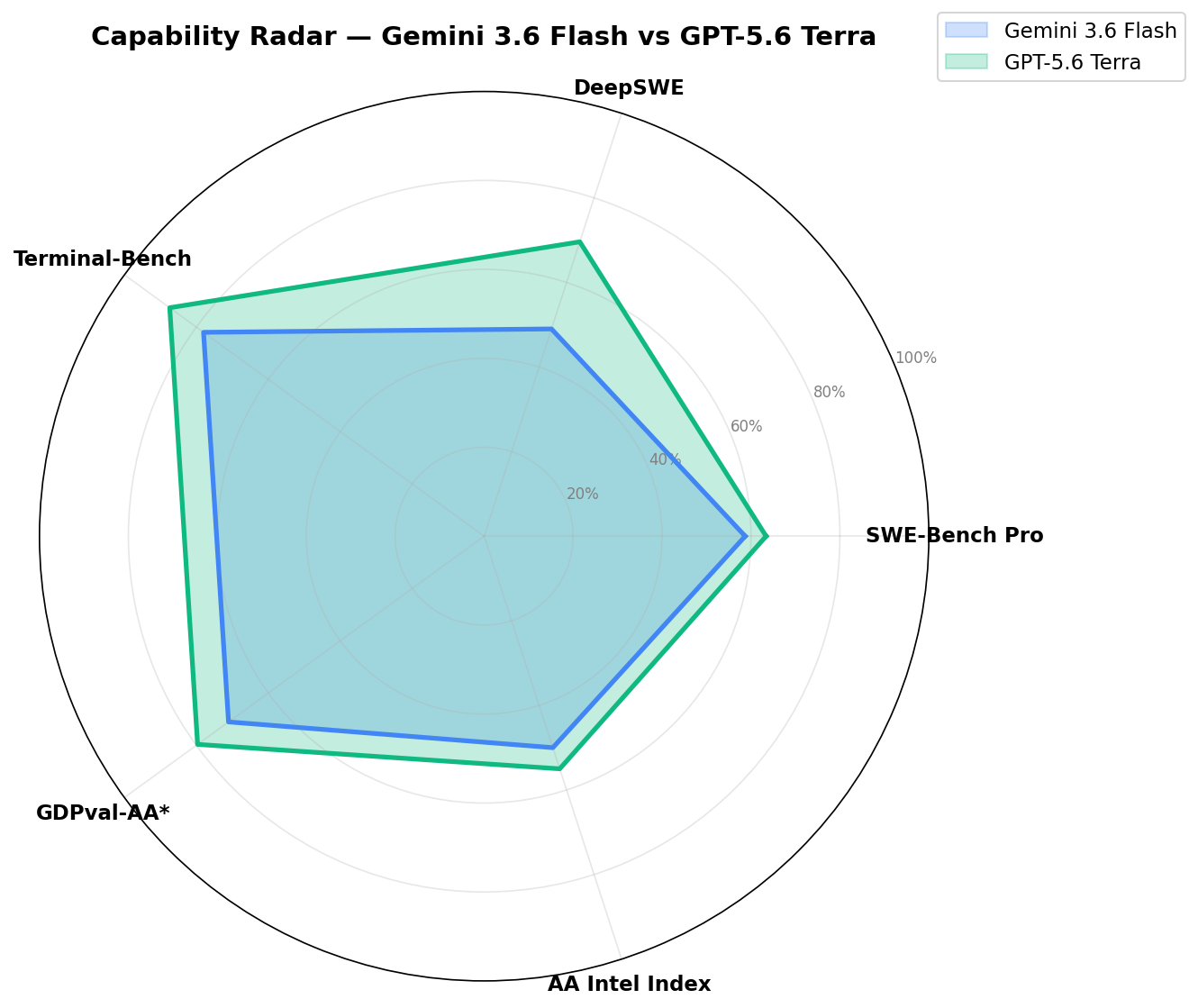
Figure 4: Radar chart. GPT-5.6 Terra (green) envelops Gemini 3.6 Flash (blue) on all five shared dimensions. GDPval-AA normalized to 0-100 scale (÷2000).
💻 Coding & Agentic Performance
This is where the comparison is most lopsided. GPT-5.6 Terra is built on the same architecture as Sol — OpenAI's best coding model ever — and it shows.
GPT-5.6 Terra — Full Coding Benchmarks
| Benchmark | Terra | Sol | Luna | GPT-5.5 |
|---|---|---|---|---|
| AA Coding Agent Index | 77.4 | 80.0 | 74.6 | 76.4 |
| SWE-Bench Pro | 63.4% | 64.6% | 62.7% | 59.4% |
| DeepSWE v1.1 | 69.6% | 72.7% | 67.2% | 67.0% |
| Terminal-Bench 2.1 | 87.4% | 88.8% | 84.7% | 85.6% |
Terra's AA Coding Agent Index of 77.4 is remarkable — it actually beats Claude Fable 5 (77.2), Anthropic's $10/$50 flagship, while costing ~85% less per task. On Terminal-Bench 2.1, Terra's 87.4% is just 1.4 points behind Sol and ahead of GPT-5.5 (85.6%).
Gemini 3.6 Flash's coding story is one of improvement rather than leadership. Its DeepSWE jumped from 37% (3.5 Flash) to 49% — a solid 12-point gain. MLE-Bench rose from 49.7% to 63.9%. But against GPT-5.6 Terra, these gains aren't enough to close the gap.
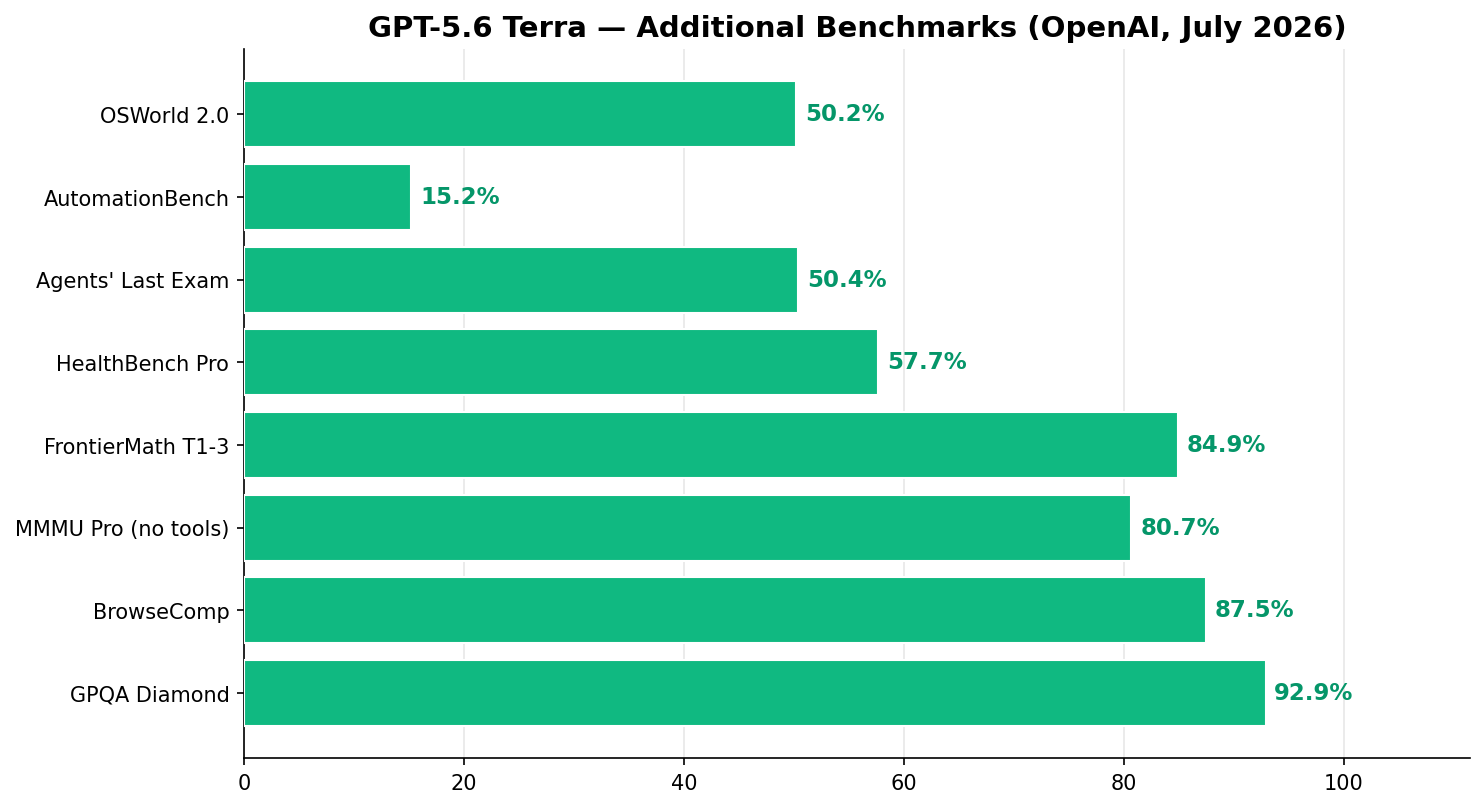
Figure 5: GPT-5.6 Terra's additional benchmarks from OpenAI (July 9, 2026). Note the 92.9% GPQA Diamond and 87.5% BrowseComp — near-frontier scores at mid-tier pricing.
🧠 Knowledge Work & Reasoning
GPT-5.6 Terra's knowledge work capabilities are genuinely impressive for a mid-tier model:
- GPQA Diamond: 92.9% — PhD-level science reasoning. This is within 1.7 points of Sol (94.6%) and ahead of Claude Opus 4.8 (92.0%).
- Agents' Last Exam: 50.4% — The successor to Humanity's Last Exam, spanning 55 professional fields. Terra beats Claude Fable 5 (40.5%) by nearly 10 points.
- FrontierMath Tier 1-3: 84.9% — Competitive math reasoning, just 4.1 points behind Sol (89.0%).
- BrowseComp: 87.5% — Agentic web search and research, ahead of Claude Opus 4.8 (84.3%).
- MMMU Pro: 80.7% — Multimodal college-level reasoning without tools.
Gemini 3.6 Flash doesn't publish GPQA Diamond, Agents' Last Exam, or FrontierMath scores. Its AA Intelligence Index of 50.0 is flat with 3.5 Flash — Google explicitly positioned this as an efficiency release. On knowledge work, Terra is simply in a different league.
👁️ Multimodal, Long Context & Computer Use
This is Gemini 3.6 Flash's territory — and it's the one area where it fights back hard.
Multimodal Input
Gemini 3.6 Flash accepts text, images, audio, video, and PDFs natively. GPT-5.6 Terra is text-plus-image. For workflows involving audio transcription, video analysis, or PDF processing, Gemini is the only option without additional tooling.
Long Context Retrieval
On GDM-MRCR v2 at 128k tokens, Gemini scores 91.8%. GPT-5.6 Terra scores 89.6% on OpenAI's MRCR v2 at 256k-512k — close but not directly comparable (different harness, different depth). At the full 1M token depth, Gemini scores 54.0% while Terra scores 72.5% on OpenAI's MRCR v2 at 512k-1M. The different evaluation methodologies make direct comparison difficult, but both models demonstrate strong long-context capabilities.
Computer Use
On OSWorld-Verified, Gemini scores 83.0%. GPT-5.6 Terra scores 50.2% on the newer OSWorld 2.0 — a different, harder version of the benchmark. These aren't directly comparable, but Gemini's 83.0% on the established benchmark is a strong result for GUI automation.
Chart Reasoning
On CharXiv Reasoning, Gemini scores 85.2% without tools and 89.4% with tools. GPT-5.6 Terra does not publish a CharXiv score, but its MMMU Pro (80.7%) suggests strong visual reasoning capabilities.
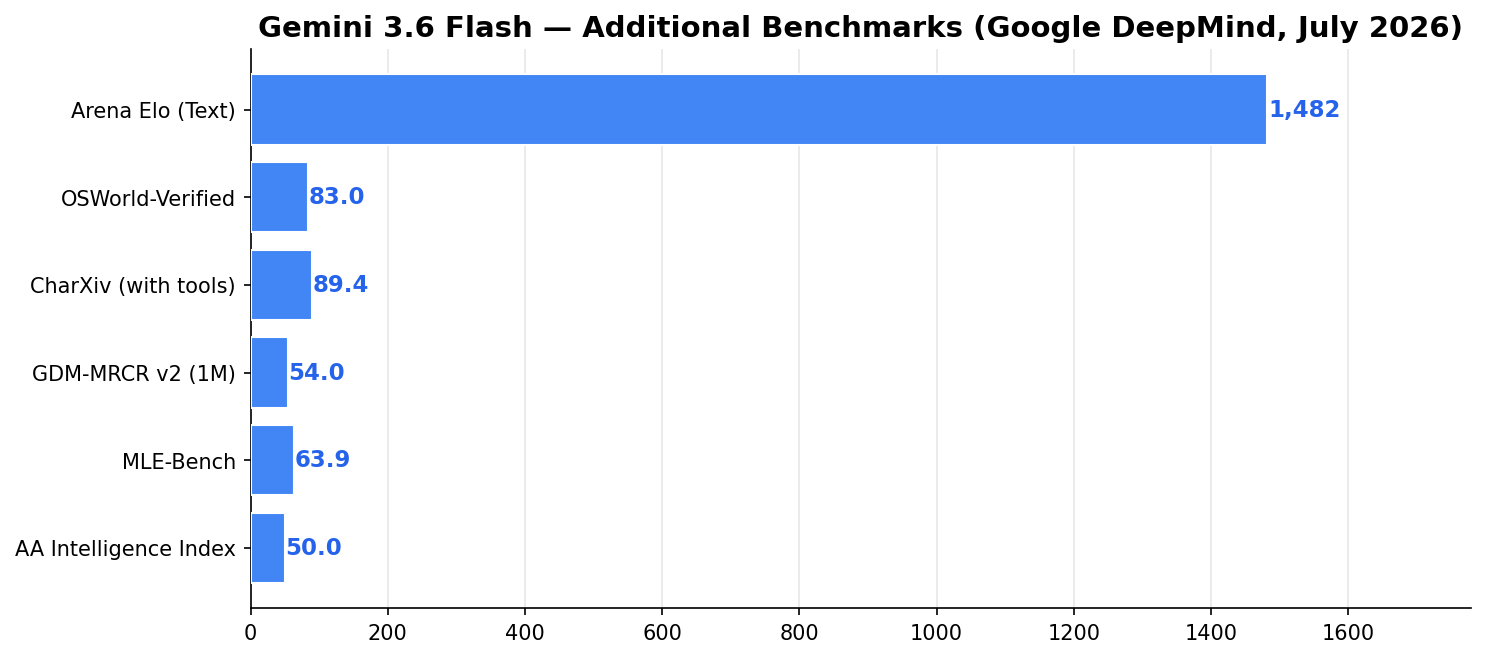
Figure 6: Gemini 3.6 Flash's additional benchmarks from Google DeepMind (July 21, 2026). Note the 91.8% long-context retrieval and 89.4% CharXiv with tools — both best-in-class.
💰 Pricing & Token Economics
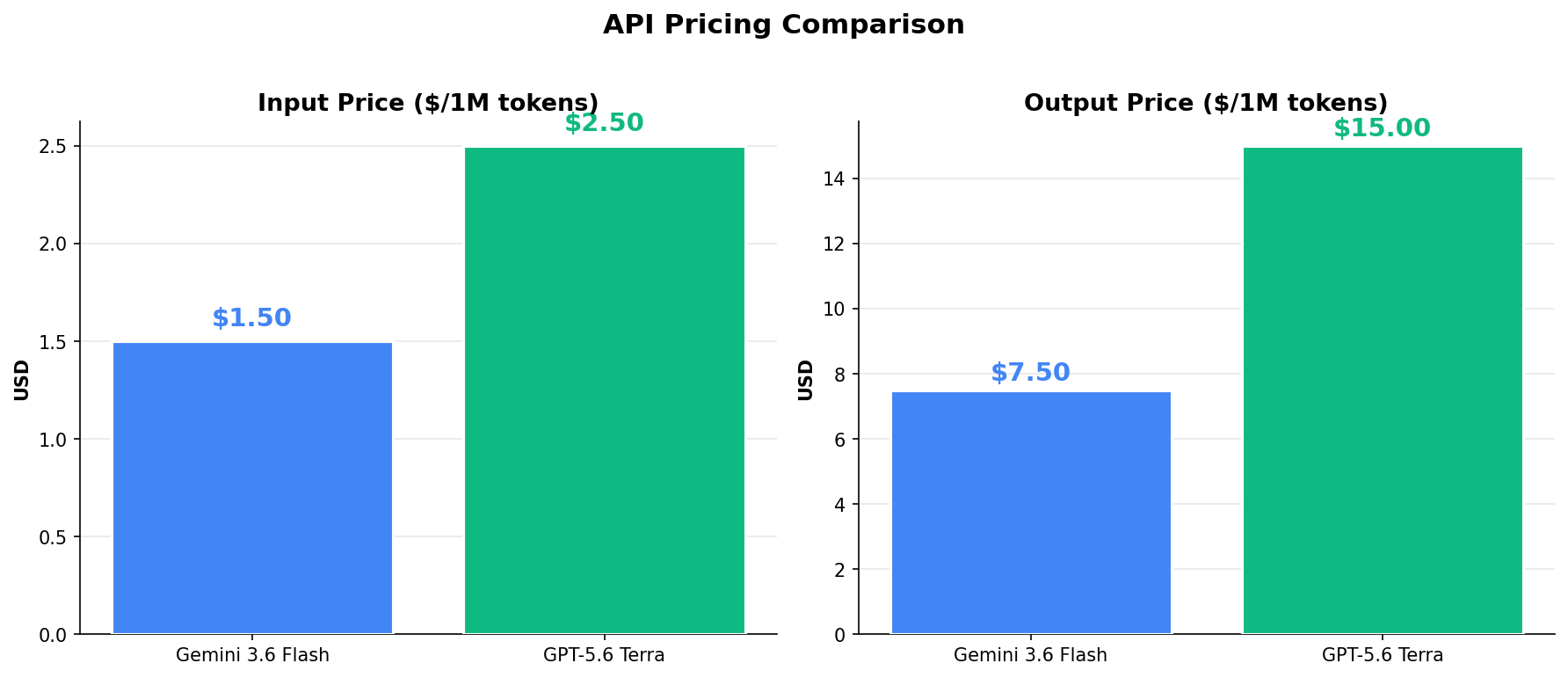
Figure 7: API pricing comparison. Gemini 3.6 Flash is cheaper on both input and output.
| Pricing Factor | 🔵 Gemini 3.6 Flash | 🟢 GPT-5.6 Terra |
|---|---|---|
| Input ($/1M tokens) | $1.50 | $2.50 |
| Output ($/1M tokens) | $7.50 | $15.00 |
| Cached Input ($/1M) | $0.15 | $0.25 |
| Context Window | 1,048,576 tokens | 1,000,000 tokens |
| Max Output | 65,536 tokens | 128,000 tokens |
| Token Efficiency | ~17% fewer tokens vs 3.5 Flash | Efficient by default (OpenAI) |
| Effective Cost/Task | 💰 Lower | 💰💰 Higher |
Gemini 3.6 Flash is cheaper on a per-token basis — $1.50/$7.50 vs $2.50/$15.00. That's 40% cheaper on input and 50% cheaper on output. With ~17% fewer output tokens per task, the real-world cost gap widens further.
However, cost-per-task isn't the same as cost-per-token. Per Artificial Analysis, GPT-5.6 Terra completes tasks in roughly one-third the time of Claude Fable 5 with about half the output tokens. If Terra is similarly efficient vs Gemini, the per-task cost gap may be narrower than the per-token prices suggest. But without direct task-level cost comparisons, Gemini holds the clear sticker-price advantage.
One advantage for Terra: 128,000 max output tokens vs Gemini's 65,536 — double the headroom for long generations.
📋 Specifications at a Glance
| Specification | 🔵 Gemini 3.6 Flash | 🟢 GPT-5.6 Terra |
|---|---|---|
| Release Date | July 21, 2026 | July 9, 2026 |
| Developer | Google DeepMind | OpenAI |
| Context Window | 1,048,576 tokens | 1,000,000 tokens |
| Max Output | 65,536 tokens | 128,000 tokens |
| Input Modalities | Text, Image, Audio, Video, PDF | Text, Image |
| Knowledge Cutoff | March 2026 | February 2026 |
| Reasoning | Configurable (thinking budget) | Effort dial (low→max) |
| API Model ID | gemini-3.6-flash | gpt-5.6-terra |
| AA Intelligence Index | 50.0 | 55.0 |
| BenchLM Overall | 75.3 (#9) | 71.99 (#12) |
🏆 The Verdict
This is a more decisive comparison than most. GPT-5.6 Terra is the stronger model on nearly every measurable dimension — but Gemini 3.6 Flash has clear strengths that matter for specific workloads.
🔵 Choose Gemini 3.6 Flash if…
- Multimodal is critical — you process audio, video, or PDFs natively
- Cost is the top priority — 40-50% cheaper per token than Terra
- Long-context retrieval — 91.8% at 128k is best-in-class
- Computer use / GUI agents — 83.0% on OSWorld-Verified
- Chart-heavy analysis — 89.4% CharXiv with tools
- You need the Google ecosystem — Search grounding, Vertex AI, Gemini app
🟢 Choose GPT-5.6 Terra if…
- Agentic coding is your focus — 87.4% Terminal-Bench, 69.6% DeepSWE
- Knowledge work quality matters — 1,593 GDPval-AA, 92.9% GPQA Diamond
- You need deep reasoning — 50.4% Agents' Last Exam, 84.9% FrontierMath
- Long output generation — 128K max output vs 64K
- You want near-Sol quality at half the price — Terra is remarkably close to the flagship
- You're in the OpenAI ecosystem — Codex, ChatGPT, Responses API, multi-agent
Bottom Line
GPT-5.6 Terra is the stronger model for coding, reasoning, and knowledge work. It leads on every shared benchmark where both models publish scores — often by substantial margins (20.6 points on DeepSWE, 172 Elo on GDPval-AA). The fact that a $2.50/$15 mid-tier model posts a 92.9% GPQA Diamond and beats Claude Fable 5 on the AA Coding Agent Index is genuinely remarkable.
Gemini 3.6 Flash wins on multimodal breadth, long-context retrieval, and price. It's the only model that handles audio and video natively. Its 91.8% long-context retrieval is unmatched. And at $1.50/$7.50 per million tokens, it's the more economical choice for high-volume, multimodal workloads.
The real story here is how good the mid-tier has become. GPT-5.6 Terra delivers capability that would have required flagship pricing ($5/$30+) just weeks ago. Gemini 3.6 Flash delivers multimodal intelligence at a price point that makes it viable for nearly any production workload. You no longer need a flagship model to do serious work. The question is simply which mid-tier model fits your specific needs.
📚 Sources
- OpenAI — GPT-5.6: Frontier intelligence that scales with your ambition (official benchmark tables, July 9, 2026)
- Google DeepMind — Gemini 3.6 Flash product page (benchmark table, July 2026)
- Gemini 3.6 Flash Model Card (Google DeepMind, July 2026)
- Artificial Analysis — GPT-5.6 benchmarks across Intelligence, Speed and Cost (July 9, 2026)
- GPT-5.6 Sol vs Terra vs Luna: Which Tier Should You Choose? (Vellum, July 2026)
- BenchLM — GPT-5.6 Terra (July 2026)
- BenchLM — Gemini 3.6 Flash (July 2026)
- GPT-5.6 Pricing 2026: Sol, Terra and Luna Tiers Explained (Finout, July 2026)
- Gemini 3.6 Flash Debuts: 17% Cheaper, 12-Point Gain (Tech Insider, July 2026)
- Google Released Gemini 3.6 Flash (DataNorth, July 22, 2026)
- The new GPT-5.6 family: Luna, Terra, Sol (Simon Willison, July 9, 2026)
- Artificial Analysis — GDPval-AA v2 Leaderboard (July 2026)