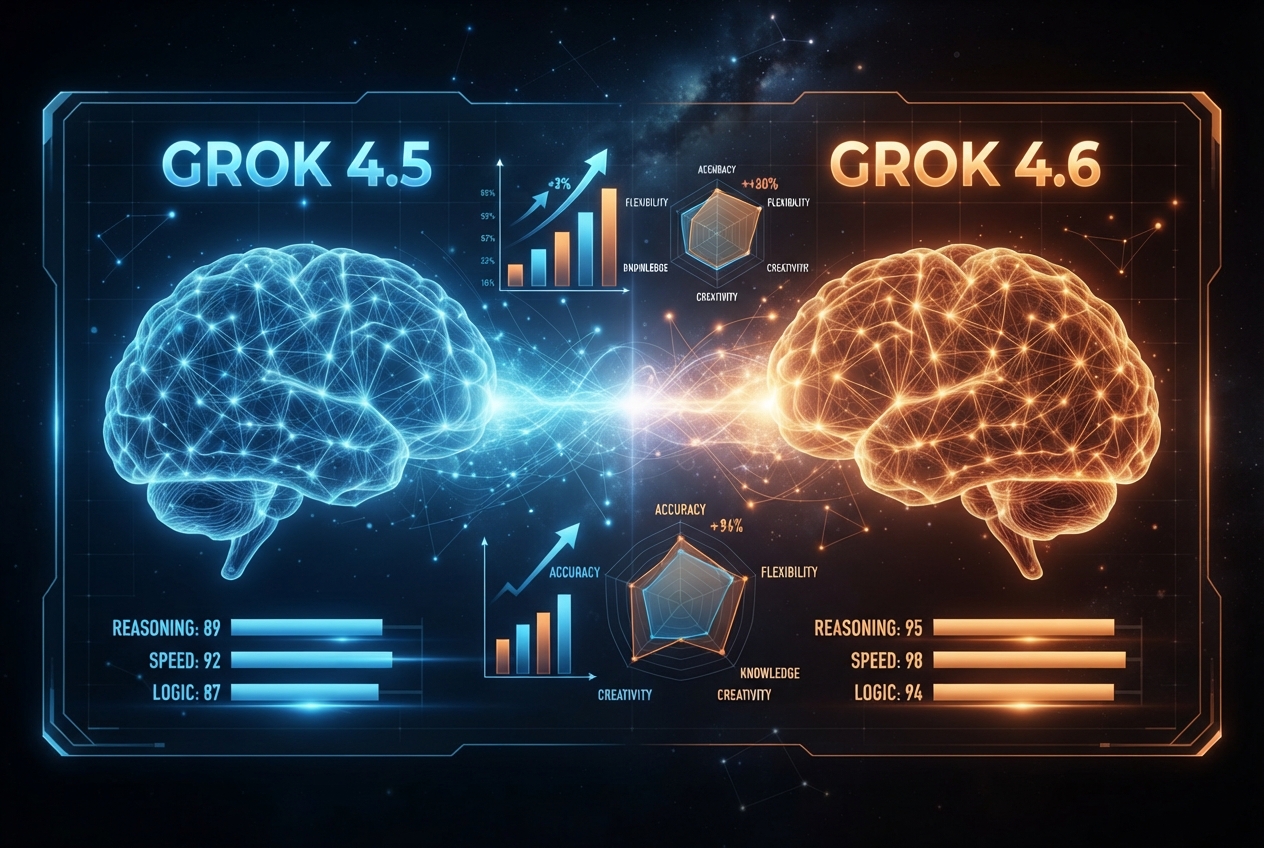
Grok 4.6 launched on August 12, 2026, just five weeks after Grok 4.5 (July 8, 2026). Unlike a typical "bigger model" release, Grok 4.6 is a post-training refresh at the same scale — same 500K context window, same headline price — but with a sharpened focus on long-running agents and ambitious interactive and visual work.
This guide compares the two models across every dimension that matters: benchmark scores, pricing, output speed, latency, and context. All figures are drawn from xAI's official launch materials, Artificial Analysis, and independent third-party reviews.
At a Glance
| Category | Grok 4.5 | Grok 4.6 |
|---|---|---|
| Release date | July 8, 2026 | August 12, 2026 |
| Best fit | Fast coding, engineering, agent tasks | Long-running agents, visual & interactive projects |
| Context window | 500,000 tokens | 500,000 tokens |
| Modalities | Text + image in → text out | Text + image in → text out |
| Reasoning effort | Low, medium, high | Low, medium, high, xhigh |
| Input price | $2 / 1M tokens | $2 / 1M tokens |
| Output price | $6 / 1M tokens | $6 / 1M tokens |
| Cached input | $0.30 / 1M tokens | $0.50 / 1M tokens |
| Model ID | grok-4.5 | grok-4.6 |
Benchmark Comparison
Here is xAI's official launch table, comparing the "High" reasoning setting of both models. Grok 4.6 improves on Grok 4.5 in every single row.
| Evaluation | Grok 4.5 High | Grok 4.6 High | Change |
|---|---|---|---|
| AA Intelligence Index | 56 | 61 | +5 |
| GDPVal-AA v2 | 1526 | 1753 | +227 |
| CursorBench v3.2 | 66.7% | 69.9% | +3.2 pts |
| DeepSWE v1.1 | 54.0% | 65.9% | +11.9 pts |
| FrontierCode v1.1 (Ext) | 56.6% | 61.3% | +4.7 pts |
| APEX-Agents | 47.1% | 57.5% | +10.4 pts |
| Terminal-Bench v3.0 | 15.7% | 26.0% | +10.3 pts |
| APEX-SWE | 53.6% | 56.4% | +2.8 pts |
| AA-Briefcase | 1313 | 1577 | +264 |
| Harvey LAB (Vals) | 12.9% | 15.8% | +2.9 pts |
Source: xAI "Introducing Grok 4.6" (Aug 12, 2026). Scores are vendor-reported; third-party scores are the best of self-reported or publicly available results.
Benchmark Gains Visualized
The gains are uneven. CursorBench improves by a modest 3.2 points, while DeepSWE jumps 11.9 points and Terminal-Bench more than doubles its relative standing (+10.3 points on a 15.7% base). The biggest wins cluster in agentic engineering — exactly the "long-running agent" territory xAI is emphasizing.
Capability Radar
Radar values are normalized (0–100) from the benchmark table for visual comparison only; they are not absolute scores.
Pricing: The Hidden Caveat
Headline pricing is identical — $2/M input and $6/M output below 200K prompt tokens. But two details changed:
- Cached input rose 67%: from $0.30/M (4.5) to $0.50/M (4.6). For cache-heavy agent loops, this is a real cost increase.
- The 200K long-context band: both models double their rates ($4/$12) once a prompt crosses 200K tokens, and the higher rate applies to all tokens in the request — not just the portion above 200K.
| Request band | Input | Cached input | Output |
|---|---|---|---|
| Short context (<200K) | $2 / 1M | $0.50 / 1M | $6 / 1M |
| Long context (≥200K) | $4 / 1M | $1 / 1M | $12 / 1M |
Grok 4.6 also adds a fast variant at 2× the price. The practical takeaway: compare cost per completed task, not cost per token. A model that uses fewer turns and fewer repeated tool calls can be cheaper overall even at a higher cached-input rate.
Speed & Latency
Speed is where the story gets interesting — and slightly counterintuitive. xAI published an 80 tokens/second serving figure for Grok 4.5, but did not publish a comparable standard-throughput figure for 4.6. Independent measurements from Artificial Analysis fill the gap:
| Metric (Artificial Analysis) | Grok 4.5 (high) | Grok 4.6 (high) |
|---|---|---|
| Output speed | 91.3 t/s | 85.8 t/s |
| Time to first answer token | ~17.4 s | 32.3 s |
| Blended price (7:2:1) | $1.35 / 1M | $1.35 / 1M |
Grok 4.6 is slightly slower to generate and noticeably slower to start. Its time-to-first-token nearly doubles (17.4s → 32.3s), reflecting heavier reasoning overhead from the new xhigh setting and longer trajectories. If your workload is latency-sensitive, this is the single most important number to test before migrating.
Context Window: No Change
Both models ship a 500,000-token context window — roughly 375,000 words, enough for entire codebases or long research packets. The upgrade in 4.6 is not more context, but better use of it: xAI reports more self-testing and verification on longer trajectories, meaning the model checks its own work before moving on.
What Actually Changed Under the Hood
Grok 4.6's training differed from 4.5 in three concrete ways:
- Longer supplemental training run with curated model-generated reasoning data, high-quality engineering data, and an improved optimizer.
- Regenerated SFT trajectories — xAI used Grok 4.5 to regenerate supervised fine-tuning data across reasoning, agent harnesses, STEM, and software engineering, then filtered problematic traces with model-based checks.
- Broader agentic RL — including domain-specific environments for kernel optimization, web development, and computer-aided design.
The result is a model that sustains work over many steps, researches unfamiliar domains, and produces stronger first passes on visual and interactive projects.
Verdict: Should You Upgrade?
The right move is not a fleet-wide switch. Replay 10–20 representative tasks on both models, and compare completion quality, tool-call accuracy, total tokens, latency, and error recovery. Migrate only where 4.6 produces a clear operational gain.