TL;DR — The Score
✅ DeepSeek V4 Pro wins: SWE-bench Verified (+2.6), SWE-bench Multilingual, Toolathlon (+3.3), Apex (+12.7), ArxivMath
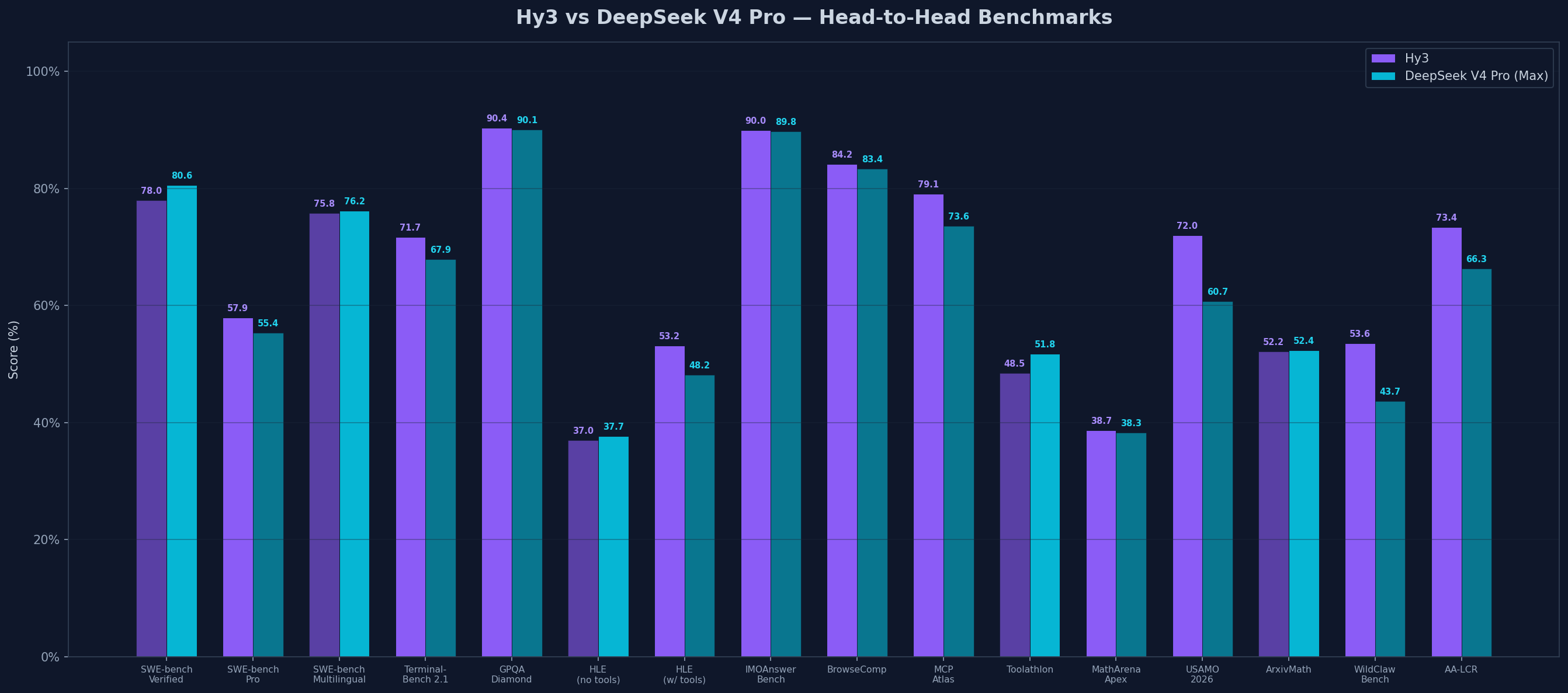
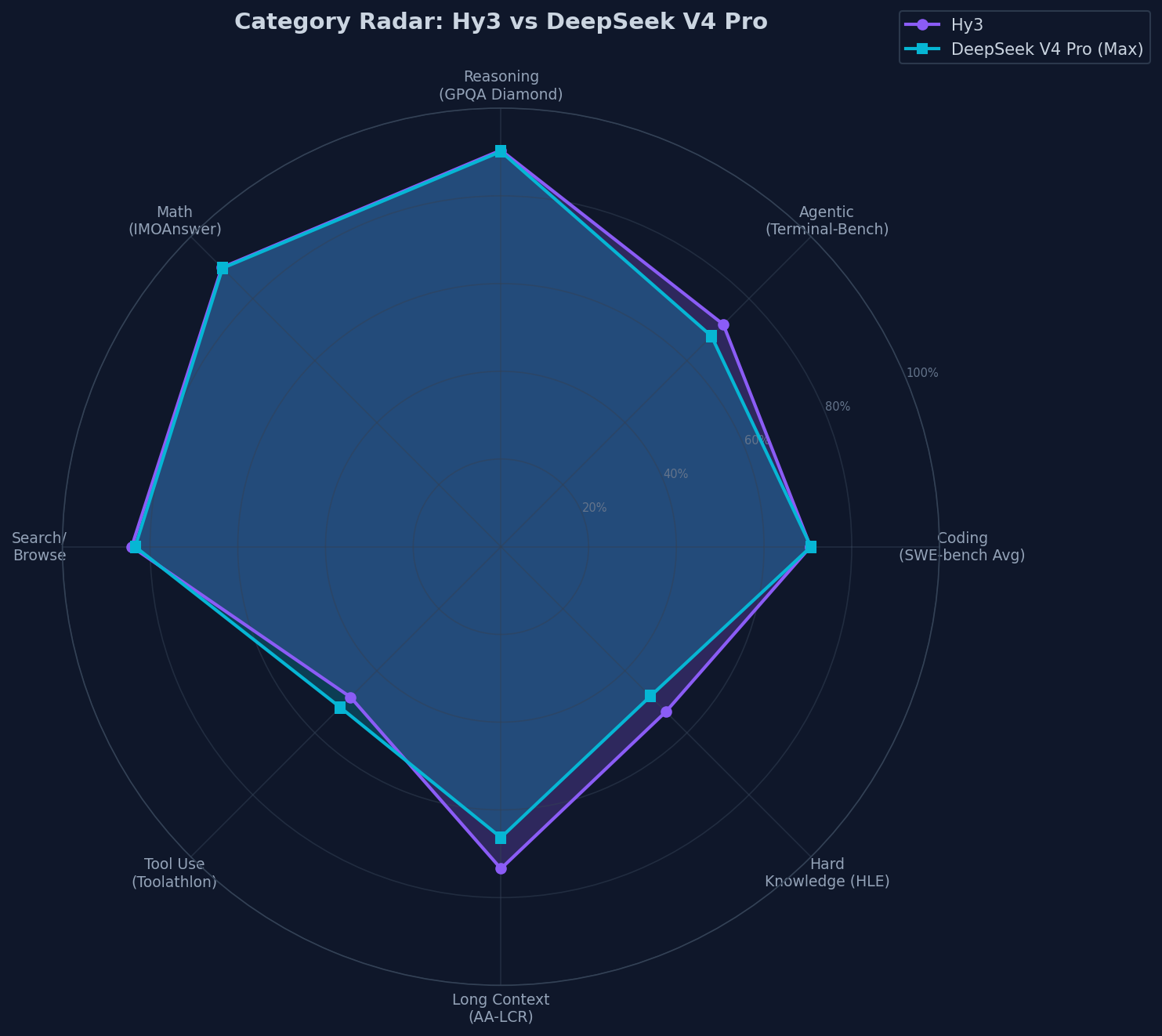
Two open-weight models. Both released within 24 hours of each other in late April 2026. Both Mixture-of-Experts architectures. Both targeting the same developer audience. But after running the numbers across 18 shared benchmarks, the picture is surprisingly clear: Hy3 punches well above its weight class, winning 12 of 18 head-to-head matchups — including the prestigious SWE-bench Pro and Terminal-Bench 2.1.
But it's not that simple. DeepSeek V4 Pro brings a 1M-token context window (4× Hy3's 256K), MIT licensing (vs Tencent's custom license), and a massive 1.6T parameter MoE that absolutely crushes on Apex and Toolathlon.
Let's break down every benchmark, every price point, and every architectural decision that matters.
Architecture & Specs
| Spec | Hy3 | DeepSeek V4 Pro |
|---|---|---|
| Developer | Tencent (Hunyuan) | DeepSeek |
| Release Date | April 23, 2026 | April 24, 2026 |
| Total Parameters | 295B | 1,600B (1.6T) |
| Active Parameters | 21B | 49B |
| Architecture | MoE — 192 experts, top-8 | MoE — CSA + HCA hybrid attention |
| Context Window | 256K tokens | 1M tokens |
| Max Output Tokens | 131K | 384K |
| Reasoning Modes | No-think, Low, High | Non-Think, Think High, Think Max |
| Multimodal Input | Text-only | Text-only |
| License | Tencent Hy Community License | MIT |
| Open Weights | ✅ Yes | ✅ Yes |
| API Input (cache miss) | $0.18 / 1M tokens | $0.435 / 1M tokens |
| API Input (cache hit) | $0.06 / 1M tokens | $0.0036 / 1M tokens |
| API Output | $0.59 / 1M tokens | $0.87 / 1M tokens |
| Output Speed | ~176 tok/s | ~67 tok/s |
The numbers tell a fascinating story. DeepSeek V4 Pro is the heavyweight — 5.4× more total parameters, 2.3× more active parameters per token. It deploys a hybrid attention architecture (CSA + HCA) that makes 1M-token inference economically viable at just 27% of V3.2's FLOPs. The MIT license means you can literally do anything with it — fine-tune, commercialize, redistribute.
Hy3 is the efficiency champion. With just 21B active parameters (less than half of V4 Pro's 49B), it delivers competitive or superior results on most benchmarks. It's also 2.6× faster at output generation and cheaper on fresh input and output tokens (though V4 Pro's disk caching at $0.0036/M is unbeatable for repeated contexts). Tencent rebuilt their entire training infrastructure from scratch to ship this model in under 90 days — and it shows.
Coding & Agentic Benchmarks
SWE-bench Family
The SWE-bench suite is the gold standard for real-world coding capability. Three variants tell three different stories:
| Benchmark | Hy3 | DeepSeek V4 Pro (Max) | Winner |
|---|---|---|---|
| SWE-bench Verified | 78.0% | 80.6% | DeepSeek (+2.6) |
| SWE-bench Pro | 57.9% | 55.4% | Hy3 (+2.5) |
| SWE-bench Multilingual | 75.8% | 76.2% | DeepSeek (+0.4) ⚡ near-tie |
SWE-bench Verified (80.6% vs 78.0%): DeepSeek takes the standard real-world bug-fixing benchmark by 2.6 points — statistically significant, but not a blowout. Both models sit in the top tier of open-weight models here.
SWE-bench Pro (57.9% vs 55.4%): This is where it gets interesting. SWE-bench Pro is the harder, more realistic benchmark with 1,865 tasks across 41 professional repositories. Hy3's 2.5-point lead suggests Tencent's RL training infrastructure is particularly good at the messy, multi-file reasoning that Pro demands.
DeepSWE (28.0% vs 8.0%): The elephant in the room. DeepSWE is a contamination-free benchmark written from scratch — and Hy3 outscores V4 Pro by 20 points. This is the single largest gap in the entire comparison. It suggests DeepSeek's SWE-bench numbers may benefit from benchmark contamination, while Hy3's generalization holds up better on truly unseen tasks.
Terminal & Repository-Level Benchmarks
| Benchmark | Hy3 | DeepSeek V4 Pro (Max) | Winner |
|---|---|---|---|
| Terminal-Bench 2.1 | 71.7% | 67.9% | Hy3 (+3.8) |
| NL2repo | 45.6% | — | Hy3 (uncontested) |
Hy3's 71.7% on Terminal-Bench 2.1 is remarkable. This benchmark evaluates autonomous terminal work over multi-hour sessions — exactly the kind of agentic workflow that demands persistent reasoning across tool calls. Hy3's lead here (+3.8) is one of the more practically meaningful results for developers building coding agents.
V4 Pro does bring persistent chain-of-thought across tool calls — a major architectural improvement over V3.2 that flushed reasoning state between invocations. But Hy3's native hybrid fast/slow-thinking architecture seems to deliver better practical results.
Reasoning & Knowledge
| Benchmark | Hy3 | DeepSeek V4 Pro (Max) | Winner |
|---|---|---|---|
| GPQA Diamond | 90.4% | 90.1% | Hy3 (+0.3) ⚡ near-tie |
| HLE (no tools, text-only) | 37.0% | 37.7% | DeepSeek (+0.7) ⚡ near-tie |
| HLE (with tools, text-only) | 53.2% | 48.2% | Hy3 (+5.0) |
| FrontierScience-Research | 21.3% | — | — |
| FrontierScience-Olympiad | 74.8% | — | — |
On GPQA Diamond — the PhD-level science reasoning benchmark — both models sit at ~90%. That's a 0.3-point edge for Hy3, which is essentially a statistical tie. Both are in the frontier tier here, though trailing GPT-5.4 (93.0%) and Gemini 3.1 Pro (94.3%).
Humanity's Last Exam tells a more nuanced story. Without tools, it's a near-tie (Hy3 37.0% vs V4 Pro 37.7%). But with tools, Hy3 pulls ahead by 5 full points (53.2% vs 48.2%). This mirrors what we saw on DeepSWE — Hy3 appears to have stronger tool-use generalization.
Hy3 also reports FrontierScience scores (Research 21.3%, Olympiad 74.8%) that DeepSeek hasn't published direct comparisons for, though CAISI evaluated V4 Pro at 74% on the combined FrontierScience benchmark.
Mathematics
| Benchmark | Hy3 | DeepSeek V4 Pro (Max) | Winner |
|---|---|---|---|
| IMOAnswerBench | 90.0% | 89.8% | Hy3 (+0.2) ⚡ near-tie |
| USAMO 2026 | 72.0% | 60.7% | Hy3 (+11.3) |
| MathArena Apex | 38.7% | 38.3% | Hy3 (+0.4) ⚡ near-tie |
| ArxivMath | 52.2% | 52.4% | DeepSeek (+0.2) ⚡ near-tie |
| HorizonMath (pass@12) | 7.1% | — | — |
| PHYBench | 77.4% | — | — |
| SuperChem | 54.9% | — | — |
| CMT-Benchmark | 37.8% | — | — |
Math is incredibly close — four near-ties out of four shared benchmarks. IMOAnswerBench (90.0% vs 89.8%), MathArena Apex (38.7% vs 38.3%), and ArxivMath (52.2% vs 52.4%) are all within a fraction of a point.
But USAMO 2026 is a blowout for Hy3: 72.0% vs 60.7%. That's an 11.3-point gap on proof-based competition math. Hy3's reported USAMO score is among the highest of any open-weight model — a testament to Tencent's heavy investment in mathematical reasoning during RL training.
Note that MathArena independently evaluates V4 Pro at 28.1% on Apex (vs DeepSeek's self-reported 38.3%) and 60.7% on USAMO (matching what we show). The gap between vendor-reported and independent scores is a recurring theme with V4 Pro.
Search & Agentic Web
| Benchmark | Hy3 | DeepSeek V4 Pro (Max) | Winner |
|---|---|---|---|
| BrowseComp | 84.2% | 83.4% | Hy3 (+0.8) |
| WideSearch | 76.4% | — | — |
| DeepSearchQA | 91.0% | — | — |
| MCP Atlas (public) | 79.1% | 73.6% | Hy3 (+5.5) |
| Toolathlon | 48.5% | 51.8% | DeepSeek (+3.3) |
| WildClawBench | 53.6% | 43.7% | Hy3 (+9.9) |
| ClawEval (pass³) | 68.5% | — | — |
| SkillsBench (79, text-only) | 55.3% | — | — |
This is Hy3's strongest category. BrowseComp (+0.8), MCP Atlas (+5.5), and WildClawBench (+9.9) all go to Hy3. The DeepSearchQA score of 91.0% puts Hy3 near the top of the public leaderboard (Claude Opus 4.8 leads at 93.1%).
WildClawBench is particularly notable: the 9.9-point gap on real-world agent tasks in the OpenClaw environment suggests Hy3's agentic capabilities generalize well beyond curated benchmarks. Tencent reports the model can reliably power complex agent workflows of up to 495 steps — an extraordinary claim backed by these numbers.
DeepSeek fights back on Toolathlon (+3.3), where its larger parameter count likely helps with the diversity of tool formats tested. It also scores well on Apex Shortlist (90.2%) and GDPval-AA (Elo 1554, leading open-weights).
Cost Analysis
This is where Hy3 becomes genuinely disruptive.
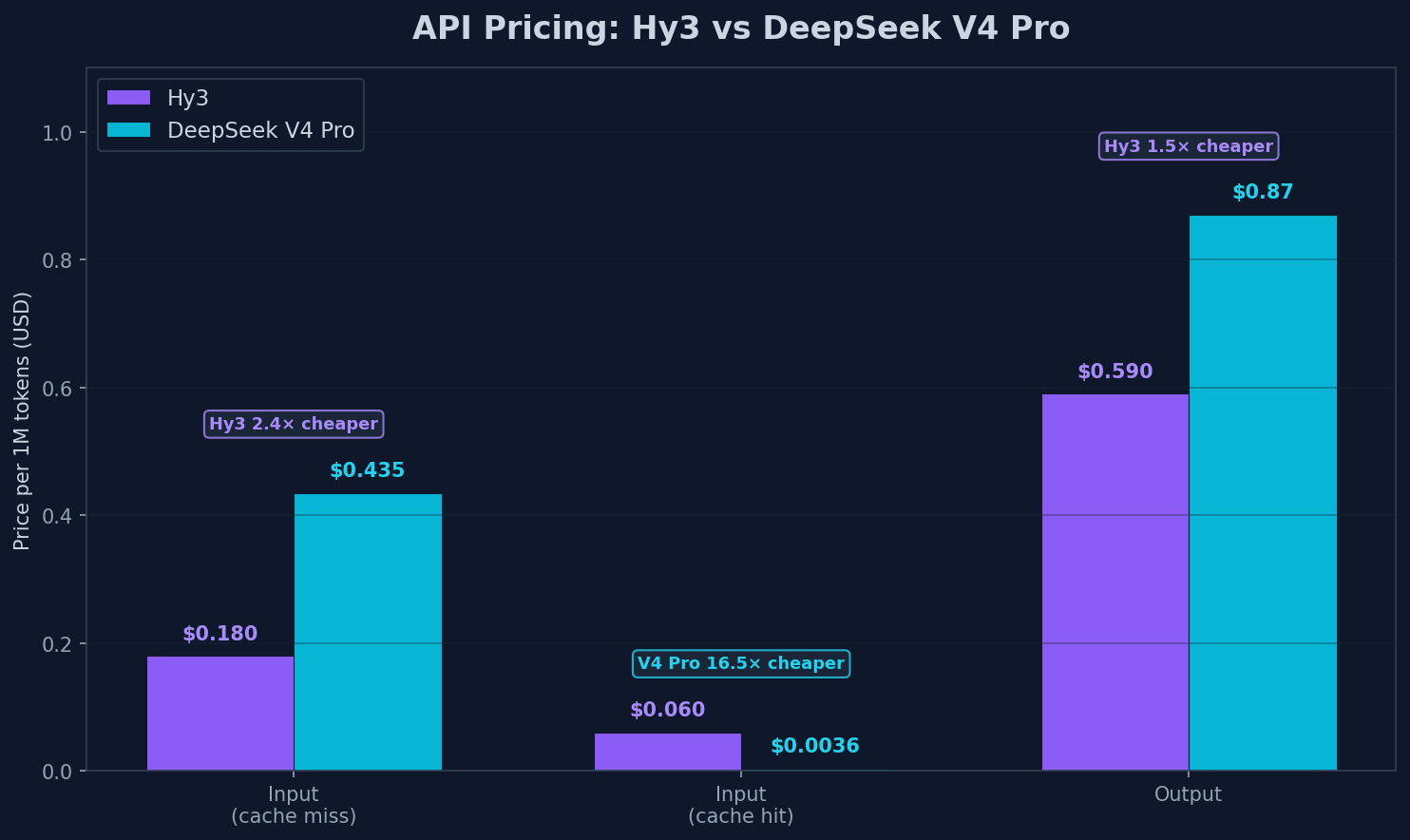
| Cost Metric | Hy3 | DeepSeek V4 Pro | Multiplier |
|---|---|---|---|
| Input (cache miss) | $0.18 | $0.435 | Hy3 is 2.4× cheaper |
| Input (cache hit) | $0.06 | $0.0036 | V4 Pro is 16.5× cheaper |
| Output | $0.59 | $0.87 | Hy3 is 1.5× cheaper |
At scale, the differences are staggering:
A typical coding agent loop (loading 50K context, producing 2K output, repeated 20 times per task) costs about $0.42 on Hy3 vs $0.55 on V4 Pro (with cache hits on repeated context, V4 Pro drops to ~$0.08). Run 1,000 such tasks per day and you're looking at $420 vs $550 — close enough that your choice should be driven by benchmark performance, not price.
But there's a catch: V4 Pro's 1M context window means you can pass entire codebases without chunking. If your workflow requires loading 500K+ tokens of context, V4 Pro is the only game in town at this price tier — and its CSA architecture makes it dramatically more efficient than previous DeepSeek generations at full context length.
Full Scorecard
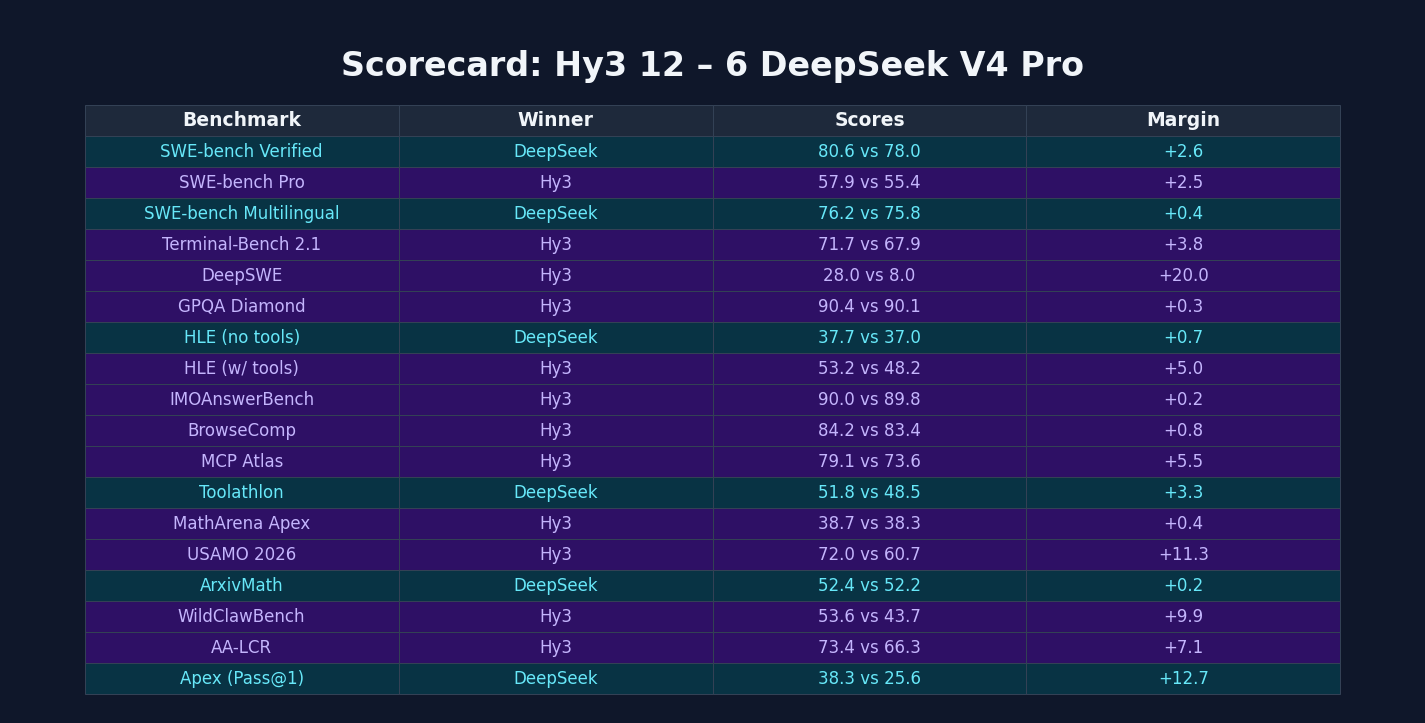
Across 18 shared benchmarks: Hy3 wins 12, DeepSeek V4 Pro wins 6. But the margins matter as much as the tally:
Hy3's Strongest Wins
- DeepSWE: +20.0
- USAMO 2026: +11.3
- WildClawBench: +9.9
- AA-LCR: +7.1
- MCP Atlas: +5.5
- HLE w/ tools: +5.0
V4 Pro's Strongest Wins
- Apex (Pass@1): +12.7
- Toolathlon: +3.3
- SWE-bench Verified: +2.6
- SWE-bench Multilingual: +0.4
- ArxivMath: +0.2
- HLE (no tools): +0.7
When to Use Which
🎯 Choose Hy3 when...
- You need competitive cost on fresh input — 2.4× cheaper input, 1.5× cheaper output vs V4 Pro
- Your context fits in 256K tokens (99% of coding tasks do)
- You run high-volume agent workflows — faster + cheaper
- You need strong agentic web search (DeepSearchQA, BrowseComp, MCP Atlas)
- You want production-grade reliability — Tencent reports 495-step agent stability
- You're doing proof-based math (USAMO, IMOAnswerBench)
🎯 Choose V4 Pro when...
- You need the 1M-token context window — whole codebases, massive docs
- You're self-hosting — MIT license > Tencent Community License
- You need competitive programming performance (Codeforces 3206, LiveCodeBench 93.5%)
- Your tasks require diverse tool formats (Toolathlon leader)
- You value ecosystem maturity — DeepSeek has broader provider support (15+ on OpenRouter vs 2 for Hy3)
- You need 384K max output for long-form generation
The Bottom Line
Tencent has done something genuinely impressive with Hy3. A 295B-parameter model with only 21B active per token matching or beating DeepSeek's 1.6T/49B flagship on 12 of 18 benchmarks — with competitive pricing on both sides — is not what anyone predicted when both models launched in April 2026.
The DeepSWE result (28.0% vs 8.0%) is the most concerning data point for DeepSeek. A 20-point gap on a contamination-free benchmark raises serious questions about how much of V4 Pro's SWE-bench Verified lead is genuine generalization vs training data memorization. Third-party evaluators like CAISI and MathArena consistently score V4 Pro below its self-reported numbers.
But DeepSeek V4 Pro remains the better choice for specific high-value scenarios: massive-context workloads, competitive programming, and any situation where MIT licensing is non-negotiable for self-hosting. Its 1M-token context window, enabled by architectural innovations in attention, is genuinely unique among frontier open-weight models.
For the other 80% of developers — building coding agents, running batch evaluations, deploying cost-sensitive production pipelines — Hy3 is the pragmatic choice. It's faster, cheaper, and measurably better on the benchmarks that predict real-world agent performance.
Try Both Models on CodingFleet
Generate, convert, and explain code with Hy3 and DeepSeek V4 Pro side by side. No setup, no API keys needed.
Start Coding →Sources & Methodology
- Hy3 benchmarks: Tencent Hy3 preview release, GitHub
Tencent-Hunyuan/Hy3-preview, Hugging Face model card - DeepSeek V4 Pro benchmarks: DeepSeek V4 technical report (arXiv 2606.19348v1), Hugging Face
deepseek-ai/DeepSeek-V4-Pro, Artificial Analysis, BenchLM.ai, MathArena.ai - Pricing: Official DeepSeek API pricing, Tencent Cloud TokenHub, OpenRouter Hy3, OpenRouter V4 Pro
- Third-party evaluations: CAISI/NIST V4 Pro evaluation, Scale Labs SWE-bench Pro, MorphLLM, WildClawBench leaderboard
- V4 Pro scores used: "Max" reasoning effort mode unless otherwise noted. Hy3 scores from vendor-reported benchmarks
Last updated: July 4, 2026. Benchmark data reflects publicly available scores as of this date. Some benchmarks are vendor-reported and may differ from standardized third-party evaluations. Always cross-reference with independent benchmarks before making production decisions.