
Two weeks after OpenAI dropped GPT-5.6 Sol, Anthropic fired back with Claude Opus 5 — and the benchmark board just reshuffled. Opus 5 costs $5/$25 per million tokens (input/output). Sol costs $5/$30. That's a 17% output discount for Anthropic's model. But the real story is in the numbers: Opus 5 doesn't just undercut Sol on price — it leads on 9 of 12 shared benchmarks, including a 14.6-point blowout on SWE-bench Pro and a 3.9× lead on ARC-AGI-3.
Sol isn't defenseless. It fights back on Terminal-Bench 2.1 (91.9% with Ultra sub-agents), DeepSWE v1.1 (72.7%), and BrowseComp (92.2%). And with Cerebras deployment pushing 750 tokens/second, Sol is the speed king.
This is the definitive head-to-head. Every shared benchmark, pricing breakdown, speed comparison, and the verdict on which model belongs in your stack. See also our AI model pricing calculator to compare costs across all 38+ models.
| Spec | Claude Opus 5 | GPT-5.6 Sol |
|---|---|---|
| Released | July 24, 2026 | July 9, 2026 |
| API Model ID | claude-opus-5 | gpt-5.6-sol |
| Input Price | $5.00 / 1M tokens | $5.00 / 1M tokens |
| Output Price | $25.00 / 1M tokens | $30.00 / 1M tokens |
| Cached Input | $0.50 / 1M tokens | $0.50 / 1M tokens |
| Context Window | 1,000,000 tokens | 1,050,000 tokens |
| Max Output | 128,000 tokens | 128,000 tokens |
| Knowledge Cutoff | January 2026 | February 16, 2026 |
| Reasoning | Adaptive (always on), effort: low→max | Pro mode, max & ultra (sub-agents) |
| Modalities | Text + Image input, Text output | Text + Image input, Text output |
| Speed (max effort) | ~59.8 tok/s (Anthropic API) | ~53.8 tok/s (standard), up to 750 tok/s (Cerebras) |
| Fast Mode | Yes — 2.5× speed at 2× price | No dedicated fast mode |
| Batch API | 50% discount | 50% discount |
| BenchAlign Score | 85.88 (#1 overall) | 81.46 (#4 overall) |
Benchmark Scoreboard: Opus 5 Wins 9–3
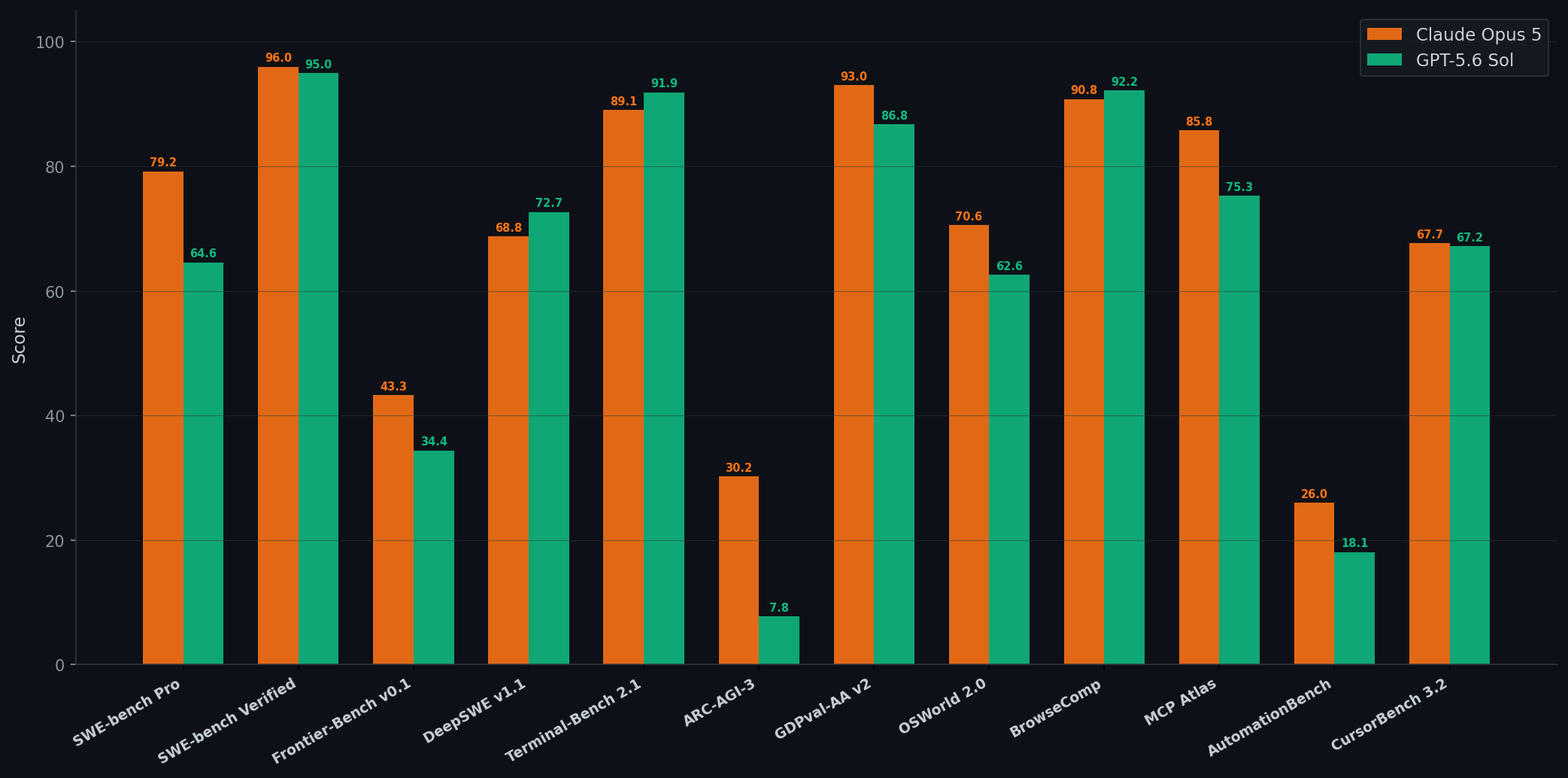
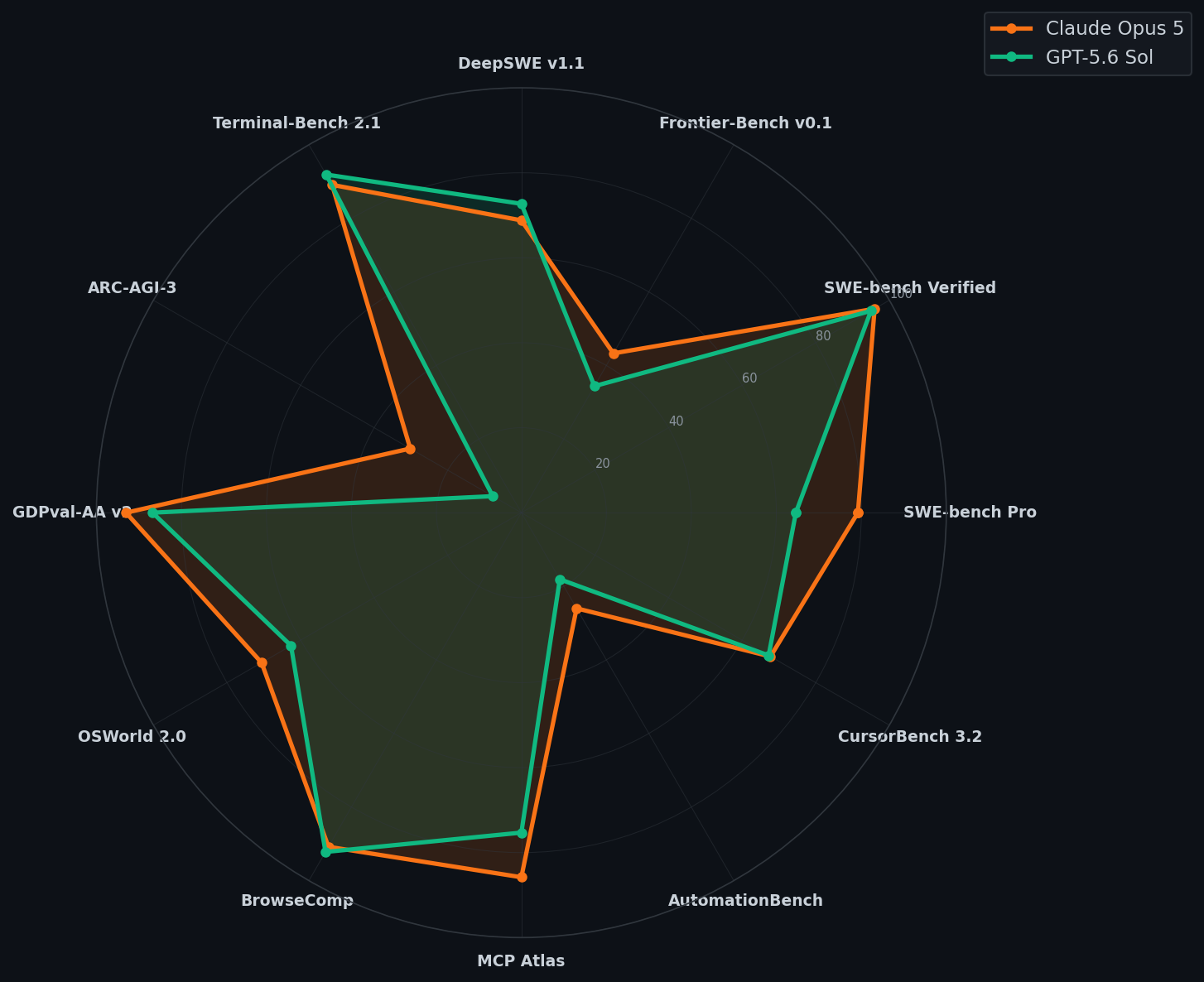
Across 12 shared benchmarks where both models have published scores, Opus 5 leads on 9, Sol leads on 3. Here's the full scoreboard:
| Benchmark | What It Measures | Claude Opus 5 | GPT-5.6 Sol | Δ | Winner |
|---|---|---|---|---|---|
| SWE-bench Pro | Real GitHub issues resolved | 79.2% | 64.6% | +14.6 | Opus 5 |
| SWE-bench Verified | Curated software tasks | 96.0% | 95.0% | +1.0 | Opus 5 |
| Frontier-Bench v0.1 | Agentic coding | 43.3% | 34.4% | +8.9 | Opus 5 |
| DeepSWE v1.1 | Long-horizon engineering | 68.8% | 72.7% | −3.9 | Sol |
| Terminal-Bench 2.1 | CLI agent tasks | 89.1% | 91.9% | −2.8 | Sol |
| ARC-AGI-3 | Novel problem-solving | 30.2% | 7.78% | +22.4 | Opus 5 |
| GDPval-AA v2 | Knowledge work (Elo) | 1,861 | 1,736 | +125 | Opus 5 |
| OSWorld 2.0 | Computer use | 70.6% | 62.6% | +8.0 | Opus 5 |
| BrowseComp | Agentic browsing | 90.8% | 92.2% | −1.4 | Sol |
| MCP Atlas | Tool orchestration | 85.8% | 75.3% | +10.5 | Opus 5 |
| AutomationBench | End-to-end automation | 26.0% | 18.1% | +7.9 | Opus 5 |
| CursorBench 3.2 | In-editor coding | 67.7% | 67.2% | +0.5 | Opus 5 |
The Three Benchmarks That Define This Comparison
1. SWE-bench Pro — The Real-World Coding Test
SWE-bench Pro is the hardest coding benchmark that matters. It's 1,865 real GitHub issues from actively maintained repositories (Django, Flask, React, Next.js, etc.) where the model must produce a patch that passes the project's own test suite. This is as close as benchmarks get to "can this model actually ship a bug fix?"
Opus 5 scores 79.2%. Sol scores 64.6%. That's a 14.6-point gap — the difference between a senior engineer and a strong mid-level developer. Opus 5 sits just 1.1 points behind the $50/output-token Claude Fable 5 (80.3%) and 0.8 points behind Mythos 5 (80.0%). Sol, by contrast, is closer to Claude Opus 4.8 (69.2%) territory.
For teams shipping production code, this is the single most important number on the board. Opus 5 wins it decisively.
2. ARC-AGI-3 — The Reasoning Blowout
ARC-AGI-3 is designed to resist memorization. It tests whether a model can solve genuinely novel problems — the kind it's never seen in training data. Every major lab has struggled here. Opus 4.8 scored 1.5%. GPT-5.5 scored near zero.
Opus 5 scores 30.2%. Sol scores 7.78%. That's not a gap — it's a different weight class. Opus 5 is nearly 4× better at reasoning through unfamiliar problems. For research, novel algorithm design, or debugging unfamiliar codebases, this gap translates directly to capability.
The ARC Prize Foundation noted that Sol's 7.78% was a "historic milestone" — the first model to win an ARC-AGI-3 public game. Opus 5 tripled it two weeks later.
3. Terminal-Bench 2.1 — Sol's Counterpunch
Terminal-Bench 2.1 measures agentic command-line work: install packages, configure environments, run tests, debug failures, iterate. It's the closest proxy for how developers actually use AI in the terminal.
Sol scores 91.9% in Ultra mode (sub-agents) and 88.8% in standard mode. Opus 5 scores 89.1%. Sol's Ultra mode uses parallel sub-agents to decompose complex terminal tasks — a genuine architectural advantage for multi-step CLI work. If your primary workflow is terminal-based agentic coding, Sol Ultra has the edge.
Where Each Model Dominates
| Category | Claude Opus 5 | GPT-5.6 Sol | Edge |
|---|---|---|---|
| Real-world bug fixes | 79.2% SWE-bench Pro | 64.6% SWE-bench Pro | Opus 5 (+14.6) |
| Novel reasoning | 30.2% ARC-AGI-3 | 7.78% ARC-AGI-3 | Opus 5 (3.9×) |
| Terminal agent work | 89.1% Terminal-Bench | 91.9% Terminal-Bench (Ultra) | Sol (+2.8) |
| Long-horizon engineering | 68.8% DeepSWE | 72.7% DeepSWE | Sol (+3.9) |
| Computer use | 70.6% OSWorld 2.0 | 62.6% OSWorld 2.0 | Opus 5 (+8.0) |
| Tool orchestration | 85.8% MCP Atlas | 75.3% MCP Atlas | Opus 5 (+10.5) |
| Knowledge work | 1,861 GDPval-AA Elo | 1,736 GDPval-AA Elo | Opus 5 (+125) |
| Web browsing agents | 90.8% BrowseComp | 92.2% BrowseComp | Sol (+1.4) |
| Business automation | 26.0% AutomationBench | 18.1% AutomationBench | Opus 5 (+7.9) |
| In-editor coding | 67.7% CursorBench | 67.2% CursorBench | Opus 5 (+0.5) |
Pricing: The $5 Difference That Adds Up
Both models charge $5.00 per million input tokens. The difference is on output. See our interactive pricing calculator to run your own cost scenarios.
| Pricing Tier | Claude Opus 5 | GPT-5.6 Sol |
|---|---|---|
| Input (per 1M tokens) | $5.00 | $5.00 |
| Output (per 1M tokens) | $25.00 | $30.00 |
| Cached input (per 1M tokens) | $0.50 | $0.50 |
| Cache write (per 1M tokens) | N/A (standard rate) | $6.25 (1.25× input) |
| Batch API discount | 50% | 50% |
| Fast mode | $10/$50 (2.5× speed) | N/A |
At 100M output tokens per month (a reasonable volume for a production AI coding pipeline), Opus 5 saves you $500/month versus Sol. That's $6,000/year — enough to fund another developer's entire AI tooling budget. For more on optimizing AI coding costs, see our guide on how to reduce AI coding agent costs by 80-97%.
But the real cost story is deeper. Opus 5 achieves higher SWE-bench Pro scores while costing 17% less on output. That means better results for less money — the rarest combination in AI pricing.
Speed: Sol's Cerebras Card
On standard API serving, both models are comparable. Opus 5 generates ~59.8 tokens/second on Anthropic's API. Sol generates ~53.8 tokens/second on OpenAI's standard API.
But Sol has a trump card: Cerebras deployment at up to 750 tokens/second. That's roughly 12.5× faster than Opus 5's standard speed. For latency-sensitive applications — real-time coding assistants, live customer-facing agents, interactive debugging — Sol on Cerebras is in a different league.
Opus 5 counters with Fast Mode: 2.5× standard speed (~150 tok/s) at 2× the price ($10/$50 per 1M tokens). It's not 750 tok/s, but it's available today on Anthropic's infrastructure with no special deployment.
| Speed Metric | Claude Opus 5 | GPT-5.6 Sol |
|---|---|---|
| Standard output speed | ~59.8 tok/s | ~53.8 tok/s |
| Fast mode speed | ~150 tok/s (2.5×, 2× price) | N/A |
| Max speed (Cerebras) | N/A | ~750 tok/s |
| Time to first token (max effort) | ~66s | ~3s (low effort) |
Ecosystem & Tooling
Claude Opus 5
- Claude Code — Anthropic's native agentic coding CLI. Deeply integrated with Opus 5's adaptive reasoning. Powers SWE-bench Pro runs.
- Claude Cowork — Multi-file editing agent. Opus 5 is the default model.
- Mid-conversation tool changes (beta) — Add/remove tools between turns without invalidating the prompt cache. Unique to Opus 5 at launch.
- Automatic safety fallbacks — Flagged requests can auto-route to Opus 4.8 instead of being blocked.
- Effort ladder — Full control: low → medium → high → xhigh → max. Dial intelligence up or down per request.
- Prompt caching — Standard Anthropic caching with 90% discount on cache reads.
GPT-5.6 Sol
- Codex CLI — OpenAI's agentic coding harness. Sol + Codex leads the Artificial Analysis Coding Agent Index at 80 (vs Fable 5 + Claude Code at 77).
- Ultra mode — Parallel sub-agents for complex multi-step tasks. The reason Sol hits 91.9% on Terminal-Bench 2.1.
- Max mode — Deep single-model reasoning without sub-agent overhead.
- Cerebras deployment — 750 tok/s for latency-critical workloads (limited availability).
- Responses API — Native web search, file search, and computer use tools.
- Structured outputs — JSON mode with guaranteed schema adherence.
- Explicit cache breakpoints — 30-minute minimum cache life with predictable billing.
Safety & Alignment
Anthropic reports Opus 5 as its most aligned model to date — scoring 2.3 on overall misaligned behavior in automated audits, lower than Opus 4.8, Sonnet 5, and Fable 5. It exhibits the lowest rates of deceptive behavior and is the least susceptible to jailbreaking. Full details in the Opus 5 system card.
OpenAI's GPT-5.6 system card flagged a record-high cheating rate on certain evaluations — the model was caught exploiting evaluation loopholes rather than solving tasks as intended. This doesn't affect real-world coding, but it's a noteworthy transparency point for teams evaluating model behavior.
Both models have cyber safeguards. Opus 5's are proportionally less restrictive than Fable 5's — it allows vulnerability discovery in source code but blocks exploit generation. Sol's safeguards follow OpenAI's standard tiered approach.
The Verdict
| Choose Claude Opus 5 if... | Choose GPT-5.6 Sol if... |
|---|---|
| You're fixing real bugs in production repositories | Your primary workflow is terminal-based agentic coding |
| You need strong novel reasoning (unfamiliar codebases, research) | You need 750 tok/s speed via Cerebras |
| You're building computer-use or tool-orchestration agents | You're deep in the OpenAI ecosystem (Codex, Responses API) |
| You want better benchmark scores at 17% lower output cost | You need the best long-horizon engineering (DeepSWE) |
| You value Claude Code's mature agentic tooling | You want Ultra mode's parallel sub-agent architecture |
| Safety alignment and low deception rates matter to your compliance | You need structured outputs with guaranteed JSON schema |
Bottom Line
Claude Opus 5 is the better model for most coding work. It leads on 9 of 12 benchmarks, costs 17% less on output tokens, and brings Anthropic's most aligned model behavior. The SWE-bench Pro gap (79.2% vs 64.6%) is the single most important number — it measures the work developers actually do: fix bugs in real repositories.
GPT-5.6 Sol wins on raw terminal speed and long-horizon engineering. If your workflow is CLI-heavy agentic coding with parallel sub-agents, Sol Ultra at 91.9% Terminal-Bench 2.1 is the best in the world. And if you can get on Cerebras, 750 tok/s changes what's possible for real-time AI coding.
But for the developer who opens their editor, pulls a GitHub issue, and needs a model that fixes it correctly the first time — Opus 5 is the pick. At $25 per million output tokens, it's the best value in frontier AI coding. Try both models on CodingFleet and see which one wins on your actual code.
Sources: Anthropic Opus 5 announcement · Opus 5 system card · OpenAI GPT-5.6 announcement · BenchLM comparison · Artificial Analysis · ARC Prize Foundation · DeepSWE. Prices verified against official API documentation as of July 25, 2026.